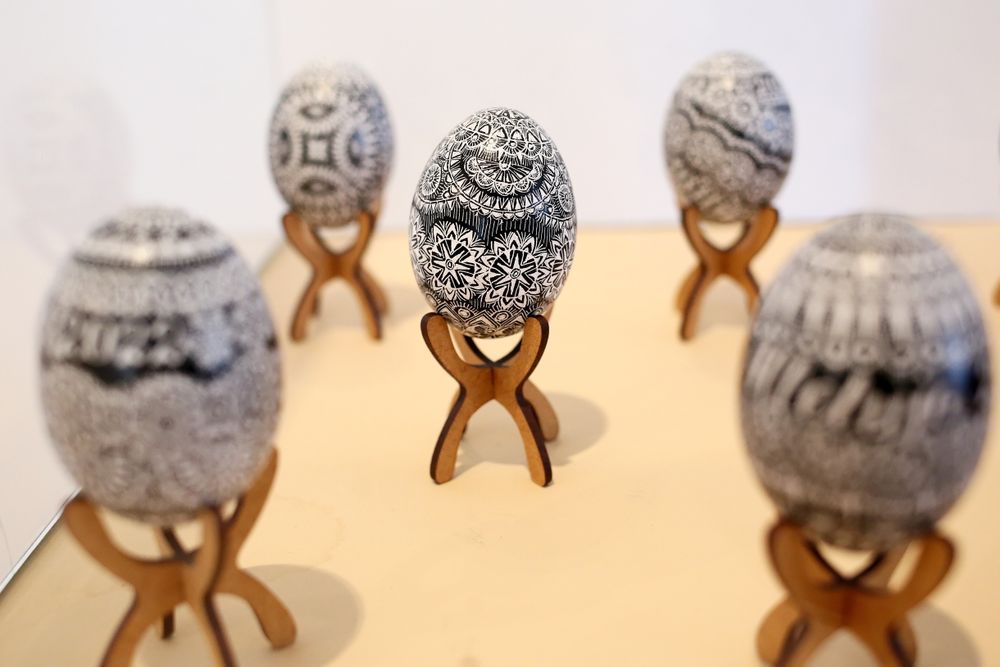
Egg-cellent! Stunning display of decorative Easter eggs honour 1,000-year-old Silesian tradition
-
 Loading...
 - Venita Mitchell
- 07 Apr 2022
- 344 Views
- 0 Like
- 0 Comment
As Easter approaches, a remarkable display of decorative eggs has gone on show in Bytom as part of a competition held to honour a 1,000-year-old Silesian tradition.
Hosted by the Upper Silesian Museum in Bytom, the exhibition seeks to spotlight an ancient custom relating to so-called Kroszonki, elaborately painted eggs engraved with often floral motifs.
Ethnographer Anna GrabiÅ„ska-Szczęśniak, the head of the Department of Ethnography at the museum told TFN: “This Polish tradition is more or less a 1,000-years-old with the custom of decorating eggs at Easter commonly thought to date back to the end of the 10th century.

“The oldest eggs were discovered at the site of the former mediaeval Slavic stronghold of Ostrówek near Opole in Upper Silesia.”
Once dyed with natural ingredients sourced from onion skins, tree bark, dried raspberry leaves and other such elements, they were then carved with sharp objects such as knives or razors before being gifted to relatives and loved ones.
The regional variation, Kroszonki, derived its name from the word krasić (to decorate).

Since the egg was adopted for its symbolic properties by Christianity, it has been commonly billed as a symbol of the resurrection as well as of new life.
However, by the middle of the 20th century concerns were raised that the art of decorating eggs in the lead-up to Easter was in danger of dying out.
To encourage younger generations to take part in the practice, competitions were established, most notably in Opole. Read More…