Elang Sutajaya’s Storytelling Scenographies
-
 Loading...
 - Akemi Ando
- 31 Mar 2023
- 87 Views
- 0 Like
- 0 Comment
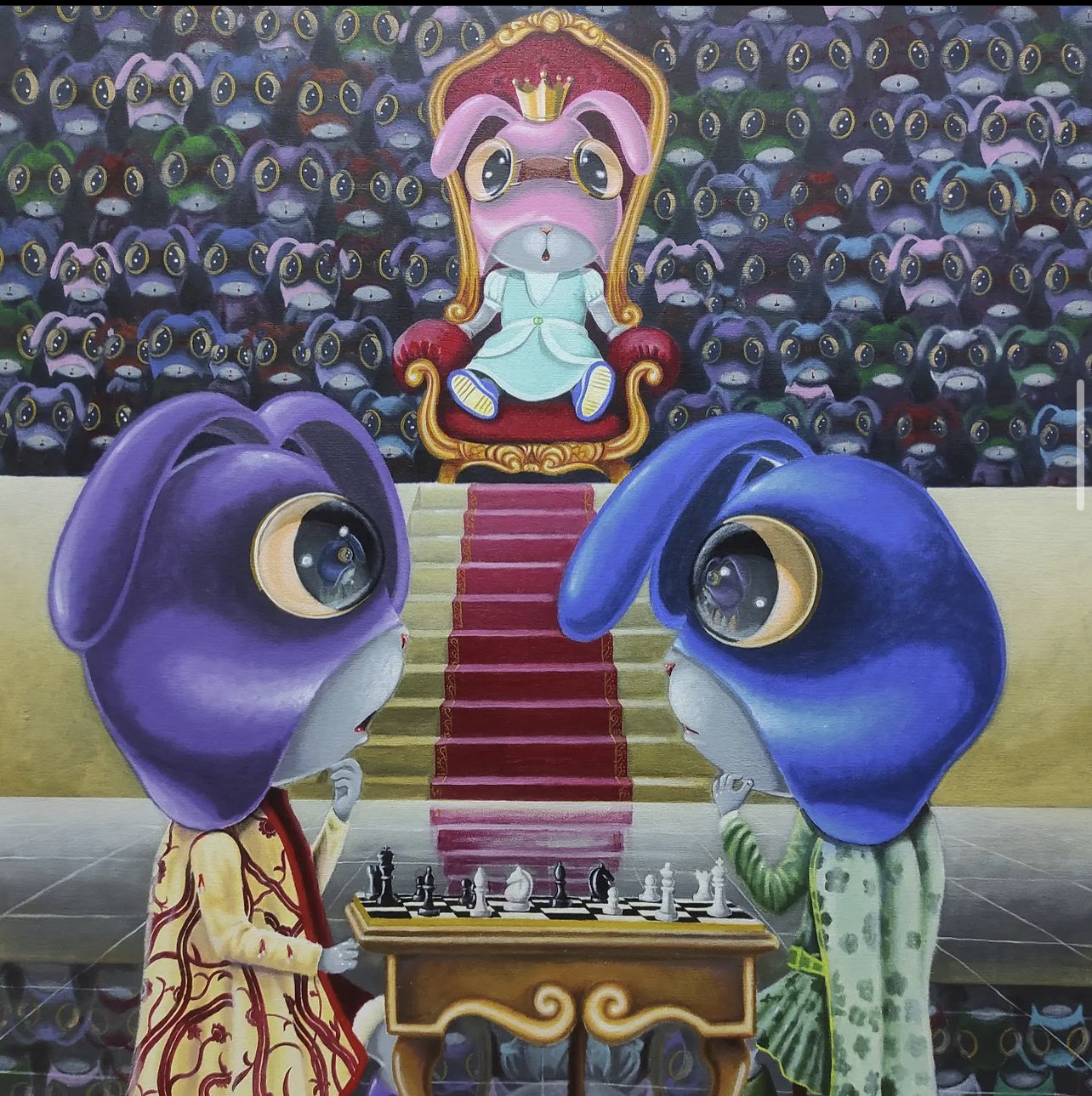
The contemporary artist Elang Sutajaya (b. 1987), an Indonesian painter hailing from Jakarta, is a visual storyteller. Sutajaya’s stories, fantastical and prismatic, netted into canvases rife with recurrent anthropomorphic rabbit aviators, are playful—cherry-dipped sweets. They melt but, first and foremost—wittingly or not—they inherit many traditions: pop art, hyperrealism, and above all, an age-old narrative tradition. This last one, which may at first glance seem far away given the stylistic rift, is worth due consideration.
The history of visual art, and at that even its prehistory, is interwoven with storytelling. To some degree, storytelling—i.e., the narrative—is the lifeblood, the plexus, and engine of visual art from its conception. The untrained hands that darted the Cave of Altamira (where most all Art History erudition begins, alongside the contested “Venus of Willendorf”) projected rugged, uneven stones into the shape of a canvas, man’s hunt of beasts unspooling: frame by frame, the stilted scenes of what would eventually be called cinema. The anthropologist Andrei Leroi-Gourhan described this process of making memories permanent by underscoring the operational synergy of tool-use where the gesture presupposes the existence of a memory in which a behavior program is stored.
As long ago as 30,000 BC, our ancestors of the Late Paleolithic era saw the act of drawing-cum-painting as a means of chronologizing the stories and travails of their day-to-day. This was an autobiographical act, one of making-exterior our memories; one that precedes the grammatically formed and collectively uttered-and-received linguistic speech acts that oral storytelling would intercept thousands of years later.
This inherent vim to project memories as stories seems, at pains of universalism, at least intuitively of a piece with our representational armory—for to tell a story to all who would have the patience to receive it, regardless of linguistic or cultural barriers, requires pointing out to the world of perpetually tangible objects, events, and actions. It requires plucking them and molding them into scenes. Thus, scenography is born from its representational baptism. Read More…