Finnish housing market strengthening
-
 Loading...
 - Kelly Jones
- 27 Jan 2022
- 427 Views
- 0 Like
- 0 Comment
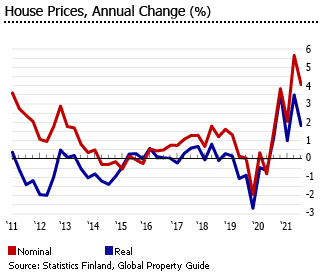
Finland’s housing market continues to strengthen despite the pandemic. The average price of old dwellings in Greater Helsinki rose by 6.68% (4.38% inflation-adjusted) to €4,137 (US$ 4,683) per square metre (sq. m.) during the year to Q3 2021, following y-o-y rises of 6.08% in 2020, 0.76% in 2019, 3.26% in 2018 and 2.04% in 2017, according to Statistics Finland. Quarter-on-quarter, prices increased slightly by 0.53% (-0.07% inflation-adjusted) in Q3.
By property type:
· The average price of terraced houses in Greater Helsinki rose strongly by 9.04% (6.69% inflation-adjusted) y-o-y to €3,728 (US$4,220) per sq. m. in Q3 2021.
· Prices of blocks of flats were up 5.28% (3.02% inflation-adjusted) to €4,404 (US$4,985) per sq. m. during the year to Q3 2021.
In the rest of the country, the average price of old dwellings increased by a more modest 2.86% (0.64% inflation-adjusted) to €1,654 (US$ 1,872) during the year to Q3 2021.
Demand remains robust, fueled by very low interest rates. In the first three quarters of 2021, total transactions of old dwellings rose strongly by 17.5% y-o-y to 60,033 units, following a growth of 11.8% during 2020, according to Statistics Finland. Sales transactions increased 13.1% in Greater Helsinki and by 19.3% in the rest of the country.
Dwelling permits and starts rose by 16.1% and 23.5% y-o-y, respectively, during the first three quarters of 2021. In contrast, dwelling completions fell by 6.6% over the same period.
Finland’s economy is expected to grow by 3.5% this year, after registering annualized growth of 7.5% in Q2 and 4% in Q3 2021, according to the Bank of Finland. The economy contracted by 2.9% last year, its worst performance since 2009, due to the imposition of strict coronavirus-related measures.
In 2000 the government removed the requirement that a nonresident must obtain a permit to buy a secondary residential property in Finland, putting foreigners on exactly the same footing as Finns. However, foreigners need permission to buy property in the Province of Aland (Ahvenanmaa), an archipelago.
A history of extreme house price cycles
From 1980 to Q1 2009, the country experienced several dramatic house-price cycles. The volatility of house prices in Finland has 3 main causes:
· the export-oriented economy’s sensitivity to global shocks;
· the housing market’s high interest rate sensitivity. In 1994, about 70% of new mortgages were variable rate. Since 2001, more than 90% of new mortgages have been variable rate, taking advantage of historic low interest rates from 2003 to 2006.
· an insufficiently responsive supply side. Finland’s long housing boom was encouraged by a decade of under-building. Less than 30,000 dwellings were completed annually from 1994 to 1999, down on 40,000 units annually from 1983 to 1991 (with a peak level of 65,397 units in 1990).
Finland’s most recent house price boom from 2001 to Q2 2008 was typical. There was strong economic and wage growth, plus a decline in interest rates. Result: a strong increase in house prices. From 2001 to Q2 2008, house prices in Finland rose by 42% and by almost 46% in Greater Helsinki, in inflation-adjusted terms. Then the global crisis caused real house prices to decline by about 6.4% from Q2 2008 to Q1 2009. Read More…