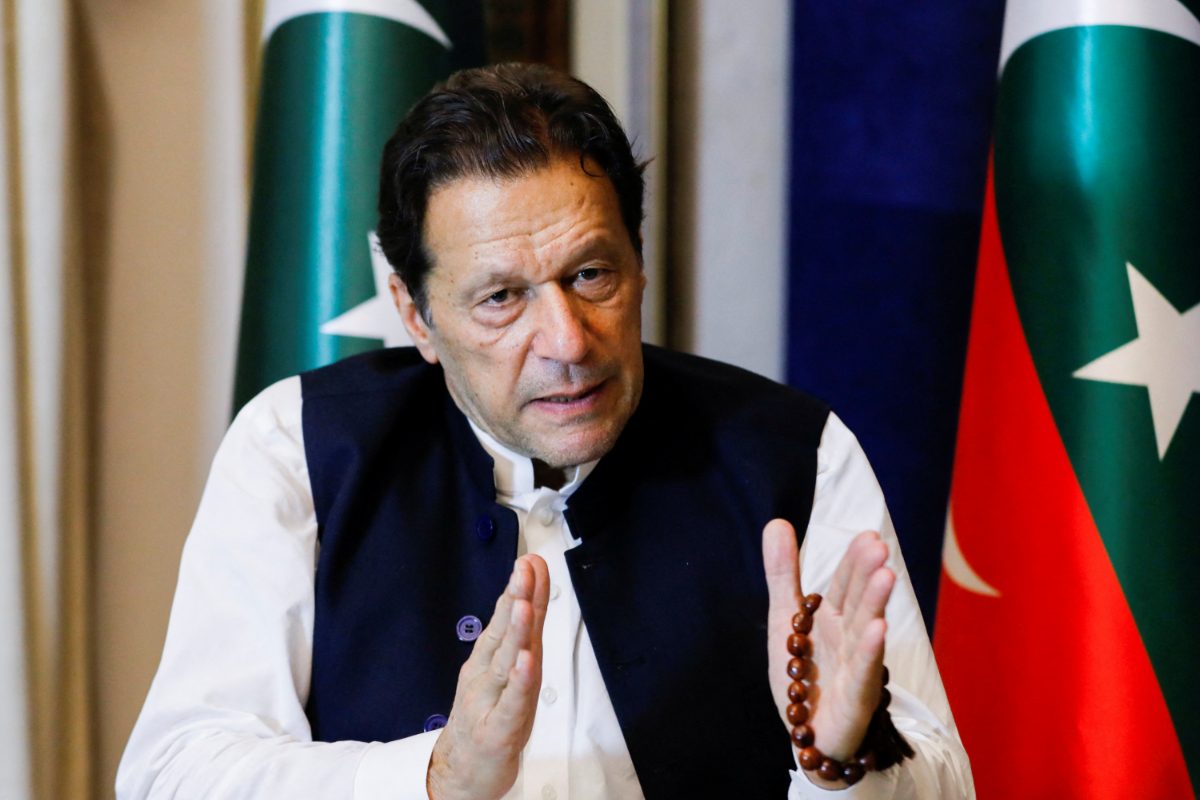
Former Pakistani Prime Minister Imran Khan has accused the military and intelligence agency of attempting to dismantle his embattled political party
-
 Loading...
 - Jerry Taylor
- 05 Jun 2023
- 69 Views
- 0 Like
- 0 Comment
In a recent interview, the ex-cricketer turned politician expressed his strong belief that he would be subjected to a military trial and incarcerated. While Khan has previously hinted at the military's involvement in a crackdown on his Pakistan Tehreek-e-Insaf (PTI) party, his recent statements during the interview at his residence in Lahore were more explicit.
When questioned about the driving force behind the crackdown, Khan straightforwardly pointed to the establishment, specifically referring to the military establishment, as the orchestrators.
He remarked, "It is completely the establishment. Establishment obviously means the military establishment, because they are really now openly – I mean, it's not even hidden now – they're just out in the open." Despite a request for comment, the military, which has exercised direct or indirect control over the country's affairs throughout its 75-year history, did not respond through its spokesperson.
The year-long tense standoff between Khan, who is the most popular leader in Pakistan according to polls, and the army intensified when military installations and properties were reportedly vandalized by his supporters last month.
This political unrest has added to the uncertainty in the nuclear-armed nation of 220 million people, which is already grappling with financial turmoil. Pakistan's struggling $350 billion economy is facing the challenges of averting default, combating record-breaking inflation, and dealing with a plummeting currency.
Khan labeled the violent protests, which erupted following his brief arrest, as a "false flag operation" intended to target him. Authorities have initiated proceedings in military court against dozens of individuals, including PTI members, suspected of involvement in the protests. Military courts are typically reserved for service members or individuals categorized as enemies of the state.
Khan expressed his belief that this is the military's strategy to imprison him and prevent his return to power in the upcoming November elections. He dismissed the approximately 150 criminal cases filed against him as baseless and destined for dismissal in a civilian court.
Asserting his conviction, Khan stated, "I have absolutely no doubt that the military courts are meant for me," while highlighting that he is currently out on bail. Amnesty International has previously criticized Pakistan's military courts for their disregard of due process, lack of transparency, coerced confessions, and executions following unfair trials.
Khan implicated the Inter-Services Intelligence (ISI), the country's most powerful spy agency, in the crackdown. He claimed that two senior PTI members were summoned by the agency and pressured to renounce their affiliation with the party. Khan also revealed that he had attempted to initiate talks with the military to resolve the ongoing crisis but received no response.
He expressed bewilderment as to why the Army Chief, Gen. Asim Munir, was fixated on sidelining him, speculating that it might be related to his request for Munir's resignation as ISI chief during his tenure as prime minister. However, Khan did not elaborate on the specific issues he had with the agency's operations.
It is worth noting that Munir was subsequently appointed as the country's top general by Khan's political rival and successor, Prime Minister Shehbaz Sharif.