France's Far-Right National Rally Party Gains Ground in Legislative Elections

Marine Le Pen’s far-right National Rally party has made significant gains in the first round of France's legislative elections, securing an estimated 34% of the votes, almost doubling their 18% share from the 2022 first round. This development poses a challenge to French President Emmanuel Macron, who has urged voters to block the far right in the second round of voting on July 7.
The high-stakes legislative elections saw the National Rally achieving a strong but not definitive lead, according to projections by polling agencies. Macron's centrist party, along with its allies, is projected to finish a distant third, trailing behind both Le Pen's National Rally and a newly formed left-wing coalition. This coalition was created to prevent Le Pen’s party, known for its anti-immigration stance and historical links to antisemitism, from forming the first far-right government in France since World War II.
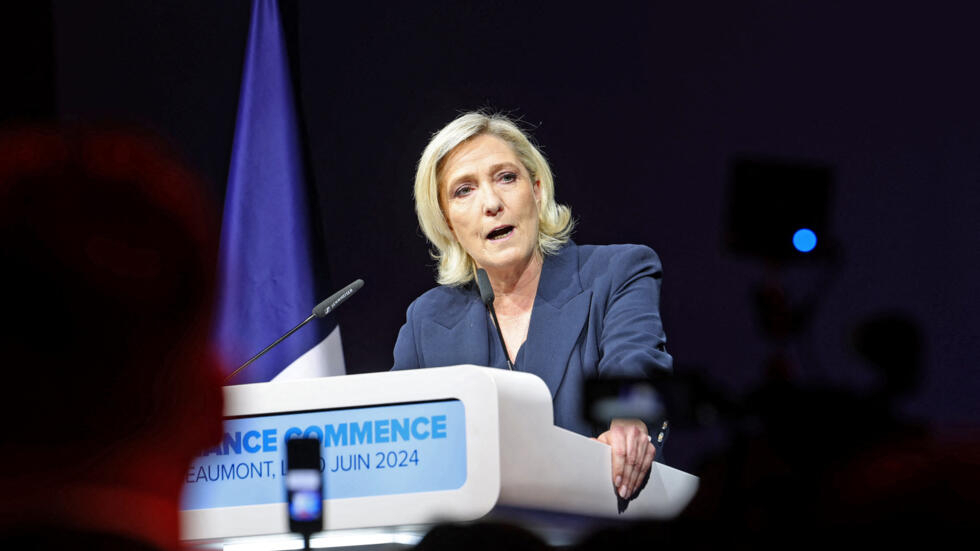
As campaigning continues for another week before the final voting, the election's outcome remains uncertain. Macron has called on voters to oppose the far right in the second round. Le Pen, addressing her supporters, urged them to help her party secure a legislative majority, which would position her 28-year-old protégé, Jordan Bardella, as the potential prime minister. If this occurs, Macron would face an awkward power-sharing arrangement known as "cohabitation."
Despite winning around one-third of the national vote, it is uncertain how this will translate into actual seats for the National Rally in the second round. Projections suggest that in the best-case scenario, the party and its allies could secure the 289 seats needed for a majority in the 577-seat National Assembly. However, due to the two-round voting system and potential inter-party alliances, the final seat distribution remains unpredictable.
French voters are expressing frustration over issues such as inflation, economic concerns, and perceived arrogance from Macron's leadership. The National Rally has capitalized on this discontent, particularly through online platforms like TikTok.
The legislative campaign has also been marked by increased hate speech and division between far-right and far-left blocs. Macron's earlier call for elections followed a significant defeat for his party in the European Parliament elections, losing to the National Rally.
A 64-year-old voter, Philippe Lempereur, expressed fatigue with politicians' inability to address basic needs, reflecting a sentiment shared by many voters who feel they are choosing the "least worse option."
Bardella, who lacks governing experience, has stated his intention to use his potential prime ministerial powers to stop Macron from supplying long-range weapons to Ukraine. The National Rally has also raised concerns by questioning the right to citizenship for those born in France and proposing restrictions on dual nationality rights, which critics argue undermine human rights and France's democratic values.
The election has also sparked market concerns due to the National Rally's and the left-wing coalition's public spending promises, which could exacerbate France's debt issues.
In France's overseas territories, such as New Caledonia, and other regions, voters have already cast their ballots, reflecting the broad geographic scope of the election.
With the second round of voting approaching, the political landscape in France remains highly volatile, with significant implications for the country's future direction.