Frog Pumps: What to Know About This Under-the-Radar Move
-
 Loading...
 - Divya Mehta
- 05 Aug 2022
- 89 Views
- 0 Like
- 0 Comment
Before you question our editing skills, the title here isn't a typo: Frog jumps are the froggy exercise you've probably heard of, but frog pumps exist, too—and we're telling you all about them!
Unlike frog jumps, frog pumps are a move that requires no jumping at all, but they do have that same unique positioning of legs that appear amphibian in placement. You perform frog pumps while lying on the floor or a mat, and you use only your own body weight. Because of this, they're an accessible move that can be done by most people, including beginners. Curious to learn more? We tapped two trainers to clue us in on this move, from the benefits of frog pumps to how to properly perform them. Ahead, we'll help you learn everything you need to know about frog pumps.
What Are Frog Pumps?
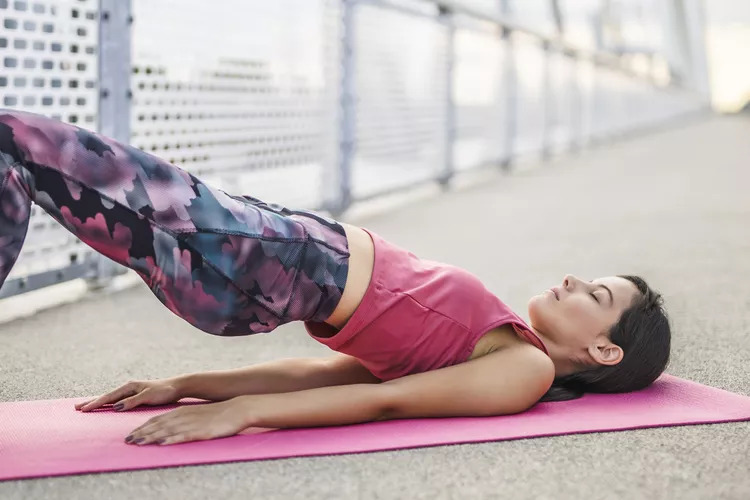
Frog pumps are in the glute bridge exercise family. They're a bit different from a regular glute bridge, though. Katelyn DiGiorgio says that "in a typical glute bridge exercise, the soles of your feet are planted in the floor. In the frog pump variations, the soles of your feet are pressed together and your knees are pressed out wide." Kelly Collins refers to them as a glute "activation" exercise, and unlike some other glute exercises, with frog pumps you can very specifically feel your glutes working.
Benefits of Frog Pumps
1. They require no equipment and are low-impact.
2. They strengthen your glutes and hamstrings. DiGiorgio says that "the frog pump exercise strengthens both gluteal and hamstring groups and takes the hip joint through a full range of motion."
3. Frog pumps help you get in touch with your glutes. Collins explains that they "are a great exercise for anyone struggling to fire their glutes through hip thrusts or squats."
4. They work your back and help improve your posture. DiGiorgio says that "full hip extension strengthens the erector spinae and latissimus dorsi, muscle groups that support back strength and ultimately proper posture."
5. Your abs get a workout, too. "The transverse abdominis also contracts isometrically to stabilize the work, and your abductor muscles are engaged to externally rotate your hip muscles," says DiGiorgio.
6. Your hips become more mobile, which is helpful in everyday life. DiGiorgio says that "performing this movement will help you improve overall hip mobility. The strength the exercises build in the glute muscles can help improve balance and complete everyday tasks with greater ease."
Proper Frog Pump Form
1. Lie on the floor or a mat, on your back. DiGiorgio instructs you to keep your arms long at your sides, and Collins says you should have "your lower back pressed into the ground and a slight tuck of your chin."
2. Bring the soles of your feet together until they touch one another. In turn, DiGiorgio says that "your knees will fall wide." Collins says that your legs should resemble a butterfly position.
3. From here, lift into a glute bridge position. It will feel different than a standard glute bridge, because instead of being flat on the floor, your feet are touching one another. DiGiorgio says to be sure to keep your upper back pressed into the floor as you lift up.
4. Slowly lower your glutes back to the floor, and repeat. Start with a set of 10 repetitions, and work your way up from there. DiGiorgio says that ideally you will "repeat the up and down movement at varying tempos for 1–3 minutes."
How to Modify
The most basic modification for frog pumps would be a standard glute bridge. DiGiorgio says that "if you feel pressure in your knees or limited mobility in your hips, a modification for a frog pump would be a traditional glute bridge. Rather than placing the soles of your feet together and externally rotating your knees open from your hips, place the soles of your feet hip-width apart and parallel into the floor." She says that a standard glute bridge instead of frog pumps are a good modification because "the traditional glute bridge position requires less flexibility in the hips."
Reducing your range of motion is another option for modifying frog pumps. Collins suggests doing this "if you have any limitations or difficulties performing the move." That can involve either not lifting your glutes all the way up, or not lowering them all the way down with each lift, depending on where your discomfort is. Read More...


