Georg Baselitz: Six Decades of Drawing
-
 Loading...
 - Nadine Dombrow
- 24 Mar 2023
- 82 Views
- 0 Like
- 0 Comment
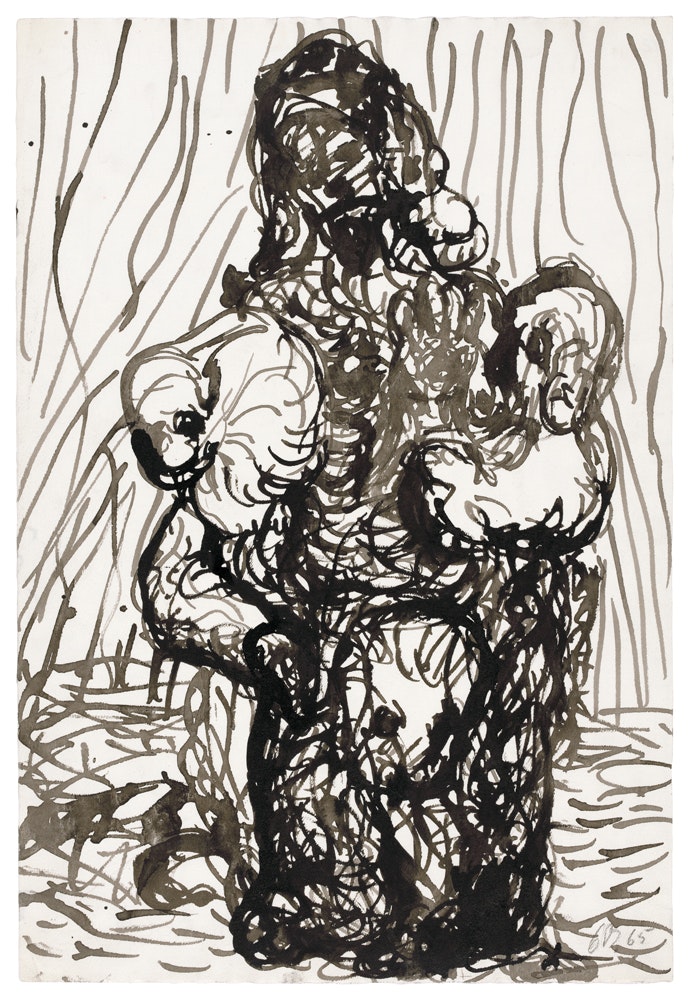
If entelechy is the process by which something becomes what nature intended it to be—the fertilized egg becomes the human being, the acorn the oak tree—then Georg Baselitz leapfrogged it, springing, like Athena, fully grown from his own forehead. His evolution into himself takes place in a remarkably short time, and he seems to have known who he was, personally and artistically, early on. He was born in 1938 in the town of Deutschbaselitz, in what would become East Germany, and changed his name from Hans-Georg Kern to Georg Baselitz in 1961, two years before he made the first drawing in this show. He took absolute charge of himself: he not only names himself but defines himself.
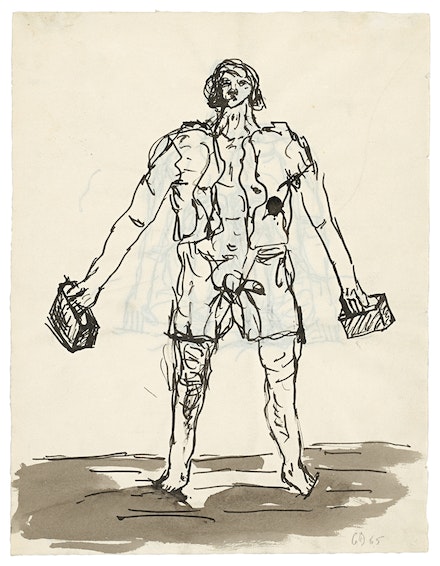
We may safely disregard Baselitz’s work before 1962, when he was twenty-four years old, as juvenilia. He himself does so, in effect saying that after 1961 he will be who he declares himself to be once and for all: Baselitz. The only significant later change in Baselitz’s style takes place in 1969, when he begins making images upside down. Why he chose to do this is a mystery—perhaps simply to shock the viewer, but perhaps also to consider more forcefully art’s relation to life. Inverted images, inevitably, remind us that mirrors not only reflect reality but are the things we peer into to find ourselves. An ordinary mirror returns a laterally reversed image of the object before it, but a concave mirror produces a vertically inverted image provided the object is more than one focal length from the mirror. So, if we stand close to a concave mirror, we see our actual reflection, but as we step back from it, the image becomes first distorted, then inverted. Read More…