Hello Cruel World: Julie Speed's Paintings of Dark Imaginings
-
 Loading...
 - Sylvie Payet
- 28 Oct 2022
- 75 Views
- 0 Like
- 0 Comment
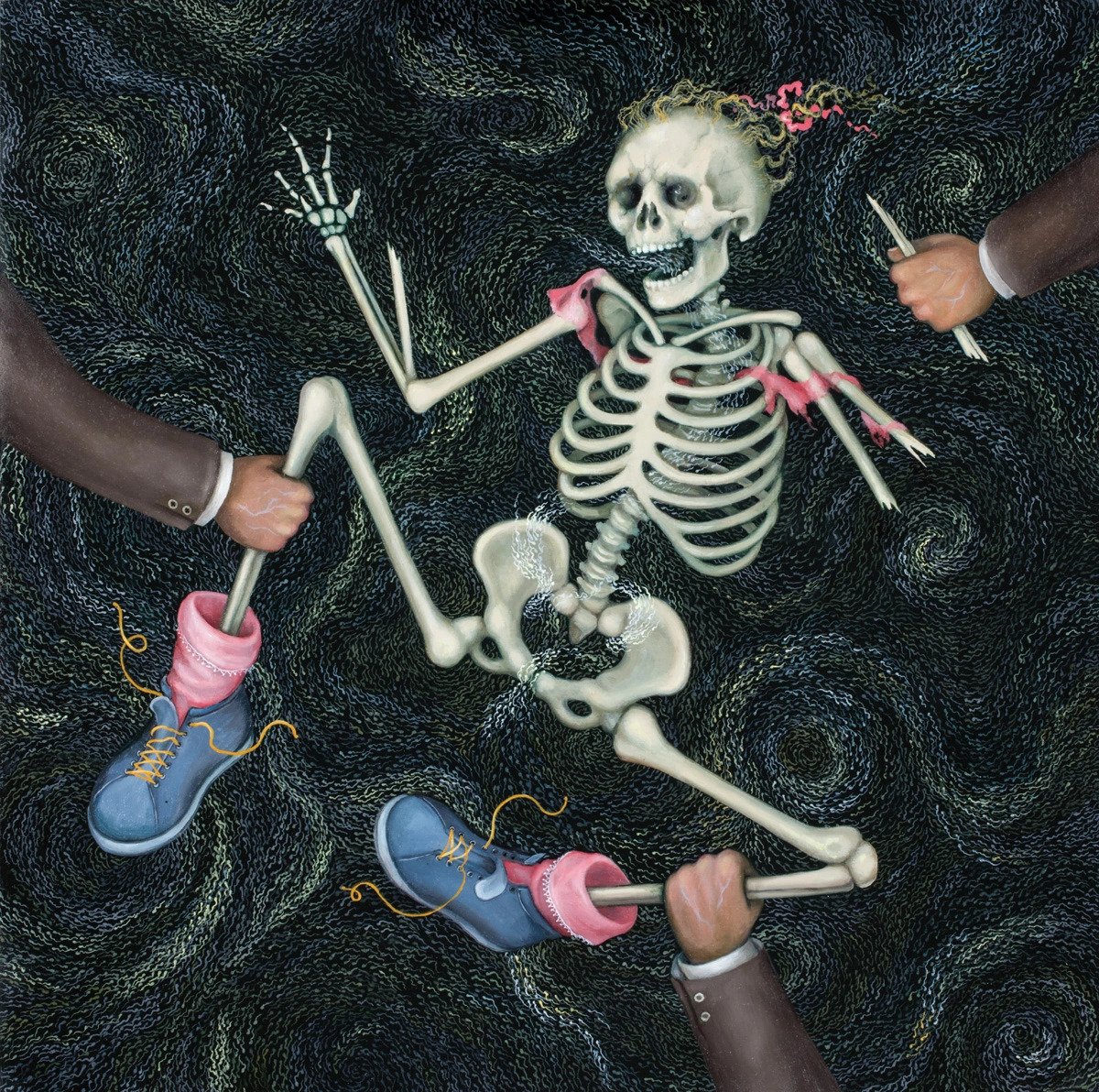
The figures in paintings by Julie Speed are often entwined, teetering and contorting with grimaced faces as they wrestle in compositions tinged with threats of calamity. The artist obsessively catalogues disaster scenes, both natural and man-made. She keeps binders of evidence against humanity for all our crimes; she even once showed me a stash of thimble-like forms that she refers to as the tips of decommissioned nuclear warheads. A survey of her voluminous paintings confirms our common fears and anticipates our blunders.
Although plagued with night terrors from an early age (she says her first memory is of a nightmare in which she got shot in the head and died), Speed doesn’t see a direct connection between her dreams and the sometimes dark mood of her paintings. “I’m sure if I’d ever been able to see a shrink, they would’ve said, ‘Oh, this is obviously connected to that.’ But I think the reason is that I have such an active imagination,” she told me.
I visited Speed’s home and studio in Marfa, Texas, three times this past spring after seeing her work on Instagram. Many artists have Instagram accounts, of course, and show their steps from the beginning of a work, as Speed does. But her rigorous, almost daily posts combined with music—a little Lucinda Williams here, a bit of Patti Smith there—made for a unique and intriguing combination that deepened my curiosity.
Born in Chicago in 1951, Speed lived in Connecticut, Michigan, Rhode Island, Massachusetts, Kentucky, California, and Nova Scotia before moving to Texas—first to Austin and then to Marfa in 2006. “My first career ambition was to be a caveman; my second choice was pirate,” Speed said. “After that, it was settled in my mind that I would just keep painting. I came from a family who were not at all artsy. If you wanted something, you made it yourself.”
Speed enrolled at the Rhode Island School of Design in 1969 but quickly discovered that it was not what she’d hoped for. “They were on a whole other track,” she said. “Frank Stella and Andy Warhol were gods. Anyone representational or a non-ironic painter was Satan. Artists were ‘giving up’ painting in droves. It was a slam-dunk case of wrong place, wrong time. After that, I just taught myself from books and museums.” Read More…