Hermitage Restores Russian Orthodox Church's Ownership of Saint Alexander Nevsky's Revered Silver Sarcophagus

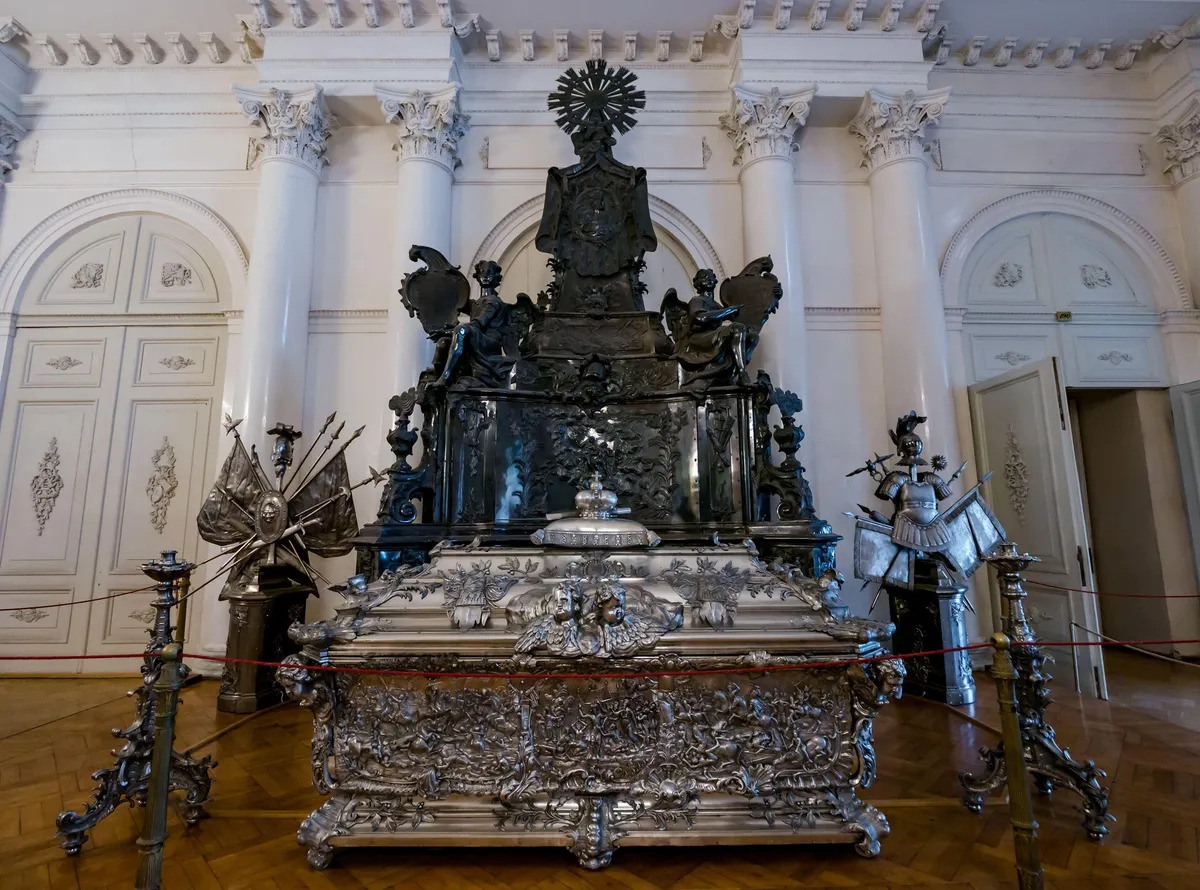
The Hermitage Museum in St. Petersburg, Russia, has returned a significant silver sarcophagus of Saint Alexander Nevsky to the Russian Orthodox Church, as reported by the Art Newspaper. This monumental sarcophagus, considered the world's largest silver monument, has been entombed in the church dedicated to Saint Alexander Nevsky.
Saint Alexander Nevsky, a renowned Russian warrior from the 13th century, was canonized in 1549. Peter the Great, selecting him as the patron saint of the capital city, commissioned the cathedral in his honor. The monument resided there for over two centuries until the Soviet era when atheism gained prominence, leading to the removal of religious artifacts from public view.
Throughout the past century, the Hermitage museum played a crucial role in safeguarding the monument from destruction on four separate occasions. For instance, in 1922, it was relocated to the museum for an exhibition aimed at protecting church silver from potential destruction.
The Baroque monument, commissioned by Empress Elizabeth in 1743 and designed by the court portrait painter Georg Christoph Groot, boasts a pyramid-like structure. The sarcophagus, situated at the base, showcases high-relief battle scenes on its sides and is adorned with a crown and a broken sword on its lid. The monument is flanked by two pedestals supporting arms and banners, with two large candelabras adorning its sides. At the pinnacle, angels with inscribed shields are seated atop the 16-foot structure.
Hermitage director Mikhail Piotrovsky stated, "Given the current geopolitical climate, the Hermitage acknowledges that reuniting the relics with the tomb at the monastery holds particular significance for the country's fate and social harmony. Today, the artifact's religious importance surpasses its artistic value, whereas the situation was the opposite for decades."
Under the agreement, the Hermitage is expected to lend the monument to the cathedral for 49 years, with the possibility of extending the loan. The church, in turn, must ensure appropriate conditions for preserving the tomb. The transaction received approval from the Museum Fund of Russia, the Ministry of Culture, and Patriarch Kirill, the head of the Russian Orthodox Church.
Piotrovsky added, "The primary consideration for the fate of cultural artifacts lies not in their physical location but in their preservation within or outside the realm of the museum."