The Artists Resisting the Myth of “White” Argentina
-
 Loading...
 - Lille Bain
- 18 May 2023
- 87 Views
- 0 Like
- 0 Comment
Argentina stands out as one of Latin America's and the world's most progressive nations, with legalized abortion, same-sex marriage, and recognition of nonbinary identities. These hard-fought victories are the result of years of activism by various dedicated groups. However, despite these progressive policies, Argentina continues to grapple with the persistence of structural racism and colorism.
Wari Alfaro, an artist and photographer, has been an active member of the Identidad Marrón Collective since its establishment in 2006. This collective comprises artists, educators, and activists who identify as marrones or marronxs. In this context, the term "marrón" extends beyond the color "brown" and serves as an umbrella term for individuals with brown skin and Indigenous features who face discrimination and racism in South America. Alfaro recognized that the social violence, microaggressions, racial slurs, and negative stereotypes they experienced were not isolated incidents. They explained, "Racism in Argentina, as well as in parts of Mexico, Peru, and Bolivia, primarily targets individuals of Indigenous descent or with Indigenous features, intersecting with social class. Our appearance, visually and conceptually, is already shaped by perceptions of danger and poverty, which are linked to unequal treatment, denial of rights, or even violence against our bodies."
Despite Argentina's progressive image, there persists a myth of it being a "White" country in South America. Growing up in Buenos Aires, whenever I raised the issue of racism, a common argument I encountered was that Argentina lacked Afro-Latino communities, and thus racism was not an issue as it was in the United States. However, as a child, I couldn't help but wonder why the word "negro" in Spanish was consistently used as a racial slur against individuals of African and Indigenous descent.

The dominance of images depicting White individuals in the media, the erasure of the massacre of Black and Indigenous people from educational narratives, and immigration policies favoring Europeans since the country's inception have all contributed to perpetuating this myth. Alfaro remarks, "Many of us had already begun questioning the absence of Indigenous and marrón identities in progressive spaces and realized that most people in those spaces did not resemble us." As the coordinator of the "Brown" Portraits project and a graduate of the Gender Studies, Politics, and Participation program at the Universidad Nacional de General Sarmiento, Alfaro holds a role in communications for the women's secretariat at the Municipality of Pilar in Buenos Aires. They state, "The spaces we now occupy were dreams for years, and we had to put in double and triple the effort to gain access to them."
At the start of the school year in March, Javier Corbalán, an artist and photographer from Salta, Argentina, and a member of Identidad Marrón, took photographs of students. Corbalán, who has been photographing the region for 15 years and works for Salta's newspaper, El Tribuno, aims to capture the unique aspects of Andean territory and his community. On this occasion, he chose to document the story of a six-year-old boy beginning first grade at a local public school in one of Salta's densely populated neighborhoods. Accompanied by his parents, who work at the city's waste disposal site, the boy walked proudly to school.
Corbalán expresses, "This represents our people, who have long been rendered invisible. To be able to showcase a marrón person walking their child to their first day of public school, witnessing the boy's smile, his new shoes, and modern haircut, fills me with immense excitement." He explains how Salta, a province in northwest Argentina, is deeply rooted in its own traditions and colonial history.
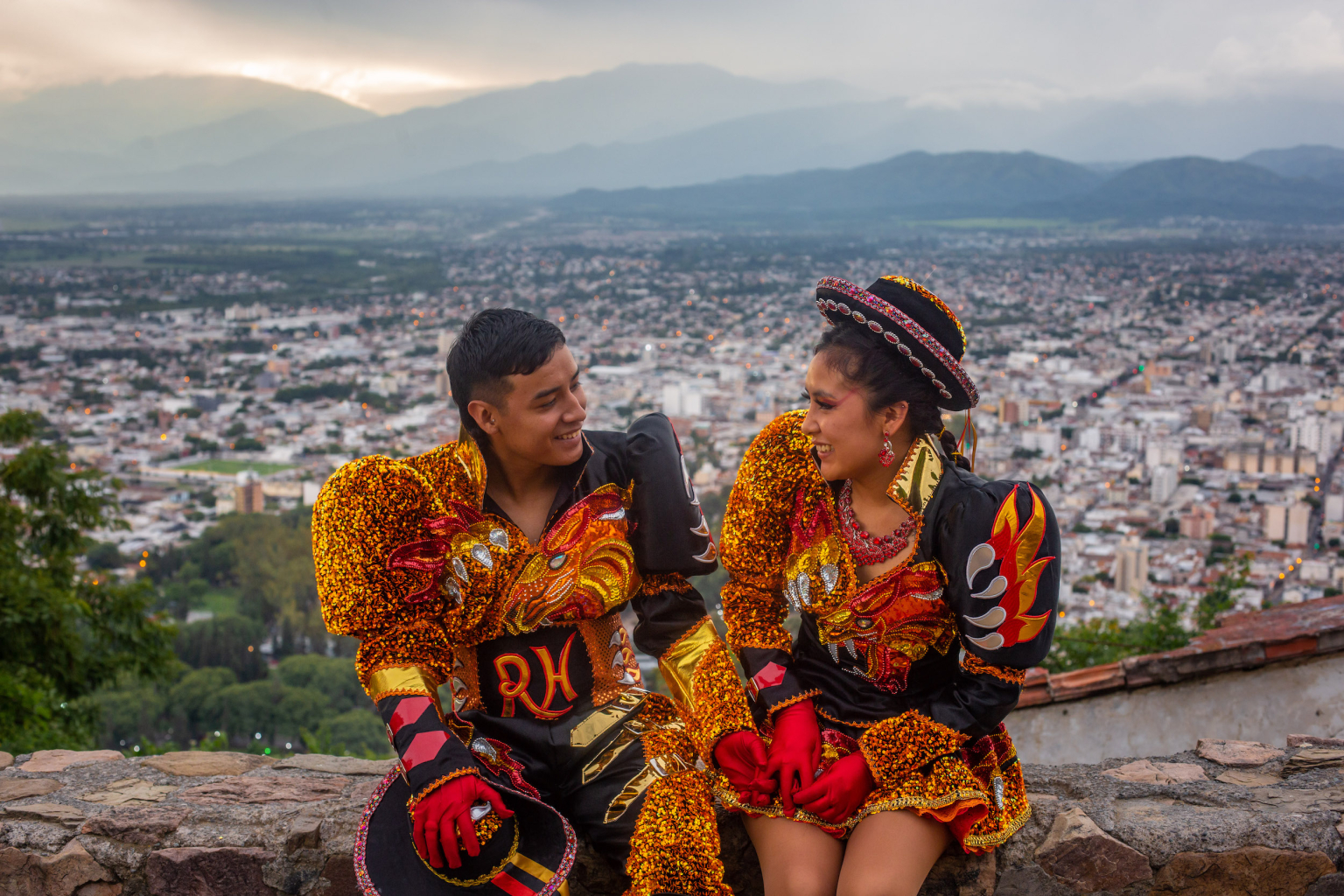
"The images presented by the media predominantly feature White individuals and are far removed from the appearance of a typical salteño," Corbalán adds. Alongside documenting climate change events, such as wildfires, droughts, deforestation, and floods, as well as carnival and religious celebrations, Corbalán consistently highlights the strength and beauty of humanity.
The Museo Nacional de Bellas Artes in Buenos Aires, one of Argentina's oldest national museums, houses a painting from 1892 that is considered the inaugural artwork in the history of Argentine art, but also perpetuates the justification of Indigenous extermination. Painted by Angel Della Valle, a White artist, the painting titled "La Vuelta del Malón" (The Return of the Indian Raid) depicts a group of Indigenous "savages" raiding a church and abducting a White woman. This portrayal exemplifies how Black, Indigenous, and marrón individuals have been marginalized and objectified through the White gaze. To counteract this, Alfaro actively reclaims visual history by employing their own perspective in creating portraits of fellow marrones and self-portraits.
Alfaro's work raises thought-provoking questions: "What if iconic artworks had portrayed individuals with our skin color? How would our lives have been shaped if we had seen more representations of ourselves, captured through our own cameras, with our own hands, our gaze, and our own creative decisions? And what messages do we want to convey to the future generations of marrones?"
During Argentina's celebration of winning the soccer World Cup last December, Alfaro ventured into the streets of Buenos Aires with their camera. They captured images of people who resembled them, beaming with joy. Alfaro explains, "It is an experience rarely seen, as our faces are typically associated with images representing poverty, ignorance, delinquency, and a myriad of negative connotations, rather than smiling faces celebrating life."
As the collective has grown, comprising over 100 artists, activists, and educators, a book titled "Marrones Escriben" was published in 2021. Compiled and edited by Florencia Alvarado, América Canela, and Alejandro Mamani, with editorial support from Pablo Cossio and Ana Vivaldi, this book emerged from years of workshops, conversations, and public interventions. Collaboratively created by Identidad Marrón, the University of Manchester project "Cultures of Anti-Racism in Latin America," the University of San Martin (UNSAM), and the University of Buenos Aires (UBA), the book features critical essays, art, and photography that explore the presence or absence of marrones in various spaces.
Alfaro emphasizes the gradual shift in Argentina, where discussions about racism were previously absent from schools, media, and academic settings, but are now finding a place in public discourse. The work of the collective members is diverse, representing stories and experiences from different regions of Argentina and Latin America.
Both Alfaro and Corbalán acknowledge that in a country where Indigenous and mixed-race narratives have been largely erased due to systemic racism, a significant effort is required to create, reclaim, archive, and preserve cultural expressions. Corbalán plans to donate all his images to a Memory Project in Salta, and he intends to incorporate artificial intelligence practices into his work. Both artists are committed to producing new cultural works from a marrón perspective. Alfaro expresses their eagerness to capture more images that portray desire, embodiment, and the existence of marrones in the world. They conclude, "There is still so much work to be done in creating representations that are currently absent."