How To Do A Hip Thrust: Workout, Form, Muscles Worked & Variations
-
 Loading...
 - Valentina Bianco
- 24 Jun 2022
- 169 Views
- 0 Like
- 0 Comment
Strong, firm glutes don’t just look nice; they’re also a functional muscle group. As hip extensors, they help you stand, sit, walk, and run – all kinds of regular daily activities. Building strength or mass in your glutes can be a great way to improve performance in your everyday life, as well as in the gym and with sports. Hip thrusts are one of the most effective exercises for targeting the butt and can be used to reach all your booty goals. They’re simple to perform, and there are plenty of variations to keep your program interesting.
What is a Hip Thrust?
A hip thrust is a must-do exercise for building strong glutes. It’s a compound lower-body movement that specifically targets the glute muscles and is a great way to build both strength and mass in your butt. As a hip hinging movement, it also helps strengthen all the hip extensors, which can, in turn, improve performance in other exercises such as squats and deadlifts.
 Hip Thrust Muscles Worked
The focus of the hip thruster is to target the glutes; however, you’ll also gain benefits in your hamstrings and adductors.
Glutes: Hit all glute muscles, including the minimus, medius, and maximus. These are the prime movers of the thrust and are engaged in both the eccentric and concentric elements of the exercise. While the maximus provides most of the force, the gluteus medius and minimus help stabilize the pelvis and extend the hip.
Hamstrings: You’ll feel your hamstrings working isometrically to hold your knees in place at 90 degrees. They shouldn’t provide the driving force, but you may feel some engagement as you extend your hips.
Adductors: Your adductors are the inner groin muscles, and during a hip thrust, they help to stabilize your pelvis. You can boost your mind-muscle connection and increase their activation but squeezing a foam roller between your thighs during your thrust.
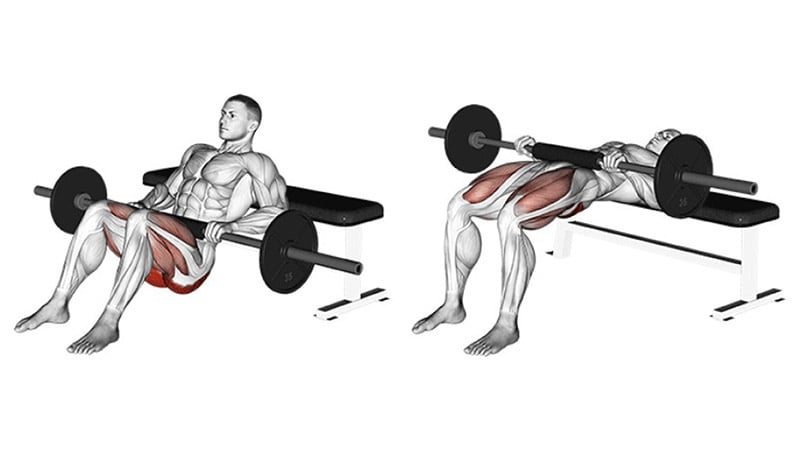
Hip Thrust Form
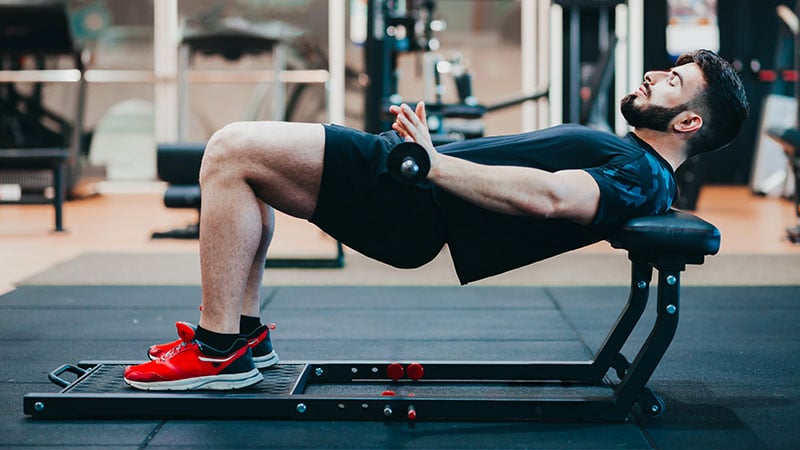
Like most exercises, the hip thrust is not complicated; however, getting your form correct is vital. If you don’t, you’ll lose out on gains and work the wrong part of your body. While most people use weights for their hip thrusts, if you’re just beginning, it’s best to get the technique correct before adding load. There are a few things to keep in mind. First, you want to keep your back and upper body straight throughout the movement without arching your spine. You’ll also want to keep your chin tucked into your chest – it can help to pick a spot high in front of you to focus on as you move. Finally, your knees should be bent at 90 degrees at the top of the thrust.
Execution
- Set yourself up on the floor in front of a flat workout bench. If it’s feeling a little wobbly, brace it with your arms out wide.
- Position your back against the edge of the bench so it sits around the bottom of your shoulder blades. Place your feet between hip and shoulder-width apart and away from the bench enough that your knees will sit at 90 degrees when you are at the top of the thrust.
- Once you’re in position, squeeze the glutes using them to drive your hips up until your torso is parallel to the floor. Keep your hips in a slight posterior tilt to help prevent your lower back from arching.
- Hold for a second at the top of the thrust before lowering with control back to just off the ground while maintaining flexed glutes. Read More...