How To Make Cycling Better For Everyone: A Muslim Perspective On Inclusivity
-
 Loading...
 - Vesa Jarvela
- 30 Jun 2022
- 130 Views
- 0 Like
- 0 Comment
Tom Würdemann is a German of mixed Syrian heritage. In the following article, he shares what it’s like being a Muslim cyclist, with a particular focus on how cycling is still a foreign thing in his community. In his opinion, this has to do with class, gender, and race.
His goal? To share the issues our sport has with inclusivity, and to give food for thought on what we can do to make cycling better for everyone. He has been inspired by the growing focus on sexism in the cycling community, and the enhanced visibility of female pro cycling, and wants to add a new facet to the discussion of our sport’s inclusivity.
Scene I: Racism
When you are married to a woman with a hijab, when you have friends who wear the hijab, you get used to the wry looks. You may also be used to being called upon for ‘companionship duty’, when you go with a friend to apartment viewings, so the chance of insults or mean treatment is lessened.
The people of the Palatinate area of south-western Germany, where I live, are known to be open-hearted and friendly, but also abrasive and rough around the edges. The great-grandfather of Donald Trump is from the region, for whatever that’s worth. In the nearby industrial town of Mannheim, multiculturalism may be an established fact, but in the forests and villages around our romantic university town of Heidelberg, as visible Muslims, we tend to stick out a little bit.
When my wife and I are riding our bikes, it is even more pronounced. We will get looks in forests and on backroads. The ‘road less travelled’ becomes a ‘road more stared at’. Old men walking their dogs in the forest turn their heads – cyclists forget to nod their head in the traditional greeting because they too are staring.
Sometimes, when pausing, you might get asked if it gets “too hot” under a hijab to ride in the summertime, which is funny but still gets annoying. Once we were asked by an older couple with suspiciously raised eyebrows: “what’cha doin’ here”, not knowing whether they were talking about our presence in ‘their’ land or merely on the forest trail.
Probably most people are just not used to seeing a woman with loose clothes and a headscarf on a mountain bike. Possibly some feel that ‘we’ are encroaching into a space that they think belongs to ‘them’. Whether they intend to or not, people from majority groups often make people from minorities feel unwelcome, or unwanted.

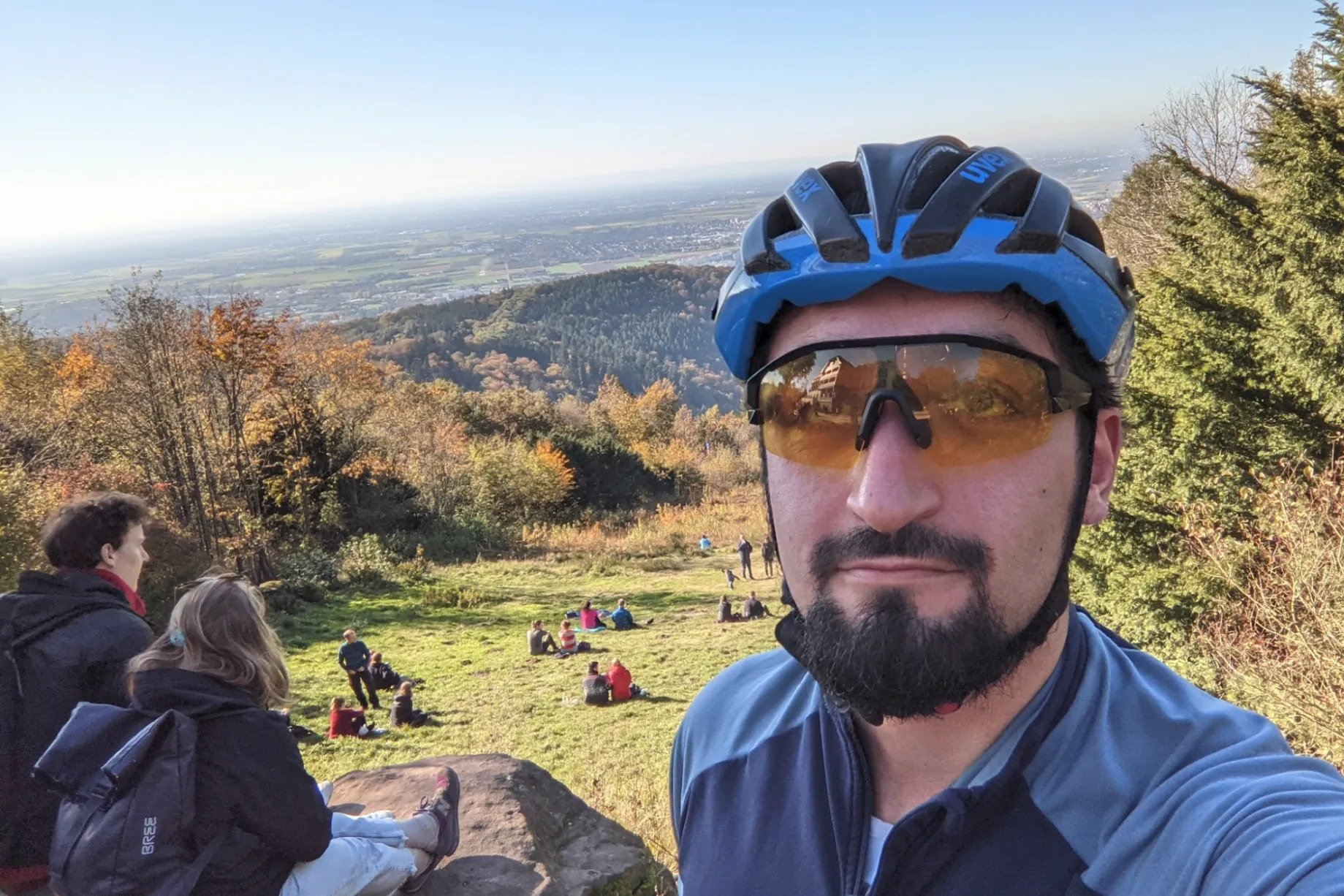
I personally can attest to how offbeat the concept of a non-European on a road bike can seem to others. Usually, people will consider me to be very Middle Eastern-looking. Of course looking “like” a heritage is a deceptive idea in a multicultural world, but you get what I mean.
In Germany, Arabic people will stop me in the street and tell me I look like a famous Egyptian entertainer – or ask me if I am the son of a Syrian Islamic preacher named Adnan Ibrahim. And my friends even made a meme of me, because I look like the 16th century painting of the Ottoman Sultan Suleiman the Magnificent (see below).
But in my bike attire, people will always assume I am Italian or Spanish – because the idea that ‘Arabs’ might be out riding a bike is almost as fanciful as the joke about me being a 16th century Sultan! Small, mostly harmless things like this will not discourage a passionate cyclist like me, but they might discourage people from taking up cycling in the first place.

Scene II: Class
“I have not ridden a bike in 10 years,” says my friend, as he casually rides a circle around me on the gravel bike I just got. “Why would an adult even ride a bike?”
I try explaining to him that I love riding it just for the sake of it. He says: “So, it’s like a sport to you?”“Yes …”“That means, like, you ride the Tour de France?”
Being a cyclist in Germany with a Muslim background is not always easy. The bike doesn’t exactly have high social value, whereas the car is an important status symbol in our community. For many young women – and young men even more so – transitioning from the bike (and public transport) to the car is seen as an important moment of reaching adulthood. While owning an expensive car is slowly falling out of favour with the middle classes in Europe (and being supplanted by other status symbols), in working-class communities the car still retains that value.
Additionally, for many Muslims in Germany, the bike is a necessity, disposed of once other means become available. This is, in part, an issue of class. It is well-known that post-materialism has a paradoxical connection to material security: Once you have achieved financial security, you can afford to scale down.

A working-class family from a migrant community would, traditionally, use their car for lots of things many middle-class urban white families would not encounter: driving all the way down to the country of origin during the summer holidays in the car, family shopping for a whole month, and transporting more than one or two children. In that respect, the connection to the car for urban people from migrant communities might be closer to that of rural people.
Moreover, working class areas usually have worse infrastructure – less public transportation and greater distances to places of work – which then demands a greater flexibility of movement from their inhabitants. It’s not as bad as in the United States, where the recognition is reached that the last hundred years of urban planning have created and enforced racial stratification in many subtle ways. But it can be felt here too, when focusing on it.
My city of Heidelberg is a good example. Its poorest district sits on a hill (at the foot of the Königsstuhl climb, featured in a 2008 Deutschland Tour stage, where Rigoberto Urán finished second). There is a bus that goes down to the city every 20 minutes, and that is it. We roadies love our hills, but if you had to climb 400 feet (120 metres) each time you wanted to return home from the city, it might start to suck. And so, the people from that district need a car for mobility. Rich people might live on hills, too, but they have more of a choice.
On the other hand, there are plenty of clichés connecting bikes to the urban, white, German middle class, who usually inhabit centralized districts with good infrastructure. The use of big cargo e-bikes to do the school run is a big one of those clichés.