How To Spot Bot And Trolls On Social Media
-
 Loading...
 - Gacoki Ndinda
- 08 Aug 2022
- 73 Views
- 0 Like
- 0 Comment
Have you ever logged in to a social network and seen an account or read comments and tried to understand if they were real or created by bots?
Have you ever read about a topic related to your company and tried to understand if it was created only for provoking an unhealthy discussion?
How important are topics and comments around the company and how difficult is it to verify the reliability in a world where bots and trolls are now on the agenda?

Over the last few years, words like “bots”, and “trolls” have become part of conversations in social networks. They have gained a huge and often unrecognized influence on social media and they are used to influence conversations for commercial or even political reasons.
Social media platforms are constantly trying to find a way to fight fake accounts, bots and trolls. Instagram has recently introduced a new feature to confront fake accounts: you must take a photo and video of yourself to demonstrate you are a real person not a bot.
In order to maintain the quality of discussion on social sites, it’s becoming necessary to screen and moderate community content. Is there a way to filter out bots and trolls? The answer is yes.
What is a bot?
Dictionary.com defines a bot as “a software program that can execute commands, reply to messages, or perform routine tasks, as online searches, either automatically or with minimal human intervention (often used in combination)”
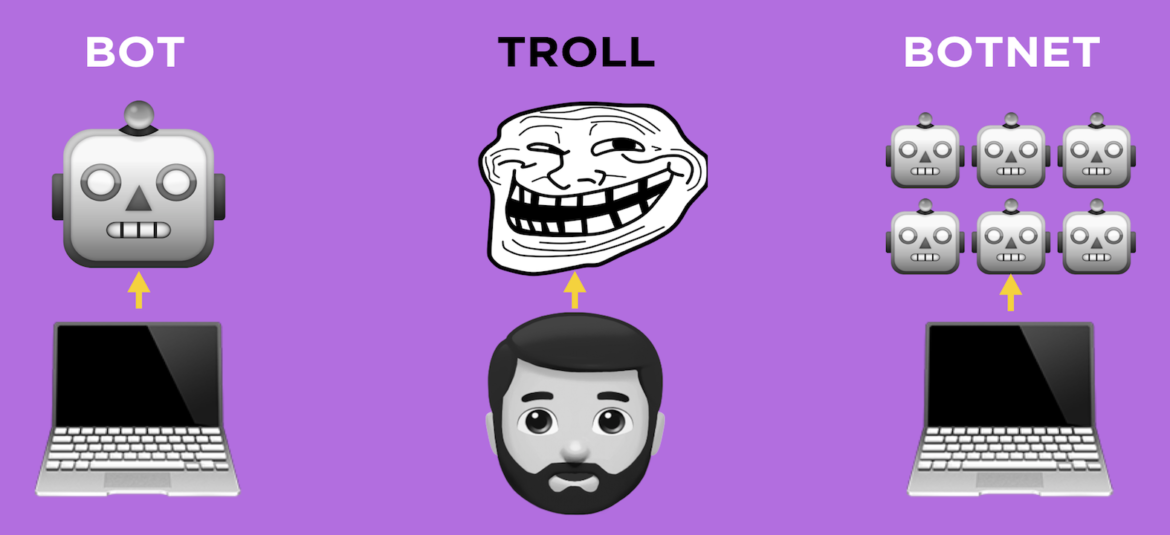
A bot – abbreviation of the term “robot” – is a computer program designed to perform online operations automatically, quickly and repetitively, without any human intervention.
Types of bots
Bots can be used in different areas of business: customer service, search functionality and entertainment. Using a bot in each area brings different benefits.
There are plenty of different types of bots designed differently to accomplish a wide variety of tasks. Some common bots include:
· A chatbot: a program that is able to analyze and understand the language of real users interacting with them. In customer service, bots are available 24/7. They increase the availability of customer service employees, so they can focus on more complicated issues. They interact with people by giving pre-defined prompts for the individual to select.
Their skills improve incrementally thanks to machine learning: bots can learn from their mistakes and, above all, from their interaction with real people. This allows them to improve their human language analysis skills and thus provide more and more precise and accurate answers. Chatbots may also use pattern matching, natural language processing (NLP) and natural language generation (NLG) tools. You can also decide your chatbot name.
· Social bots: bots have now become a very frequent presence even within social networks in the form of fake profiles. They operate on social media platforms and instant messenger apps such as Facebook Messenger, WhatsApp, and Slack.
People use them, for example, to inflate the number of followers and make people believe, in this way, to be more famous than they actually are. “Social” bots, however, are also acquiring an increasingly political dimension.