How to Take Your Passport Photo at Home in 2022
-
 Loading...
 - Maisah Abbas
- 04 Aug 2022
- 86 Views
- 0 Like
- 0 Comment
A passport is almost always a necessity when traveling outside your country, and a photograph is required along with identity documents, filling out a form, and paying a fee when applying. The photograph is potentially the most challenging part of the process. The good news is that the photo can be taken and printed at home as long as careful attention is given to the rules.
In this article, we will take an in-depth look at how you can shoot your own passport photos in the comfort of your own home or photo studio.
Avoid Common Problems with Passport Photos
Several rules must be followed to have the best chance for a submitted passport photo to be approved. Since it can take quite some time for processing, it’s best to get it right the first time to avoid long delays. Some of the most common problems have to do with the subject smiling broadly, turning slightly to one side more than the other, or being unevenly lit.
Technical issues to avoid include having something other than white showing in the background, such as a shadow or other object appearing in the frame. The size of the subject is important and so is their facial expression. There are even rules about clothing. A picture must be no more than 6 months old at the time of submission for use as a passport photo.
Equipment Needed to Take A Passport Photo
A camera is needed, of course, and a passport photo can be taken with a modern smartphone or a separate camera. Recent models are typically good enough as long as there is sufficient lighting. The result should not be grainy, blurry, or pixelated — a viewer should not be able to see any pixels or printer dots. Naturally, a dedicated camera might produce even better photographic quality and a sharp, well-exposed picture is best.
A white background is necessary which might require a large sheet of white paper if a white or off-white wall isn’t available. If there isn’t sufficient light in a room to light the subject and avoid shadows, some type of additional lighting will be needed. The end result is what matters and specialized equipment is not necessary.
What Kind of Background is Needed for a Passport Photo?
A perfectly, white backdrop isn’t necessary, however, it is best to use a white or off-white wall or a white paper backdrop that’s free from shadows. A paper roll or a large sheet of poster board are commonly used backgrounds. Paper can be taped or tacked to a wall to avoid folds and wrinkles. A light might be needed for the background to remove any shadows and nothing else should be visible in the cropped picture that is submitted.
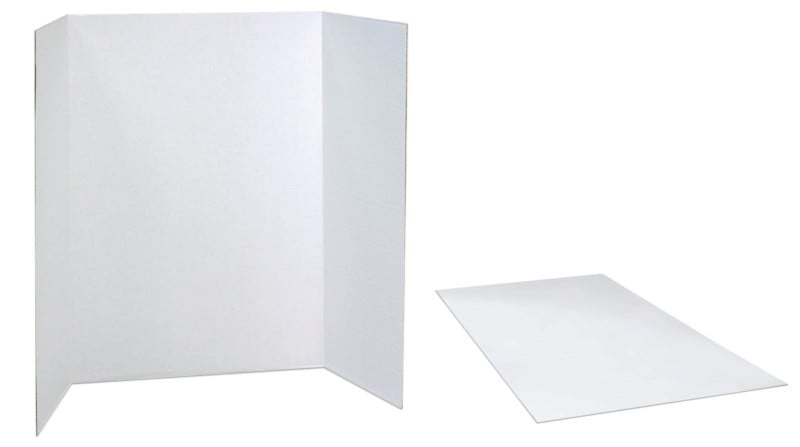
A foam-backed project board is a nice solution since it’s large enough to fill the background without feeling cramped for space when taking the photo. Since a project board is rigid, it can stand upright on a table.
The Importance of Good Lighting for a Passport Photo
It’s very important to take extra time when arranging the lighting. The subject should not have any shadows. The background should also be free from shadows. This might require a separate light to be used for the background to eliminate a shadow cast by the subject.
Using a flash is an easy way to eliminate shadows on the subject but can result in shadows in the background. A little trial and error might be needed to get good results and this is probably the most time-consuming part of the process if professional lighting isn’t available.
Getting the Subject Ready for a Passport Photo
The person being photographed should remove any hat, glasses, or facial obstructions. If a hat, glasses, or head covering is part of religious attire or required for a medical condition, that is acceptable but a written document will have to be submitted along with the passport application attesting to this need. For medical purposes, a doctor’s statement is required. Jewelry and piercings are gray areas and are allowed ‘as long as they do not hide your face.’
Smiling in a passport photo is now allowed, however, it must be a ‘natural, unexaggerated smile’ with both eyes open and a neutral expression is most likely to be accepted. The subject should face the camera so that both sides of the face are equally visible and the head should not be tilted. The only restriction on clothing is to avoid anything that looks like a uniform or camouflage attire. Read More...