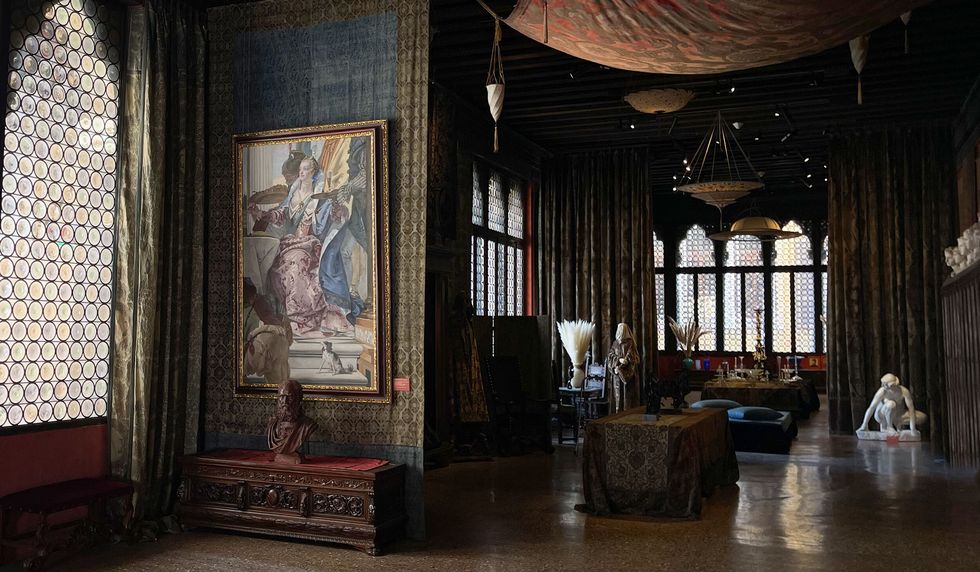
If you love Fortuny fabrics, then this museum is a must-see
-
 Loading...
 - Charlotte Brown
- 30 May 2022
- 280 Views
- 0 Like
- 0 Comment
When you hear the name “Fortuny” you might think of rich damasks, pomegranate-printed velvets, and cascading silk lanterns as intricate as the sails of a model ship. But the world of the storied textile company’s founder, Mariano Fortuny, went far beyond decoration. The Spanish-born, Venice-based polymath was a notable early-20th-century tinkerer and inventor who excelled in fields as diverse as painting, set design, engineering—he patented an early version of a dimmer switch and invented a motorboat propeller—and fashion.
To celebrate the designer’s brilliance and commemorate the 100-year anniversary of Fortuny, the company’s 15th-century Venetian residence, the Palazzo Pesaro degli Orfei—often simply referred to as Palazzo Fortuny—has been restored and reopened as a museum dedicated to its founder’s life and work.

“He really was one of those incredible geniuses that was just as brilliant with his creative mind as he was with his engineering mind,” explains longtime Fortuny creative director Mickey Riad, who caught up with ELLE DECOR via phone from Venice’s storied Piazza San Marco.
“The overall mission of the museum is to give people a better understanding of the breadth of [Fortuny’s] work and influence,” he continues. “When people think of Fortuny, they think of his fabrics or they think of his fashion. But when you go here you see the scientific side of his work—not just the decorative side.”
Mariano Fortuny’s mother moved the family from Paris to the Palazzo Pesaro degli Orfei in 1889, when Fortuny was 18 years old. Venice at the time was a far cry from the cruise ship–clogged tourist destination it is today; the floating city marked the crossroads of the world where history—and the city’s ethereal light—was omnipresent. A young Fortuny drank it all in, shutting himself up in his studio to think, read, and create. “The light inside the palazzo was quite spectacular,” Riad explains. “It’s where he had his studio and his workshop, and it’s where he came up with his inventions and patents.”

Two years before the move to Venice, however, Fortuny had met the woman who would become his longtime lover and muse, Henriette Negrin. She moved to Venice to be with Fortuny in 1902. “It was quite scandalous at the time, especially since they weren’t married and she was a divorcée,” Riad says. The affair didn’t go over well with Fortuny’s mother and sister, either—the day Negrin arrived in Venice, as the story goes, a bell tower in the Piazza San Marco collapsed. Fortuny’s sister even analyzed Negrin’s handwriting and declared the match to be a bad one. “But they ended up staying together for the rest of his life,” Riad says.
Together at Palazzo Pesaro degli Orfei, the pair dreamed up the world of Fortuny, creating sumptuous fabrics and clothing that appealed to the bohemian tastes of the time. (Of Fortuny’s flowing Delphus gown, Marcel Proust is said to have declared it was “faithfully antique but markedly original.”) Due to the popularity of these creations, Fortuny realized he needed to expand the business. In 1919, he found a former convent on Giudecca, an island in the Venetian Lagoon, and converted it into a factory. The first fabrics produced there rolled out in 1922 and have been made there ever since using Fortuny’s original machinery and secret processes.

Mariano Fortuny died in 1949, and Negrin (whom he eventually married) bequeathed his palazzo to the city of Venice on the condition that it remain open to the public and that Fortuny’s library be preserved. The lower levels were used for rotating exhibitions, including a series of shows curated by Axel Vervoordt and, in 2012, devoted to legendary fashion editor Diana Vreeland. But this month, after undergoing extensive renovations to address water damage from the flooding that inundated the city three years ago, the building has reopened as a museum exclusively dedicated to Fortuny. “This is the first time since 1949 that both the factory and his home are linked together again,” Riad says. “And that’s really what we’re most excited about.” Read More...