In a neighborhood of Atacames, women free themselves by creating enterprises
-
 Loading...
 - Santiago Loor
- 04 Apr 2022
- 334 Views
- 0 Like
- 0 Comment
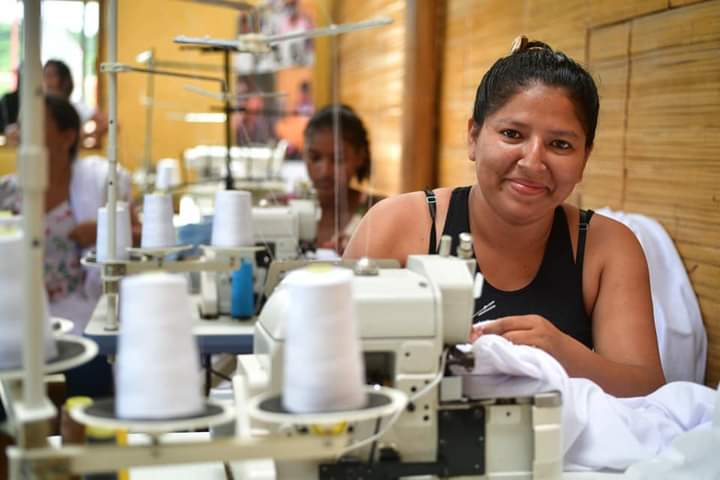
In the Nueva Esperanza neighborhood, in Atacames (Esmeraldas), extreme poverty, precarious housing and social exclusion abound. For this reason, to help its inhabitants , the Women's Entrepreneurship House was established, a space in which courses are taught and from which 37 women in the sector have already graduated in sewing and aesthetics since 2019.
Improving their quality of life is the goal currently shared by 13 women in the dressmaking group and another 12 in the esthetics and beauty group . These are the two training areas that were born from the Caemba Foundation project , which offers sustainable livelihoods. Caemba helped with the infrastructure of the center and this has resulted in the graduation of women.
Nelly Ortiz belongs to the dressmaking group and now has her own business . “I have learned to do things that my mind never thought of, like making clothes. My entrepreneurship is cutting and sewing ”, She comments optimistically. A group of Montubias, mestizas, Afro-Ecuadorians, indigenous people, who two years ago had no opportunity to start a business, are now an example that it is possible to get ahead despite any adverse circumstance.
The coordinators of the multifunctional center have very pleasant experiences: "The most beautiful thing is to see them graduate," says Maritza Orellana, one of the field coordinators of the Caemba Foundation . She says that the graduates are between 25 and 45 years old and most of them are mothers.
From the House of Entrepreneurship , built with bamboo, Orellana lights candles and prays that these women finish the training process and start their journey independently. "It's not a college graduation, but it's an individual achievement." The taboos begin to disappear when they show that mothers and young people not only stay at home, but also work.
This program was born in a neighborhood previously known as 'La 13'. A marginalized place, where machismo blocks and takes over certain women who want to join this project. It is considered one of the most dangerous places in Atacames . Its inhabitants are easily labeled as "criminals" and even "people without opportunities".
The April 2016 earthquake marked the lives of millions of people and from there solidarity was born and the Caemba Foundation was created to support vulnerable and low-income families in the provinces of Esmeraldas and Manabí.
"Before the Women's Entrepreneurship Center was born , we had a donation of 21 sewing machines and I, without knowing, accepted them," says Cristina Latorre, director of Caemba . She knew that a possibility would be born there so that single, abandoned and young mothers could obtain their economic freedom.
The awareness process is not easy for the coordinators, but they fight to change the attitudes and customs of the area; to keep your projects on track. “Coexistence is sometimes not easy because of the schedules; They go in groups, but they still stay there”, explains Maritza Orellana. "The work becomes heavy when convincing the women 's families , since in some cases it is difficult for them to even leave the house."
Training at the center is a two-year process. It is inevitable that there are phases in which enmities arise between the group, jealousy of work and difficulties in terms of mobilization. But there are already several women who have completed their first goal.
“You see faces of happiness and satisfaction knowing that they did make it,” says Orellana, recalling the graduation of the students.
A neighborhood and a country for entrepreneurs
According to a study carried out in 50 countries by the Global Entrepreneurship Research Association, Latin America has the highest percentage of women who dare to undertake . The Nueva Esperanza neighborhood group undertook for their freedom, to stop depending on their family, "which makes them submissive or submissive women," says the director of Caemba .
The motivation of an enterprise as an alternative to work became a reality in a business designing t-shirts and selling bags for the foundation itself . And the 12 women who remain in dressmaking already have their own businesses. Read More...


