India After Gandhi | Book Excerpt
-
 Loading...
 - Krisha Anand
- 03 Feb 2023
- 80 Views
- 0 Like
- 0 Comment
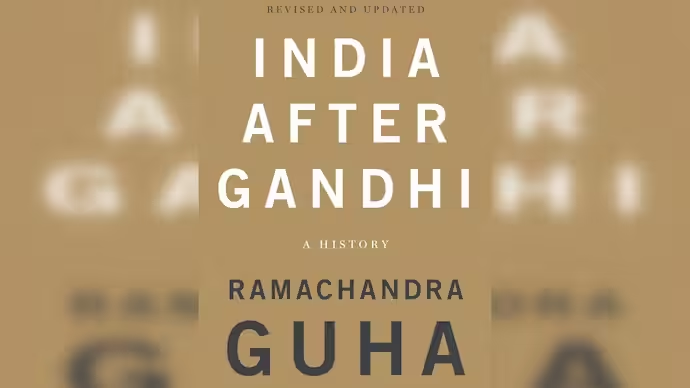
Published to coincide with the seventy-fifth anniversary of Gandhi’s assassination, Ramchandra Guha's India After Gandhi is a magisterial account of the pain, struggle, humiliation and glory of the world’s largest and least likely democracy.
India, after its independence, has gone through waves of prosperity as well as devastating incidents like demonitisation, the abrogation of Kashmir’s autonomous status, large-scale citizens’ protests and an unprecedented state crackdown on dissent. Ramchandra Guha’s third edition of India After Gandhi narrates all these incidents from a very literary and historical perspective.
Published to coincide with the seventy-fifth anniversary of Gandhi’s assassination, the book is a magisterial account of the pain, struggle, humiliation and glory of the world’s largest and least likely democracy.
Here’s an excerpt from the book:
In those first, fraught, years of independence, many observers had cast doubt on the survival of India as a single and united country. This scepticism was not without foundation. The nation had been born in August 1947 against the backdrop of division, civil war, the flight of refugees, the unresolved question of the princely states, economic scarcity and an uncertain international situation. Barely six months after the transfer of power from British to Indian hands, the ‘Father of the Nation’ was murdered by a Hindu fanatic. Could India survive? Would India survive?
These forebodings were understandable, though they perhaps underestimated the capabilities of the Indian leaders in charge. As narrated in Chapter 1, perhaps the most consequential outcome of Gandhi’s assassination was the reconciliation of Jawaharlal Nehru and Vallabhbhai Patel, Prime Minister and Home Minister respectively. The two had been comrades during the nationalist movement against the Raj, but had in recent months drifted apart, owing to their varying interpretations of their respective roles. Now, with their mentor gone, and the country’s survival at stake, they chose to bury their differences and work together.
Ever since Narendra Modi became Prime Minister in May 2014, he and his party, the BJP, have sought to present Jawaharlal Nehru and Vallabhbhai Patel as rivals rather than colleagues. The Hindu right claim that Gandhi erred grievously in choosing Nehru as Prime Minister; they argue that Patel was far better suited for the job, and that had he been in charge, India would have fared much better on the economic, social and political fronts. On social media, particularly, this revisionism is widespread. Read More…