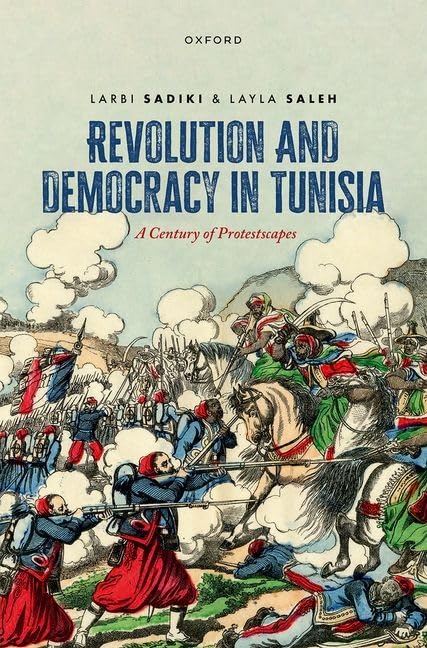
Revolution and Democracy in Tunisia: A Century of Protestscapes – Review
-
 Loading...
 - Bridget Walsh
- 28 Oct 2024
- 41 Views
- 0 Like
- 0 Comment
In "Revolution and Democracy in Tunisia," authors Larbi Sadiki and Layla Saleh offer an interdisciplinary exploration of Tunisia's extensive history of protest, positing that popular resistance has been a fundamental force in shaping the nation’s identity. Elena Korosteleva highlights the book's nuanced theoretical framework and human-centered narrative, which illuminate the concept of “peoplehood” as a grassroots catalyst for political change.
Under its seemingly straightforward title, "Revolution and Democracy in Tunisia" (2024) reveals the intricate and multifaceted journey of Tunisians striving for democracy. The authors argue that the democratization process is ongoing and is driven by “peoplehood” or hirak, an Arabic term meaning “movement.” This concept encapsulates a grassroots surge of protests that challenge authoritarian governance. Sadiki and Saleh articulate that peoplehood embodies the agentic, affective, and cognitive struggles against authoritarian rule, illustrating how a collective identity emerges from these efforts.
The authors contend that the revolution that led to the ousting of Zine al-Abidine Ben Ali, who ruled Tunisia for nearly 25 years, was not merely a singular event but rather the culmination of a long-standing struggle for democracy. This struggle, which dates back to protests against French colonialism in 1864, has not only shaped Tunisia but has also inspired a wave of similar movements across the Middle East and North Africa, collectively known as the Arab Spring.
Sadiki and Saleh recount this revolutionary process through both synchronic and diachronic lenses, connecting the memories of a historically marginalized populace to their awakening as a cohesive entity driven by aspirations for freedom. The book provides a compelling theoretical framework that challenges Western perspectives on revolution, emphasizing the importance of local narratives and experiences.
The authors begin with conceptual chapters that address the notion of “the missing people” — those historically voiceless in the political landscape. They critique Western scholarship for its limited understanding of the Arab experience, coining the term “conversations with metropolitan revolution” to highlight the disconnect between Western theories and the realities of Arab societies. They then identify peoplehood as a vehicle for change and a sign of democracy-in-the-making, both in Tunisia and the broader region.
The authors introduce a unique lexicon to articulate Tunisia’s distinct situation, including terms like protestcape, dissentscape, and democracy learning loops. These concepts serve to provide an alternative and more affirmative vision of the revolution, countering prevailing misconceptions. The term protestscape is particularly insightful, offering a lens through which to understand the dynamics of rebellion as a “free play of the unfree.”
Sadiki and Saleh examine various forms of activism, including workers’ syndicalism, student movements, and women’s voices, framing these as part of a larger “carnival” of resistance. Drawing on Bakhtin’s ideas of a “feast of becoming,” they illustrate how these diverse perspectives converge into a powerful expression of peoplehood, marking a pivotal moment in the quest for democracy.
The book’s analysis extends beyond Tunisia, resonating with contemporary global movements for democracy. The authors draw parallels between Tunisia’s revolution and other uprisings, such as those in Belarus, Russia, and Ukraine, suggesting that these struggles are interconnected. They argue that the emergence of a “clamor of peoplehood” signifies a broader transformation of previously marginalized populations into active agents of change.
In their conclusion, Sadiki and Saleh emphasize the importance of studying revolution through spatio-temporal and relational lenses, addressing questions of imagination and collective identity. Their work not only redefines the sites of resistance in Tunisia but also offers insights applicable to global contexts, reaffirming the potential for democratic futures.
"Revolution and Democracy in Tunisia" is a significant contribution to the scholarship on political change and democracy. By re-ontologizing the narratives of resistance, Sadiki and Saleh illuminate the enduring power of collective action in the face of authoritarianism. Their exploration of peoplehood as a driving force for change serves as a reminder that, despite the persistence of dictatorships, the flame of popular resistance can ignite transformative movements. This book is essential reading for anyone interested in understanding the complexities of Tunisia’s journey toward democracy and the broader implications for global struggles for freedom.