4 Books Set In Italy That Will Inspire You
-
 Loading...
 - Noemi Alonge
- 07 Jun 2022
- 319 Views
- 0 Like
- 0 Comment
Whether it’s Italian culture, history, nature or cuisine you’re interested in, you’re in the right place. Below, we’ve collected four of our books set in Italy across a variety of genres.
We hope you enjoy one of the books you find here - and if you do, please take a moment to leave the author a review :) Don’t agree with our choices? Leave a comment below and let us know what books are your favorites!

Portrait Of A Conspiracy (Da Vinci's Disciples Book 1) by Donna Russo Morin
Few people gave notice to the plainly-dressed woman hurrying down the Via delle Caldaie, crossing the Via San Maria to the Via Romana, leading not only through, but out of the Porta San Piero Gattolino.
For the first time when making this retreat, Isabetta scanned the road behind and before her, fearful any should see her hurried get-away. Such action could be seen as escape, escape as guilt; but it was only the truth of her own existence from which she ran.
Once beyond the battlemented gate, Isabetta quickly stepped off the road in favor of the narrow, well-trod path beckoning from the right. It was one she had taken on many occasions, telling no one she was going. She never did on such sojourns.
Her step became a scamper. Her need to find release from her worries, greater with the disappearance of her friend, urged her on. Scurrying now, her breath grew labored as softly rolling meadow turned to hill.
Unlike much of the surrounding landscape, where hundreds of villas jutted from their tucks in the cliffside, or where the vineyards and olive groves drew lines upon their faces, this hill was as it was born, wild with whatever nature decided should grow upon it. Outcroppings of rock shared space with bright tufts of newly sprouting grass speckled with the purples and yellows of fresh blooms.
Isabetta climbed the first hill and turned round. From here, she could see her city sprawled out like a tapestry of golden and russet threads laid upon the earth. Enclosed by gigantic walls portioned off between twelve mammoth gates, the city—once nothing more than an encampment of the great Julius Caesar in the years before the birth of Christ—Florentina, the Latin word for flourishing, had become a magnificent citadel, cleaved in two by the gently curving Arno River. The Black Death had taken many, yet her home still boasted one of the largest populations in the world, as much or more than the places she read about: Rome, Milan, and somewhere called Lon-don, such a strange sounding word. Like a bird wafting above, her gaze scanned the mosaic below her, and she could not help but wonder what magic lay in the few miles between these walls.
Was it something in the water they drank or the air they breathed? Some other-worldly singularity creating so many extreme talents in one place? Dante, Petrarch, Donatello, Boccaccio, Giotto…all gone now, but not their influences—their legacies. Alberti, Bruneschelli, Botticelli. Painters, sculptors, writers, architects—the greatest the world had ever produced—all within these walls. How many more untold talents were there? She knew the work the sisterhood produced, knew more than some of it belonged on the walls beside those of Giotto, in sculptor gardens next to a Donatello, denied their glory by the feminine hands creating it. It blossomed within the confines of these city walls still, like a grape that had weathered a frost.

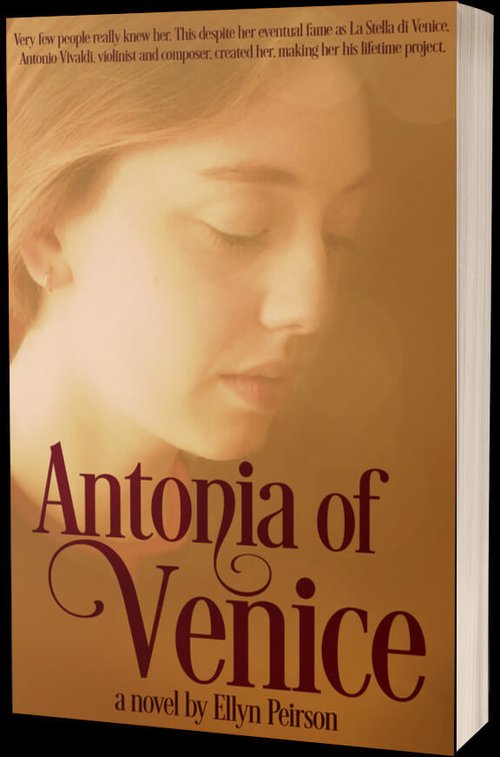
Antonia of Venice by Ellyn Peirson
It was as though the music created itself. Once Antonia realized she was most creative after time at the Rotunda, she began to scheme a way to spend more time there. There was much activity in the Court that did not include her. In fact, she rarely attended functions. Life in Mantova was dreadfully lonelier than life in Venice. She knew no one, and, most probably, very few Mantovans knew she existed. In this longest, dreariest period of her life, Antonia longed for something to do and someone to talk to. Composing made loneliness vanish.
Sitting in the Rotunda one Sunday evening, she devised a plan. She would gradually extend her time at the Rotunda, starting with Sundays. She would do this for a month. That seemed reasonable. If there were no discovery, she would then dare to go on Wednesday afternoons. This was the perfect day! Court functions began every Wednesday morning and lasted until the early evening. Who, then could possibly notice she was missing? Servants came to clean the Maestro’s quarters on Mondays and Thursdays. Again fortuitous! There was no need to worry about people on Wednesdays. And Wednesdays cut through the tedium of the week.
Her experiment with Sunday evenings had gone smoothly. The path was clear now for Wednesday afternoon flights to the Rotunda. Antonia hadn’t felt this excited since she had been allowed as a ten year old to go with the Maestro’s manservant to San Marco to see an exhibition of Murano glass. Domenico had been so enthusiastic, explaining the glass-making process to her and showing her the beautiful flowered glass rods. The glass-blowers were magicians! Somehow they’d been able to blow clear glass around the rods to create multi-coloured patterns of flowers. Why, the reds and yellows and blues of the rods were like her musical visions! Patterns—patterns in music, patterns in glass, patterns in colours. The world was full of patterns.
She parted the heavy draperies and looked out the window and down to the grounds. Happy desertion!
Antonia sat on her bed. Oh, how much happier she would be in Venice – her Venice—her home of water and glass and patterns to be re-discovered and transformed into music. It had been so long since she had had any sense of time and place. She knew this time in Mantova was the only way to begin a new life together with the Maestro and the Prioress. But, she was weary. She was weary of captivity. That’s what life was in Mantova.
Well, what good did it do to feel sorry for herself and be weary? It was time to test Wednesdays at the Rotunda! Antonia stood up, shook her skirt and threw her cloak around her shoulders. She slipped quietly down the stairs, walked outside and pulled up her hood.

A Death in Tuscany by Dick Rosano
We continued this discussion on our ride back to the Castello. But, once there, our conversation was cut short by the stream of visitors who wanted to pay their respects to the fallen giant. The great room of the Castello, where the Trantino family had hosted so many celebrations with wine, food, and great cheer, seemed hollow that day, even with crowds of well-wishers murmuring their condolences to members of the family.
I greeted each of them with a perfunctory smile as they entered through the massive stone archway leading to the main part of the Castello, passing each visitor along to my cousins and other relatives, but I recognized few of the sad and sullen faces that came before me. I knew they were friends and acquaintances, as well as an ample showing of business relations who had bought and sold wines from the Castello dei Trantini over the years. The rest of the Trantino family seemed to know them well and I soon tired of the parade and wanted to sneak off to a quieter place to think.
Near the end of that very long day, I decided to gather up my belongings in the guest suite at the far end of the residential part of the castle and move to the foreman’s house nearby. It was a sturdy stone building overlooking the vineyards once occupied by the man responsible for the care and upkeep of the vineyards. He lived there with his family, in a house given freely by the lord of the Trantino clan, and it was his as long as he worked at the winery. But, in time, the vineyard manager decided to move into another home near the town of Pianella. The stone villa stood empty for a while, but I had claimed it as my own during previous visits to the Castello dei Trantini, and I planned to do so again this time.
I got a ride to the villa from one of the vineyard workers. The little stone home stood on a level clearing at the top of a hill overlooking the olive trees and grapevines. On the horizon to the south, Siena sprawled across the hills in the distance, while the forests of our estate crowded in from all other directions. The prized cinghiale roamed through those trees and the hunt for them each autumn was a time of great camaraderie and challenge, rewarded with succulent aromas of roasting meat over an outdoor fire.
I stepped out of the car and paused only briefly to take in the scene around me, then carried my luggage up the stone steps to the covered portico at the top. This loggia offered a spectacular view and, before entering the villa itself, I had to stop again and savor the vista. Memories flooded past me from all the years spent in the embrace of this property, and I gazed out at the pastoral wonder of it all. I was supremely happy with my feet planted on Trantino land, so happy that even the tragedy that brought me here this time was not enough to squelch my pleasure.
I slipped in through the wooden door happy to be there, but I wanted to get unpacked and settled quickly so I could return to the loggia — this time with glass and bottle in hand — and pass the cool evening hours with some liquid refreshment. So, I went straight to the back of the villa where I would find the bedroom I always occupied on these visits. The villa had three bedrooms, if you didn’t count the small one in the upstairs loft, two bathrooms, and a small but functional kitchen. The main room included a couch, several easy chairs, a desk and a fireplace. Off to one side of the room was a table and chairs that served as the dining area. All in all, it was far too much room for me to fill, but I was the villa’s most frequent guest and so I considered it my own.
I hung as many of the shirts and jackets as I could in the cramped armoire in the bedroom, then wandered through the main room in search of the pile of books I usually left behind whenever I returned to the States. Picking up one volume that I had started but not finished, I trod into the kitchen to see if there was anything there I could eat. There would always be wine in the cabinet beside the desk, so I didn’t need to search too hard for a bottle of Castello dei Trantini Chianti Classico.
I opened the door to the refrigerator and was stunned to see it filled nearly to capacity. There was cheese, milk, fruit, a large bowl of olives, and several hunks of salame. I also found fresh loaves of bread and cans of coffee and other snacks in the cabinet above. When I looked over at the cutting board, I saw a note neatly penned in rural Italian script:
“Signor Filippo: Welcome home. I knew you would end up here instead of at the Castello, so I did a little shopping for you. There should be plenty food for a couple of days and by then I’ll check in on you and see what else is needed.” It was signed Elisabetta, one of my grandfather’s favorite employees and someone who had always taken a maternal interest in my welfare.
I loaded a platter with a generous sampling of the goods Elisabetta had stocked, then added a knife and napkin, and grabbed a simple glass tumbler from the cabinet. Except for formal tastings, I was accustomed to drinking my wine out of plain glasses, a throwback to the instincts for simple living I had preserved from my grandfather’s teaching, and delivered those things to the table on the loggia before returning to the main room for a bottle of wine. Read More...