Indian artists at Sotheby's Surya collection
-
 Loading...
 - Nitara Guha
- 07 Jun 2022
- 282 Views
- 0 Like
- 0 Comment
A number of works in this sale belong to India’s abstractionists, amongst them are Biren De, Mahirwan Mamtani, Sohan Qadri, and Ambadas Khobragade.
German gallerist
Ute Rettberg, now in her 80s, was a trailblazing German gallerist who played an important role in the expansion of the Indian art market abroad. Ute lived in Mumbai during the 1960s where she worked as one of the first women in the German diplomatic service. She and her husband were drawn to the vibrant colours of Indian contemporary art to decorate their Juhu Beach residence and began to purchase works by talented young artists to decorate their home.
Kekoo Gandhy
When the Rettberg’s returned to Germany, Kekoo Gandhy (founder of the pioneering Chemould Gallery in Mumbai) began to send Ute works to show in her newly-established Surya Galerie, based near Frankfurt. The gallery became the first of its kind in Europe to represent up-and-coming contemporary Indian artists, and these fresh, colourful and diverse works aroused great interest in Germany and further afield.
Ambadas Khobragade
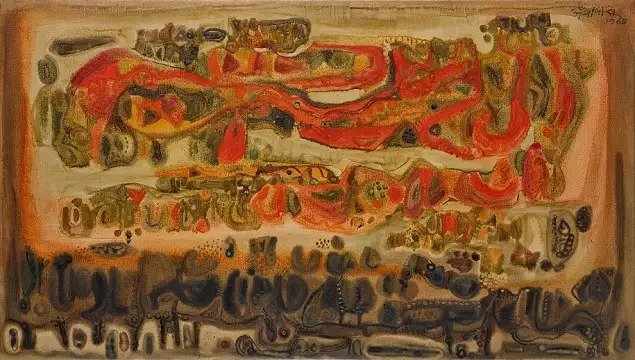
Colour, process and technique all coalesce in these two masterpieces by Ambadas Khobragade Closed Membranes of Silence 1968 and an Untitled Work from 1973 both reflect an abstractionist who created in his own island of solitude. The autumnal accents in both works have about them a deeper resonance that mirrors his understanding of the layers of abstract moorings. Rather than setting out to paint something, Ambadas painted forms that floated in the penumbra of passionate assertion, wherein the picture begins to assert itself….,the first stage of this assertion was both free, and unconscious. The final stage was born in the rivulets of what was intuitive.
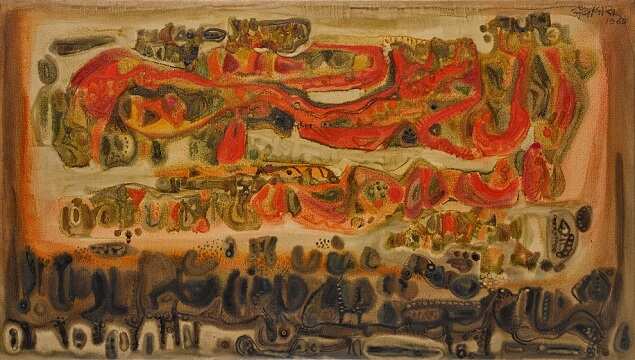
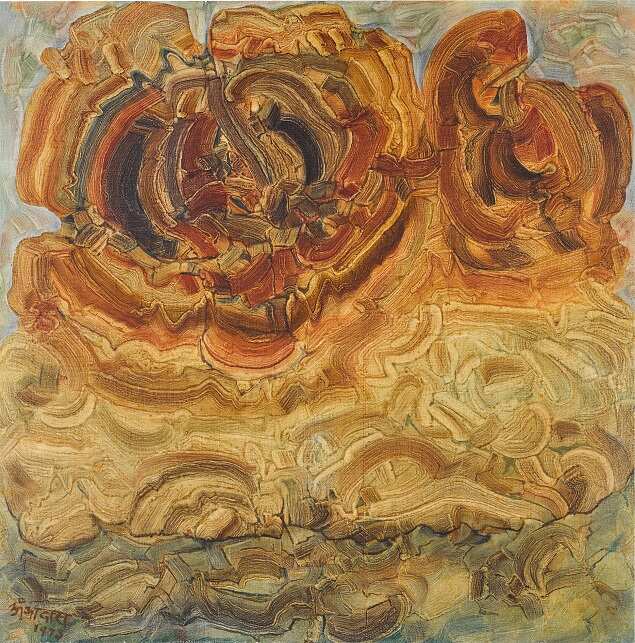
“Art to me is a happening and performance, an instant plunging, flirting and merging, with life, with it’s being and becoming it. All that is there on the canvas is but a charge in celebration.”said Ambadas.
Mumtaz A Khan
Mumtaz Khan’s intaglio Ramdu Kraj is an intriguing work that echoes tribal influences and symbolism.The figure and the face both create a corollary of myriad conversations that mirror intensity and compositional brilliance in understanding Indian indigenous elements.Her works were recognised by Prodosh Das Gupta as early as 1973 when he wrote:
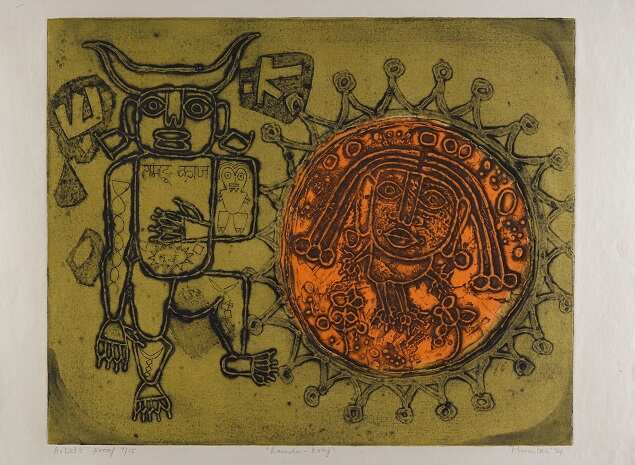
“ Mumtaz Sultan Ali [now Mumtaz J. A. Khan] is a rising talent of our country in the field of graphic art. The sheer virtuosity of her work blended with a rare sense of aesthetic judgement in coordinating line, form and colour in a composite whole is indeed a great achievement… Her lines are sharp and precise as if furrowed on the plate with a sure hand… [and] her introduction of decorative motifs here and there… bring life into the formal construction. The breath of freshness brought out in sensitive colours augments it.”
KK Hebbar
A sumptuous landscape is K.K.Hebbar’s Versova beach near Mumbai. Hebbar and his family visited Versova often, in part, to buy the fenugreek leaves that were grown along the beach. Known to always carry paints with him, Hebbar would sketch the fishermen drying their fish on the sand. The present work, painted spontaneously on the reverse of a Lalit Kala invitation, is a charming depiction of one of Hebbar’s favourite places. His words reaffirm his love for the everyday idiom.
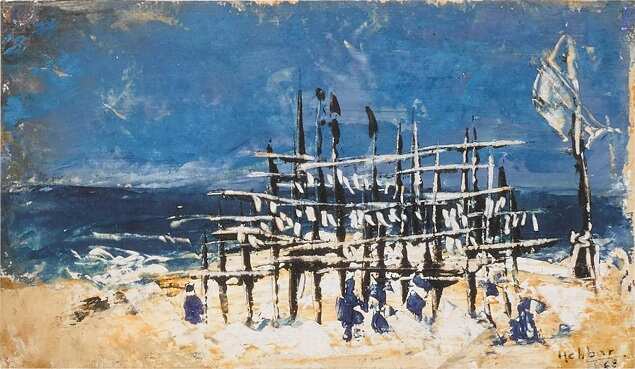
“From the very beginning of my life as a painter it has been my aim to be able to express my joys and sorrows through colour and line as freely as a child expresses hunger by crying or its joy by laughter. For this purpose I had to learn the vocabulary of art and also to draw sustenance from the vast treasure accumulated from the past and practiced at present all over the world.”
Sohan Qadri
An Untitled 1973 work made in Copenhagen Sohan Qadri’s lingam is full of mystique as it echoes the tenets of Purusha Prakriti and the inchoate juxtaposition of forms within the lingam created in ebony. Qadri the tantric seer, poet and abstract thinker created early works that had spiritual echoes of form. Qadri fused Tantric imagery and late modernist minimalism as he evoked the many tenets of the Shiva Shakti principle in both canvasses as well as later works on paper. Read More...