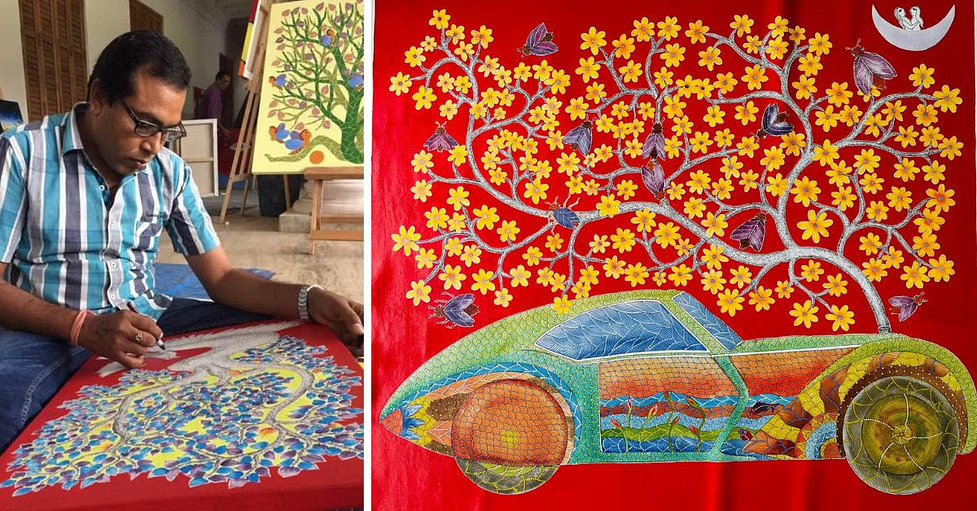
Rode Rickshaw, Painted Film Posters: ‘How I Reached Los Angeles to Display My Gond Art'
-
 Loading...
 - Saira Bhalla
- 07 Jun 2022
- 270 Views
- 0 Like
- 0 Comment
As we enter Venkat Raman Singh Shyam’s studio in Bhopal, Madhya Pradesh, we stop short at the sight that greets us. A 30 ft expanse with rolls of paper, silk and canvas stacked together, paintings that are done by the artist, unframed and awaiting their chance to be displayed. In the centre of the room, sits the 52-year-old Gond artist, wielding his brush as he fills canvases with deft strokes of colour and creates art that tells a story.
For Venkat Raman, who started his painting journey in Bhopal 36 years ago, life has come full circle.
But the journey was no mean feat.
Having grown up in the Gondwana land of Sijora in Eastern Madhya Pradesh, Raman shares that Gond art was once called bhiti chitra (wall painting) as it was done on walls and it was only later that it started to be known by its current name.
He was never a stranger to painting, as it seemed to be in the family’s genes. While his maternal uncle was a painter whom young Raman would keenly observe at work, on the paternal side there was the late Jangarh Singh Shyam, a contemporary Indian artist and the pioneer of Gond art.
At a young age, Raman would replicate the sights of the village onto paper and sometimes the walls, despite having no formal education in the same.
Then in 1986, his avenues opened up when his paternal uncle visited his home.
A visit that shaped Raman’s art trajectory
Recounting the incident, Raman Singh says his uncle Jangarh had come to see his younger brother who was also Raman’s father.
“I wasn’t at home at the time, but when he saw my paintings that were in the hall, he asked my father who had done them. My father replied, Raman.”
Jangarh spotted talent on the mud walls of the home and asked for the 16-year-old to be sent to Bhopal where he would work closely with him to learn the intricacies of their pride — Gond art.
Thus began Raman’s life in Bhopal, learning under the guidance of his uncle. After three long years, he decided it was time to move on.
The next part of his life took shape in Delhi, where he wanted to make a name for himself in the world of art.
However, there were a series of challenges that awaited.
The struggling artist was now faced with hardships and was now living from hand to mouth. “I would take on multiple jobs, sometimes taking up labour work, while other times cooking, being a rickshaw driver, painting homes, etc,” he says, adding that the aim was to get a square meal every night.
In the attempt to survive in the city, Gond art had taken a backseat.
But the artist’s love for painting still thrummed in the background, and it was one day that he thought, ‘Why not take up painting jobs?’
Sometimes film posters, other times hoardings, Raman was now painting commercially.
But his time in Delhi was cut short when he was struck with a bout of cerebral malaria in 1993, after which he returned to Bhopal to be a sign board painter, a job that he would pursue for the next 8 years until another significant event would shake him up.
‘The day I got the news of my uncle’s death, I put down my brush.’
In 2001, Raman Singh Shyam was going about his usual day when he received the news that his uncle Jangarh, the very person who had inspired him to grow in the field of Gond art, was no more.
He quit being a signboard painter and decided to continue the legacy of his uncle from then on.
But while he had a clear intent this time, he missed the acceptance of people.
“People were not very receptive to my work,” he says, recounting how they would snub him and not permit him to showcase his works in galleries.
“You are a new artist,” they would say.
While trying to create a niche for himself, Raman decided to write his book ‘Finding My Way’ and the same released in 2016, after 10 years of researching, thinking, writing down his thoughts, and looking for a publisher.
The book was a success, but people still hadn’t quite accepted his art.
“What people missed is that my art bore no resemblance to my uncle’s,” he says.
Raman acknowledged this fact. “I had gone back to Gond art after years. My line strokes had changed, and the hand patterns were different. It was tough.”
This was when he decided to follow his late uncle’s advice, ‘apni khud ki pehchaan banao’.
So in 2004, the artist decided it was time to tie old learnings with new ones and create a niche for himself in museums and people’s hearts alike.
“I started visiting museums abroad, seeing how famous painters and legends such as Picasso had painted their works of art. I began looking at my art, not from the eyes of the painter but the eyes of the people,” he says.
And when he returned to Gond art this time, he was fuelled by a new zeal.
“I would keep the roots of my paintings the same, the traditional Gond inspiration. But I would adapt the art, play with colours, adopt wash techniques instead of flat colour, change motifs, make linear art into circular designs, and bring in an identity of my own,” he notes.
Were his art pieces accepted by people this time around?
The answer lies in his paintings that went on to be displayed at famous galleries and historic places around India — the Chhatrapati Shivaji Museum in Mumbai, Chitra Kala Parishad, Bengaluru, Bharat Bhavan, Bhopal, the State Museum in Jhansi and more.
From the homeland, Raman Singh Shyam’s art reached foreign shores too.
His collections can be found at the Los Angeles Country Museum of Art, the National Gallery in Ottawa and the Queensland Art Gallery.
He also went on to win prestigious awards such as the State Award of Madhya Pradesh in 2002, and the Tallest Story Competition Trophy from Inverness Film Festival, Scotland in 2007.
After having come so far from his humble beginnings in the village, Raman Singh Shyam says he wants to create art that moves people. “Through the medium of art, I want to convey the problems that our planet is facing. I want my art to propel people to work towards solutions.” Read More...