Korea Successfully Launched 3rd Nuri Rocket
-
 Loading...
 - Kaeo Phasuk
- 15 Jun 2023
- 74 Views
- 0 Like
- 0 Comment
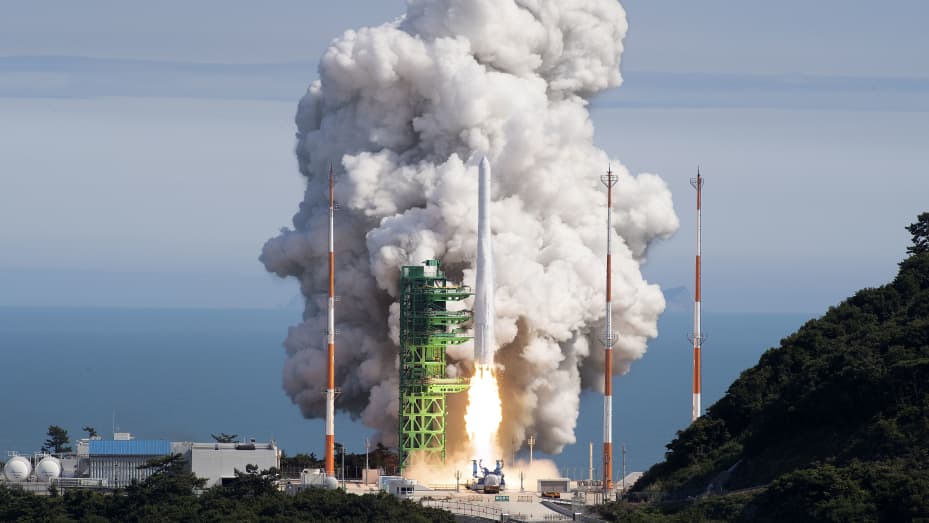
South Korea achieved a significant milestone in space exploration as it successfully executed the third launch of its indigenous Nuri rocket. The satellite launch vehicle performed flawlessly, reaching the intended altitude and deploying satellites into orbit, further cementing the country's progress in space technology.
During a press briefing, Minister of Science and ICT, Lee Jong-ho, highlighted the significance of the third launch, stating, "Following the successful second launch of the Nuri rocket last year, today's mission not only reaffirms its flight capabilities and reliability but also showcases our potential in satellite deployment and space exploration."
The Nuri rocket completed its flight sequence by reaching an altitude of 550 kilometers, traveling at a speed of 7.6 kilometers per second, in a total duration of 783 seconds (equivalent to 13 minutes and 3 seconds). The launch took place at 6:24 p.m. from the southern coast of the country.
Distinguishing itself from the previous two missions, the Nuri rocket's third launch included the deployment of the country's second next-generation small satellite, named NEXTSat-2. Additionally, seven cube satellites were also released into orbit. The Korea Advanced Institute of Science and Technology developed the NEXTSat-2, which features a homegrown synthetic aperture radar for space radiation observation. The cube satellites were developed by the state-run Korea Astronomy and Space Science Institute, along with three private companies: Lumir, Justek, and Kairo Space. These satellites will contribute to various missions such as Earth observation, testing waste-reduction technology in space, and analyzing microplasma changes in space.
The Ministry of Science and ICT and the Korea Aerospace Research Institute confirmed that the Nuri rocket, also referred to as the Korea Satellite Launch Vehicle-II, successfully deployed seven out of the eight satellites it carried. Officials stated that additional time is required to verify the proper release of one of the four cube satellites developed by the Korea Astronomy and Space Science Institute (KASI).
The ministry plans to provide an update on the status of the eight satellites in space during a press briefing scheduled for 11 a.m. on Friday.
Ko Jeong-hwan, the head of KARI's KSLV-II project, expressed satisfaction with the mission's outcome, stating, "The primary objective for us was to ensure the Nuri rocket reached the designated orbit and successfully deployed the NEXTSat-2. As both objectives were accomplished flawlessly, we consider the third launch of the Nuri rocket a resounding success."
The launch of the homegrown rocket experienced a delay from Wednesday to Thursday due to a software communication issue on the ground. The launch control committee decided to postpone the mission approximately three hours before the scheduled launch time. The problem originated from a communication malfunction between the computers controlling the launch operation and the launch pad's equipment. Specifically, the automatic operation of the helium valve connected to the rocket's umbilical cables faced difficulties.
Once the issue was identified, engineers promptly initiated the repair process on Wednesday afternoon, which concluded a little after 5 a.m. on Thursday. Multiple tests were conducted to ensure the proper functioning of the software's automatic communication.
Notably, the third launch of the Nuri rocket marked the first involvement of a private system integration company in the project.
The Nuri rocket project commenced in 2010 with a budget of 2 trillion won ($1.5 billion). South Korea's previous rocket project, the Korea Satellite Launch Vehicle-I (Naro rocket), was successfully launched in January 2013, approximately 10 and a half years after its inception in August 2002. The Naro project, with a budget of 500 billion won, utilized a 170-ton engine from Russia for the first stage of the rocket.