Japanese Scientists Develop Living Skin for Robots Capable of Smiling

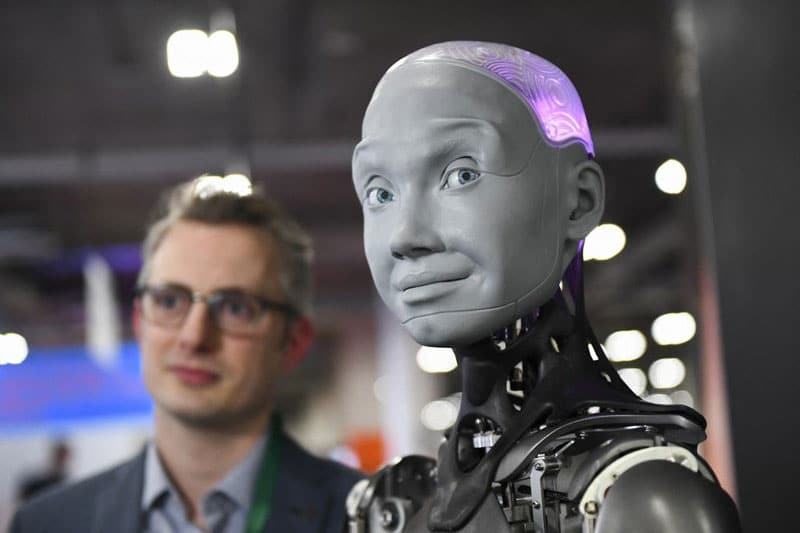
In a groundbreaking development, Japanese scientists have engineered a form of living skin using human cells that can be affixed to robotic surfaces, enabling them to exhibit a disturbingly realistic smile. This innovative research was detailed in a recent publication in the journal Cell Reports Physical Science.
Living Skin for Robots
Researchers from the University of Tokyo have successfully created a "skin-forming cell-laden gel" to produce a robot enveloped in living skin. This new material allows the robot to display lifelike facial expressions, including a smile, which the team showcased in a video that captured the pink, gel-like substance being manipulated into an eerie grin.

Advancements and Potential Applications
Led by Professor Shoji Takeuchi, the biohybrid robot specialists aim to utilize this technology to develop androids with more human-like appearances and capabilities. "We hope this will also provide insights into wrinkle formation and the physiology of facial expressions," said the research team. They anticipate applications in the development of transplant materials and cosmetics, given the skin's potential to mimic human biological functions more closely than traditional synthetic materials.
Challenges and Future Directions
While this development marks a significant step forward, the scientists acknowledge that their goal of endowing robots with the self-healing properties of biological skin remains unachieved. In prior experiments, they successfully grafted collagen onto a lab-grown skin covering a robotic finger to demonstrate repair capabilities. However, they noted that replicating similar repair tests on their smiling robotic skin presents a future challenge.
Creating a Natural Smile
To achieve a "natural smile" that moves fluidly, the researchers gelatinized the skin-like tissue and secured it within the robot's structure, drawing inspiration from the ligaments of human skin. This innovative approach could signify a departure from traditional humanoid robots, which typically use silicone rubber skins that lack the ability to sweat or self-heal.
As the scientists continue to refine this technology, they move closer to a future where robots could possess skin that not only looks and feels human but also functions similarly, opening new possibilities in robotics and beyond.