Liquid mirror telescope opens in India
-
 Loading...
 - Akash Basu
- 13 Jun 2022
- 254 Views
- 0 Like
- 0 Comment
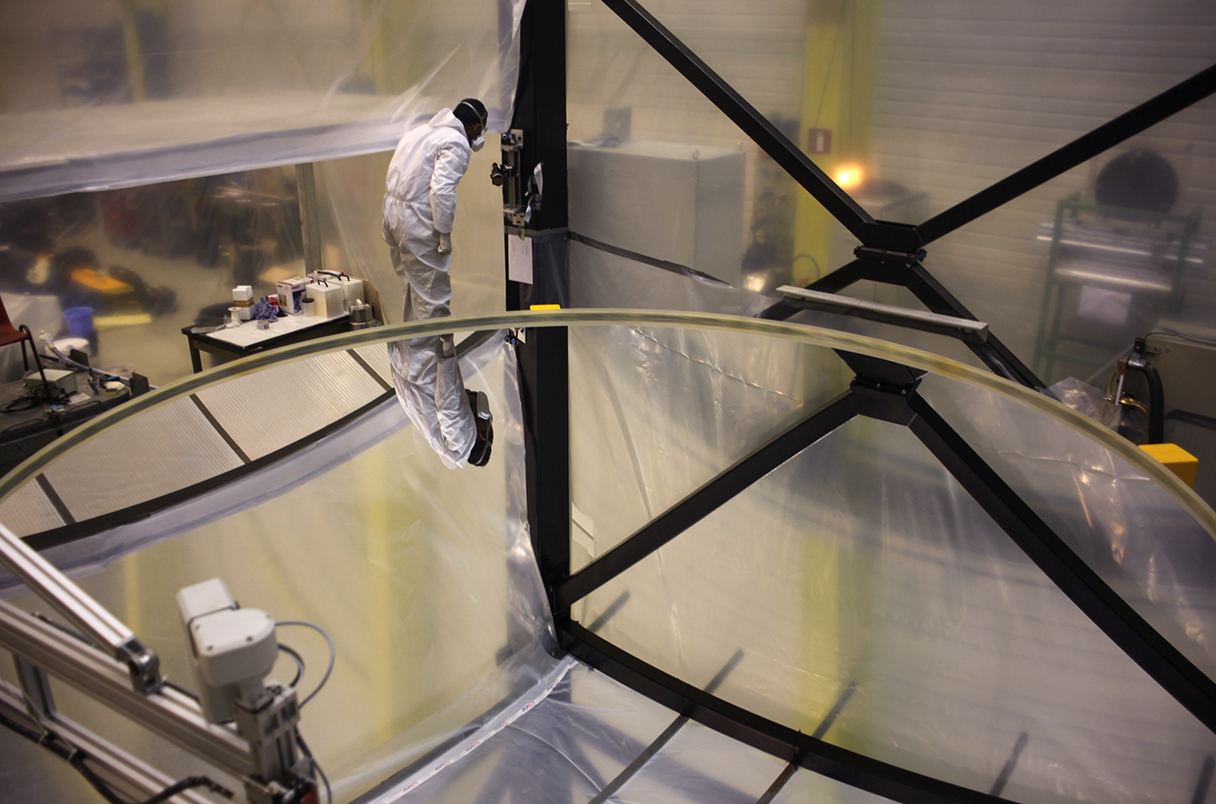
A unique telescope that focuses light with a slowly spinning bowl of liquid mercury instead of a solid mirror has opened its eye to the skies above India. Such telescopes have been built before, but the 4-meter-wide International Liquid Mirror Telescope (ILMT) is the first large one to be purpose-built for astronomy, at the kind of high-altitude site observers prize—the 2450-meter Devasthal Observatory in the Himalayas.
Although astronomers must satisfy themselves with only looking straight up, the $2 million instrument, built by a consortium from Belgium, Canada, and India, is much cheaper than telescopes with glass mirrors. A stone’s throw from ILMT is the 3.6-meter, steerable Devasthal Optical Telescope (DOT)—built by the same Belgian company at the same time—but for $18 million. “Simple things are often the best,” says Project Director Jean Surdej of the University of Liège. Some astronomers say liquid mirrors are the perfect technology for a giant telescope on the Moon that could see back to the time of the universe’s very first stars.
When a bowl of reflective liquid mercury is rotated, the combination of gravity and centrifugal force pushes the liquid into a perfect parabolic shape, exactly like a conventional telescope mirror—but without the expense of casting a glass mirror blank, grinding its surface into a parabola, and coating it with reflective aluminum.
ILMT was originally dreamt up in the late 1990s. The dish-shaped vessel that holds the mercury was delivered to India in 2012, but construction of the telescope enclosure was delayed. Then researchers found they didn’t have enough mercury. As they waited for more, the COVID-19 pandemic struck, making travel to India impossible. Finally, in April, the team set 50 liters of mercury spinning, creating a parabolic layer 3.5 millimeters thick. After such a long gestation, “we’re all very happy,” says team member Paul Hickson of the University of British Columbia, Vancouver.
Staring straight up, the rotating mirror will see a swath of sky almost as wide as the full Moon while Earth’s rotation scans it across the heavens from dusk to dawn. “You just turn it on and let it go,” Hickson says. Objects appear as long streaks in the image; the separate pixels can be added together afterward to create a single long exposure. Because the telescope sees roughly the same strip of sky on successive nights, exposures from many nights can be added together to get extremely sensitive images of faint objects.
Alternatively, one night’s image can be subtracted from the next’s to see what has changed, revealing transient objects such as supernovae and quasars, the bright hearts of distant galaxies that wax and wane as supermassive black holes consume matter. Surdej wants to hunt for gravitational lenses, in which the gravity of a galaxy or galaxy cluster bends the light of a more distant object like a giant magnifying glass. ILMT’s sensitive measurement of the object’s brightness reveals the mass of the lens galaxies and can help estimate the expansion rate of the universe. A study suggested as many as 50 lenses might be visible in ILMT’s strip of sky.
Conventional survey telescopes, such as the Zwicky Transient Facility in California and the upcoming Vera C. Rubin Observatory in Chile, cover much more of the sky. But they are unlikely to return to the same patch every single night to search for changes. “We’re forced to have a niche,” Hickson says. ILMT has the added strength of sitting next to DOT, which is equipped with instruments that can rapidly scrutinize any fleeting objects discovered by its next-door neighbor. This tag-team approach “is more comprehensive, and scientifically more rich,” says Dipankar Banerjee, director of the Aryabhatta Research Institute of Observational Sciences, which runs the Devasthal Observatory.
If ILMT is a success, Surdej says the technology could be scaled up to build much larger liquid mirrors on the Moon, an attractive location for future giant telescopes because it is less seismically active than Earth and has no atmosphere. On Earth, the Coriolis effect, from the planet’s rotation, would warp the motion of the mercury in mirrors larger than 8 meters. But the Moon rotates more slowly, allowing much larger liquid mirrors—although not of mercury. It is too heavy to transport to the Moon and would freeze at night and evaporate during the day. But more than a decade ago, liquid mirror pioneer Ermanno Borra of Laval University showed that “ionic liquids,” lightweight molten salts with low freezing points, would survive lunar conditions and could be made reflective with a thin coating of silver. Read More...