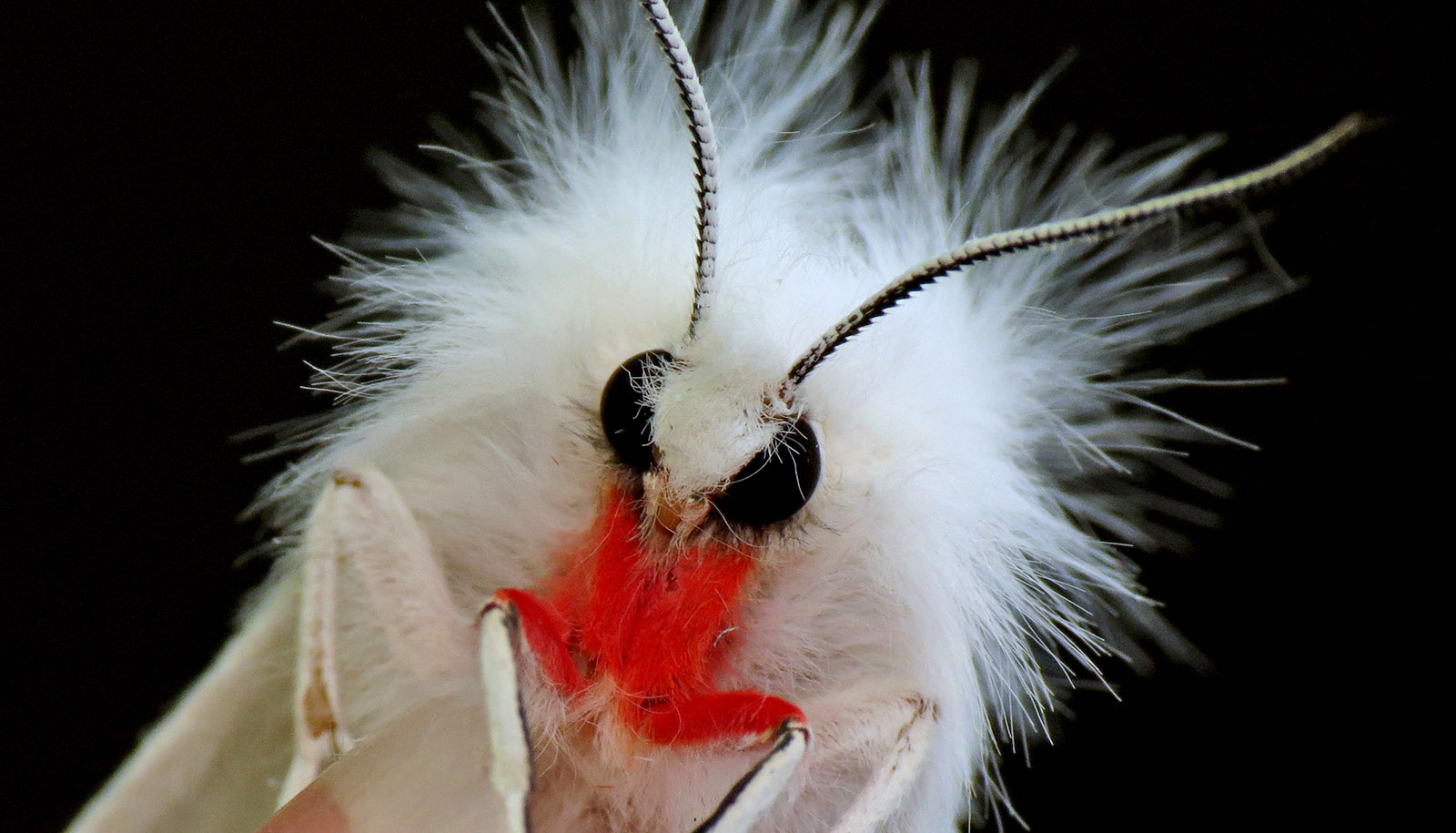
Lots more moths use ultrasound than previously known
-
 Loading...
 - Levi Wilson
- 01 Aug 2022
- 87 Views
- 0 Like
- 0 Comment
The finding adds three newly discovered sound-producing organs, eight new subfamilies, and potentially thousands of species to the roster.
Bats pierce the night with their own ultrasonic pulses that enable them to construct an auditory map of their surroundings, which is bad news for moths, one of their favorite foods.
Not all moths are defenseless prey, however. Some emit ultrasonic signals of their own that startle bats into breaking off pursuit. Many moths that contain bitter toxins avoid capture altogether by producing distinct ultrasounds that alert bats to their foul taste. Others conceal themselves in a shroud of sonar-jamming static that makes them hard to find with bat echolocation.
While effective, these types of auditory defense mechanisms in moths are considered relatively rare, known only in tiger moths, hawk moths, and a single species of geometrid moth. The new study in the Proceedings of the National Academy of Sciences says otherwise.
“It’s not just tiger moths and hawk moths that are doing this. There are tons of moths that create ultrasonic sounds, and we hardly know anything about them,” says senior author Akito Kawahara, a curator at the Museum of Natural History’s McGuire Center for Lepidoptera & Biodiversity.
The researchers were also interested in understanding how these sounds might converge between moth species. In the same way that non-toxic butterflies mimic the colors and wing patterns of less savory species, moths that lack the benefit of built-in toxins can copy the pitch and timbre of genuinely unappetizing relatives.
After collecting and studying thousands of moths for over a decade in Ecuador, French Guiana, Mozambique, and Malaysian Borneo, the researchers spent a final two weeks in Ecuador, where they recorded the alarm calls of every moth they could catch. Afterward, they analyzed these recordings with the help of a theoretical physicist and a machine learning algorithm that scrutinized each note, looking for similarities.
The program reveals what, up until now, other researchers had only guessed at: Moth species don’t act like individual composers, each with their own unique calling card and distinct style. Instead, a small number of moths derive their own scores, which other moths seem to replicate in complex acoustic mimicry rings.
Lead author Jesse Barber, a biology professor at the State University, says more work is needed to uncover the exact nature of these sounds, but he suspects the trailblazing moths at the center of these rings are likely noxious, while the copycats at the fringes are merely false advertisers.
“Moths and butterflies are collectively one of the most diverse groups on the planet, containing one of every 10 named animals. If these results pan out, it will likely be the largest set of mimicry complexes on Earth,” he says.
HOW MOTHS MAKE ULTRASOUND SIGNALS
These ultrasonic warning systems seem so useful for evading bats that they’ve evolved independently in moths on multiple separate occasions. In each case, moths transformed a different part of their bodies into finely tuned organic instruments.
“Tiger moths have structures called tymbals, which buckle inward and outward,” Kawahara says. “Some of them use structures on their wings, some use their abdomens, while others use modified genitals!”
Several of the various clickers and scrapers moths use as a bat repellant are described in this study for the first time. This includes a species of calpine moth that rubs together overlapping abdominal scales, similar to the way crickets make their characteristic chirping sounds. Another species, in a group called the snout moths, makes noise by using a structure resembling a guitar pick between its wings, which is strummed against when the moth is in flight. Read More...