Manhattan's Japan Society Explores Artist Kazuko Miyamoto's Relationship with her Studio Architecture
-
 Loading...
 - Ayame Hayashi
- 21 Sep 2022
- 70 Views
- 0 Like
- 0 Comment
Recreating the artist studio in an exhibition has always been a challenge for curators and exhibition designers––bringing in the right amount of “mess,” intricately revealing the workings of artistry, and maintaining the visual coherence are all boxes to be checked while letting the audience behind the curtain. Kazuko Miyamoto: To perform a line, Japan Society’s survey of the artist’s five-decade career in sculpture, drawing, and performance solves this challenge in ways that are both practical and poetic.
Miyamoto’s string constructions series pairs the simplicity of her two materials—thread and nail—with the visual allure of their seemingly impossible harmonious assemblage. Countless repeating lines of thread are affixed onto the wall and the floor in hallucinatory compositions that gently claim the space while prompting the audience to notice their heft and labor. Miyamoto initially made these three-dimensional drawings at two different downtown Manhattan studios in the early 1970s. The Japanese-born artist appended hardware store nails onto her wooden floors and walls, weaving industrial twine used for meatpacking back and forth. In an early example, Untitled (1973), she followed the mortar lines of a brick wall for precision; her progression to three-dimension in the following years required her to use a ladder and instructions in order to recreate the pieces elsewhere.
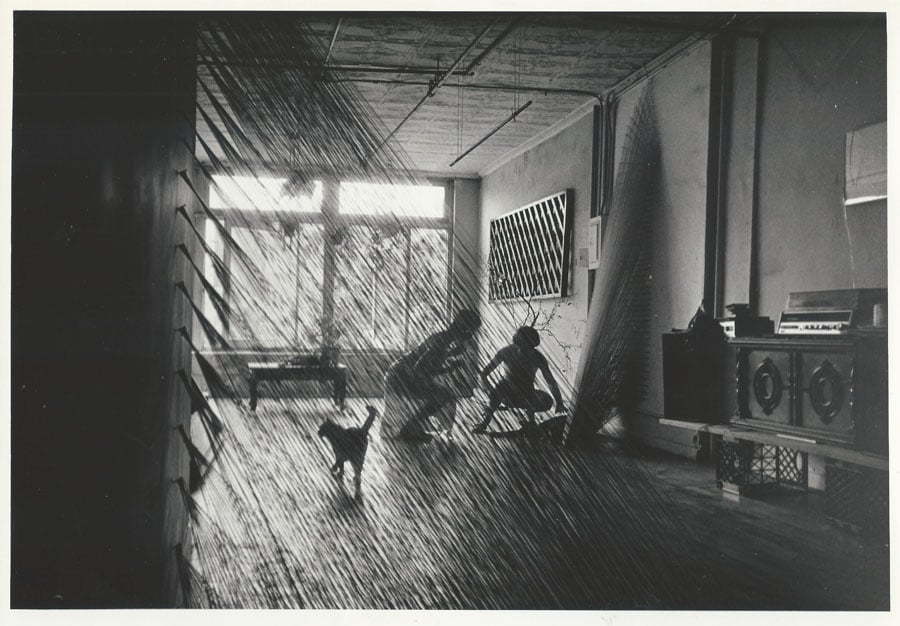
Miyamoto began the series a decade after moving to the United States from Japan and studying painting at the Arts Student League. During the Minimalist boom of the ‘70s, she focused on the male-dominated movement’s potential with light, space, and gesture—the thread and nail constructions reveal her interest in subtle mark-making within the space through laborious gestures. Read More...