“Mary Cassatt at Work” Honors the Labor of Attention and Love
-
 Loading...
 - Isis Jamal
- 28 Jun 2024
- 82 Views
- 0 Like
- 0 Comment
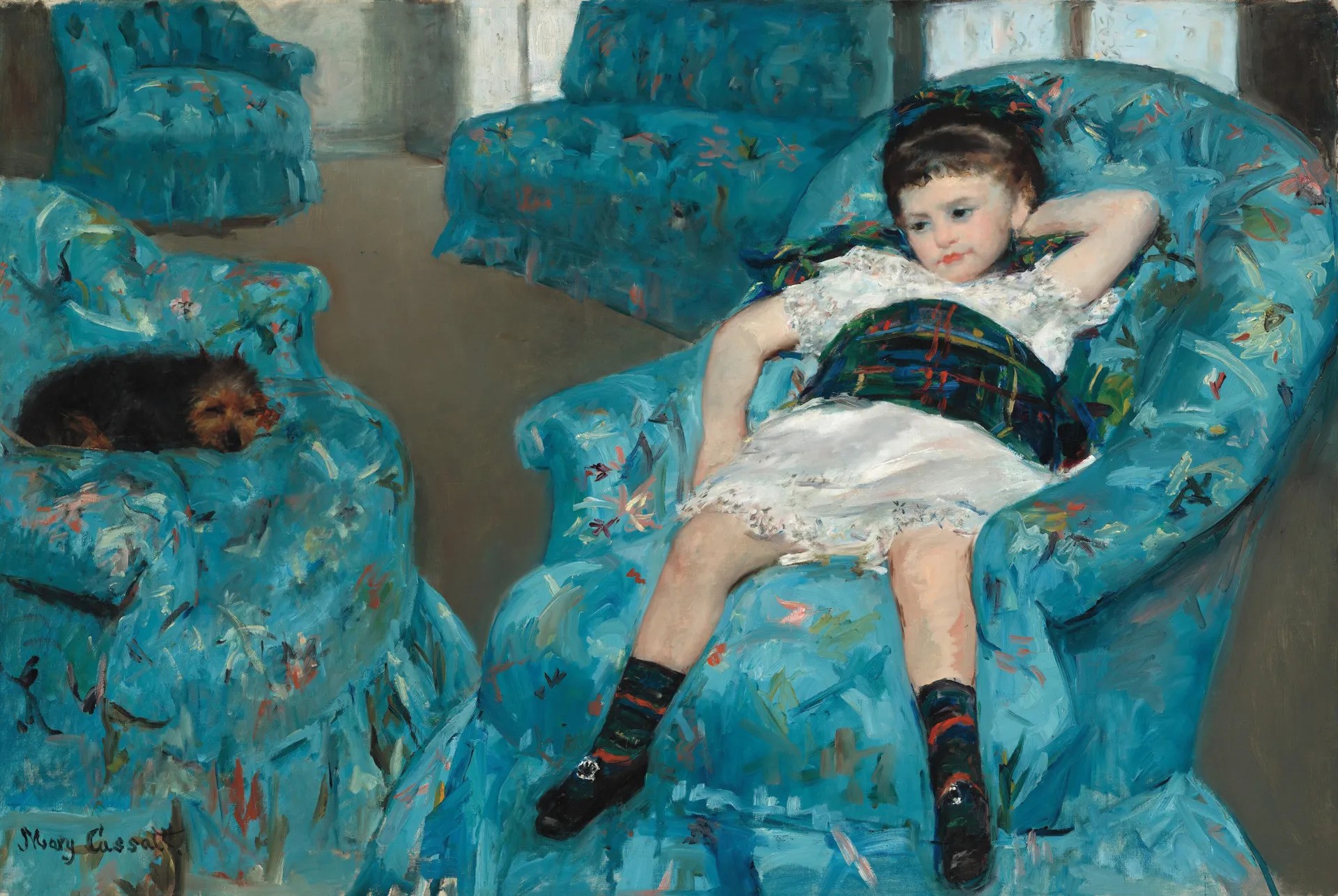
After visiting the Mary Cassatt exhibition at the Philadelphia Museum of Art, I now understand what it looks like to think. Her figures progress from deep thought to blankness and then beyond, reflecting the complexities of introspection. Curators Jennifer A. Thompson and Laurel Garber aimed to present a closer look at who Cassatt was, how she wished to be remembered, and the legacy of her seemingly serene paintings by focusing on her process. Cassatt was obsessed with her work, striving tirelessly to achieve the casual auras of light, glimmering colors, modern movement, and the private pensiveness of her women and children.
Cassatt’s paintings convey simplicity—a playful green here, a girl in a buggy there—but the exhibition reveals her method was anything but simple. Her art involved an arduous struggle for maximal directness, akin to the efforts of Marguerite Duras, Yasujiro Ozu, and Clarice Lispector. Cassatt achieved this by changing mediums, experimenting with colors, and focusing on seemingly trivial subject matter, exploring it from every angle. She also mastered the art of printing, as shown by her vibrant aquatints and delicate drypoints in the "Set of Ten" (1891), inspired by Japanese woodblocks, depicting Parisian women in everyday activities like bathing and caretaking.
Surrounded by many Cassatt works—little Françoise reading, ladies at their toilette, boys embraced by loving arms, two girls peering into an invisible map—you grasp what it means to paint with levity. This does not trivialize her subjects; children, opera boxes, and quiet afternoons are not light topics. Over the years, Cassatt has been labeled in ways that seldom capture the depth of her canvases: “Impressionist,” “woman painter,” “American,” “upper-middle-class white,” “sentimentalist,” “suffragette.” These labels, while true, do not convey the intensity of her struggle to capture the perfect shade of raspberry pink or the subtle mourning black in Portrait of Madame J (1883), where grief is concealed behind a veil and still, bleary eyes.
Cassatt’s dedication to her work—which includes physical labor and the hard work of noticing—is distinct. She meticulously observed the expressions and desires of her subjects, differing from Paul Cézanne’s relentless dissatisfaction with his blocky apples or Gustave Courbet’s and Jean-François Millet’s Socialist/Realist portrayals of laborers. Cassatt was captivated by the everyday labor hidden in domestic scenes, such as ensuring a baby’s survival. This labor of attention and love, even if overbearing, is crucial and valuable.
Deborah Solomon, in her New York Times review, claims that Cassatt “belongs to the second tier of Impressionists” and does not share the same exalted status as Degas or Manet. This hierarchical ranking is tiresome and reductive. Arrêt!

The hierarchy of artists that relegates Mary Cassatt to the "second tier" is as tiresome as the simplistic notion that her work merely depicts mothers and children. This viewpoint overlooks the nuanced complexity of her subjects and the depth of her artistic vision. Cassatt, though never a mother herself, masterfully captured the essence of maternal relationships, transcending mere social norms and delving into the profound emotional landscapes of her characters. As an upper-middle-class American and a stockbroker’s daughter, she specialized in portraying the ordinary bourgeois scenes she knew intimately, yet she imbued them with an extraordinary, almost mystical quality.
Cassatt’s work elevates the mundane, much like her contemporaries Henry James and Edith Wharton. She transforms a limited perspective into a rich tapestry of objects and emotions, creating subtle yet powerful rhapsodies that go beyond mere social commentary. Unlike James, who grappled with the neuroses of unraveling complexities, Cassatt embraced the incomplete and the unknown, portraying her thinking women with an assuredness that invites viewers to lose themselves in her pigments and blank spaces rather than in words.

Two paintings exemplify this approach. Françoise in a Round-Backed Chair, Reading (1909) epitomizes meditation. Though not as formally radical as some of her other works, it subtly captures the essence of contemplation. The incomplete details, like the lost book jacket and Françoise's far-off gaze, invite us to wonder what she sees or thinks. This sense of solemn yet playful introspection draws us into a quiet, reflective space.
The Map (1890), a black-and-gray drypoint print, features two girls examining what appears to be a map but is rendered as a single line, making it look like a blank piece of paper or a table. This minimalist approach forces the girls—and the viewers—to decode the map through a shared, calm effort, reflecting Cassatt’s focus on the collaborative and contemplative nature of understanding.
Cassatt's prolific output created numerous mini-worlds, each distinct and inviting. Her works echo Henry James’s advice to place the center of the subject in the young woman’s consciousness, capturing the beautiful difficulty of truly knowing someone. Cassatt’s art allows us to experience the unceasing mystery of faces that cannot be fully understood, evoking a sense of being with someone in their most private moments.
In Cassatt’s world, we lie on the divan, reading, weaving, or simply being, alongside her subjects. We watch them as they meditate on their own thoughts, feeling satisfied with the fragments of their lives she presents. These moments, seemingly mundane, are filled with profound significance, demonstrating the politics of care and the labor of attention and love that Cassatt so masterfully portrays.