Mesmerizing Close-Up Shots Unveil Astonishing Details Concealed within the Sun's Radiance
-
 Loading...
 - Charlotte Reid
- 22 May 2023
- 71 Views
- 0 Like
- 0 Comment
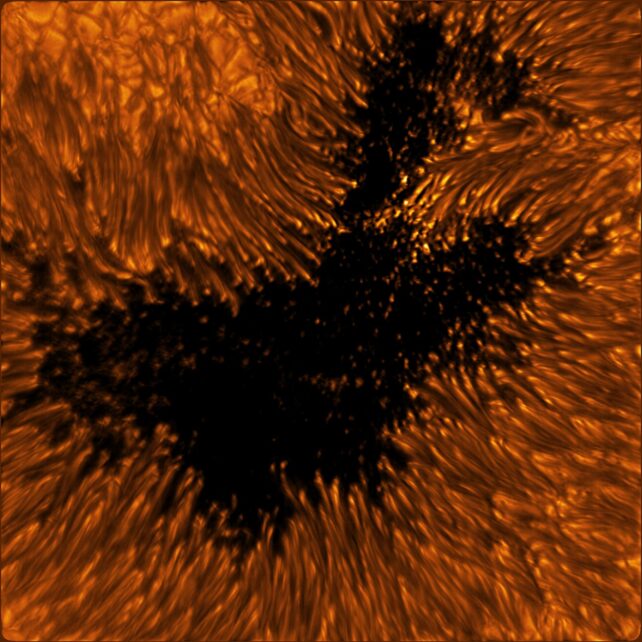
The Earth is now graced with extraordinary and awe-inspiring views of the Sun's surface, thanks to the unveiling of the most colossal and potent solar telescope on the planet. The Daniel K. Inouye Solar Telescope has captured a series of breathtaking images, offering a glimpse into the intricate intricacies of sunspot regions, the turbulent convective cells, and the movement of plasma within the solar atmosphere. These images possess an exceptional resolution, allowing us to discern details as small as 20 kilometers (approximately 12 miles).
At such scales, the plasma formations resemble strokes of a brush or textures on a masterpiece painting. To put it into perspective, a solitary solar convection cell is only slightly smaller, on average, than the state of Texas in the United States.
Yet, these captivating images produced by the Inouye Telescope serve a purpose beyond merely evoking a sense of insignificance in viewers. They provide a tantalizing preview of the scientific discoveries to come, as researchers meticulously analyze the solar surface to unravel the enigmatic processes taking place within.
Sunspots, which often surpass the size of our entire planet, are temporary imperfections characterized by unusually powerful magnetic fields. These regions appear darker than their surroundings due to their relatively lower temperatures. Furthermore, they are associated with the Sun's more violent eruptions: when magnetic field lines become entangled, snap, and reconnect, they unleash tremendous bursts of energy in the form of coronal mass ejections and solar flares.
The activity of sunspots is not constant but rather linked to cycles that occur roughly every 11 years. During these cycles, sunspot and flare activity reaches its peak at solar maximum and diminishes almost entirely during solar minimum. At solar maximum, the Sun's poles undergo a reversal. Presently, we are on track to reach the next solar maximum in 2025, after which solar activity will gradually decrease once again.
The mechanisms driving these solar cycles and the formation of sunspots remain unknown. However, this information holds great significance for us here on Earth. Coronal mass ejections often associated with sunspots can emit colossal clouds of charged particles that collide with Earth's magnetic field, posing various disruptions to our technologically dependent way of life.
The remarkable images captured by the Inouye Telescope display numerous intricate structures associated with sunspots. For instance, within the umbra (the central dark spots), we observe bright patches known as umbral dots. Surrounding the umbra is the penumbra, a brighter region characterized by penumbral filaments, which appear as luminous strands. Occasionally, we encounter solar pores, which resemble sunspots in terms of concentrated magnetic fields but lack the peripheral penumbra. Solar pores form when the necessary conditions for penumbra formation are not met. Moreover, during the decay and disappearance of a sunspot, it may exhibit light bridges crossing its surface—a rare phenomenon to capture.
Even when the Sun appears calm, it is far from featureless when observed in the visible spectrum. The solar surface, or photosphere, is dotted with convection cells, as depicted below. These cells give the photosphere its distinctive "popcorn" texture. Hot plasma rises from the core of each cell, travels to the edges, and then descends as it cools. These convection cells, or granules, are astonishingly vast, reaching diameters of up to 1,600 kilometers (994 miles).
Above the photosphere lies the solar atmosphere, known as the chromosphere. This region is occasionally adorned with delicate, dark threads of plasma resembling brushstrokes or spicules. These filaments, or spicules, exhibit diameters ranging from 200 to 450 kilometers (125 to 280 miles). Erupting from the photosphere, they last for only a few minutes. Although scientists have yet to determine how fibrils are generated, their abundance and consistent alignment provide valuable indications of the complex solar magnetic field.
Scientists anticipate that data from the Inouye Telescope will unravel some of the enduring mysteries surrounding these captivating solar phenomena. Consequently, this knowledge will contribute to a deeper understanding of larger-scale phenomena, including the internal dynamics of the Sun and the driving forces behind solar cycles.
The Inouye Telescope has already begun delivering remarkable results. Earlier this year, scientists unveiled the first-ever observations of solar atmospheric waves within a sunspot.
"Astronomer Thomas Rimmele, the director of the Inouye Solar Telescope, proclaimed last year that there is no other facility comparable to this revolutionary instrument. It now serves as the foundation of our mission to expand our understanding of the Sun, offering cutting-edge observational opportunities to the research community. It is truly a game changer."