Moroccan Beauty Secrets You Can Try at Home
-
 Loading...
 - Nathan Brooks
- 12 Jan 2022
- 620 Views
- 0 Like
- 0 Comment
Morocco lies at a crossroad between Africa, Europe and the Middle East. This North African country is well known for its sumptuous traditional cuisine and diverse wanderlust landscapes, but did you know that people around the world are increasingly interested in Morocco’s centuries-old beauty secrets?
Moroccan women are known to respect and adhere to ancestral beauty traditions using only natural products and treatments. Throughout the ages, they have relied on natural herbs, oils and extracts known for their amazing health and beauty properties.
The Amazigh people, indigenous to Morocco, were the first to utilize various plants and herbal mixtures as beauty remedies and cosmetics. Later the Arabs arrived, bringing their own Middle Eastern beauty traditions by way of ancient trade routes.
The fusion of these influential cultures resulted in creative natural beauty treatments that promote flawless, glowing skin and lustrous, healthy hair. Over time, influences from the Saharan desert, Africa and Europe also became part of Moroccan beauty traditions.
Morocco is home to many trees and plants that provide essential oils, essential waters, and other mixtures for enhancing beauty. Among them are the olive tree, almonds, bitter oranges, roses, lavender, prickly pear, and argan tree.
Perhaps the most famous of these is the argan tree. Argan oil is well known for its anti-aging properties and as a skin and hair treatment, and is widely used and distributed throughout Morocco and now the rest of the world.
Below we’ll take a look at argan oil and other traditional Moroccan beauty secrets you may want to try at home.
Argan Oil – Morocco’s Liquid Gold
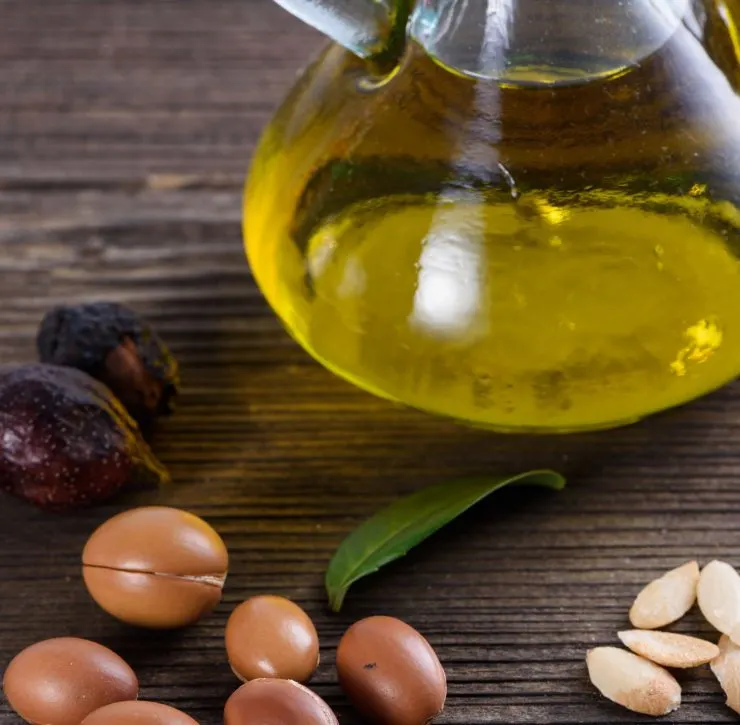
Extracted from the kernel of the fruit of Morocco’s indigenous argan tree (Argania spinosa), argan oil is a natural beauty product that has become famous worldwide. Argan trees primarily grow in the semi desert Sous valley of Southwestern Morocco.
The traditional method of obtaining argan oil is a laborious process. One by one, the pits or “nuts” of the fruit are hit between rocks to reveal the kernels, which are then ground in a stone mill to extract the oil. This painstaking hand extraction process continues at a number of cooperatives in southern Morocco, providing a valuable source of income to local women.
In modern times the oil might be extracted by machine, helping save time and manual labor. Worldwide demand for argan oil is growing rapidly. The size of this market was valued at USD 22.9 million in 2019 and is expected to expand by 10.8% over the next seven years.
How to Use Cosmetic Argan Oil
Argan oil is often called Moroccan “liquid gold” due to its numerous health and beauty benefits. In addition to moisturizing the skin, it can be used to treat multiple conditions including dry skin, eczema, burns and infections.
To use cosmetic argan oil on the skin, all you need is one to two drops as it’s very potent. Simply add the drops to your palm and massage into your face in small, round circular motions. After absorption, your face will feel soft and smooth.
To use on the hair, put a few drops of cosmetic argan oil onto your fingertips, then run your fingers through your hair from the roots to the tips. This will not only help your hair grow, but also treat split ends. Massaging argan oil into the scalp can boost scalp health.
Culinary Argan Oil
Culinary argan oil is obtained by roasting the kernels before extracting the oil. This polyunsaturated oil is deeper in color than the cosmetic oil, has a mild, nutty flavor, and is packed with nutritional benefits and antioxidants.
In Morocco, culinary argan oil is enjoyed as a dip for bread or is drizzled onto food as a finishing oil. It might also be used in tagines or other dishes cooked at low temperature, and it’s a key ingredient in amlou, an almond and honey spread or dip.
Moroccan Black Soap – Sabon Beldi
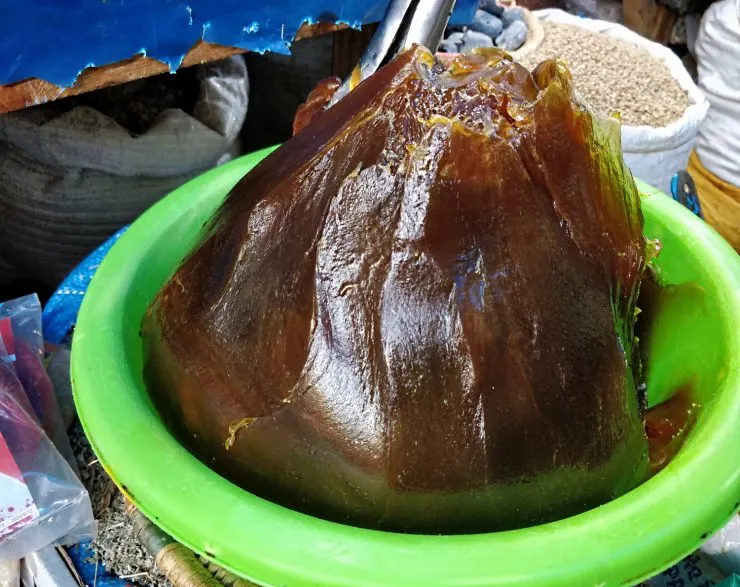
Moroccan black soap (sabon beldi or savon noir) is a brown soft soap made from pureed black olives, glycerol, essential oils and plant extracts. Every region in Morocco has its own exclusive recipe with its own unique additions of plants and oils.
Locals usually buy sabon beldi from Moroccan spice and herb vendors called ‘attars. It’s sold by the dirham or weight, scooped from a tub into a clear plastic bag, and then transferred to a jar or plastic container at home.
More expensive commercial varieties of Moroccan black soap, professionally packaged in jars, can be found in supermarkets and boutiques. The packaged soaps list all the ingredients, whereas the unlabeled bulk soap doesn’t.
How to Use Black Soap to Exfoliate
Moroccan black soap is famously used to help exfoliate the skin. Rich in Vitamin E, it softens the skin and cleanses it while adding moisturizing nutrients. Some versions contain lavender oil, others rose oil; in fact, you can find black soaps containing many different extracts.
Black soap is scooped onto the hand and lathered onto the body. It’s left on for at least a few minutes for maximum benefits, then washed off. Next the body is scrubbed to remove dead skin cells. This leaves the skin glowing, clean and extra smooth and soft.
Other Uses of Savon Noir
While its primary use is to aid in exfoliation, many Moroccans also use black soap for household tasks such as scrubbing and brightening aluminum pots and pans or cleaning marble floors. And, according to French soap maker Le Savonnier Marseilllais, liquid black soap has additional uses including in the garden to prevent aphids or on animals as a natural and gentle shampoo.
Moroccan Hammam – Turkish Bath
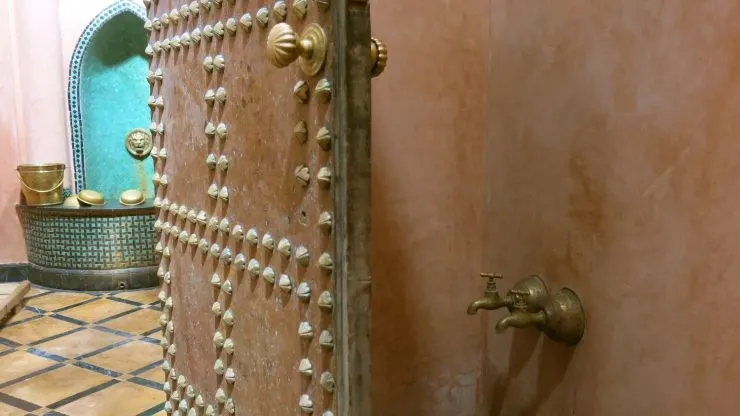
Going hand-in-hand with sabon beldi is the hammam, or Turkish Bath. In Morocco, the hammam is a wood-fueled bathhouse that produces steaming hot water and a sauna-like atmosphere for its visitors, who come to purify their bodies and scrub off dead skin cells on a regular basis.
Traditionally, Moroccans will visit the hammam at least once a week, where they will not only exfoliate their skin, but also gather with friends and socialize while participating in bathhouse cleansing and beauty rituals.
Small neighborhood hammams tend to be modest structures that primarily serve locals. In poorer neighborhoods where some homes may not have hot water, visits to the hammam are necessary for basic bathing.
Larger, modern hammams may offer a more luxurious spa-like atmosphere and cater to wealthier Moroccans, foreign residents and tourists.
A hammam is traditionally built with three open rooms: a hot steam room for heating up the skin; a warm room for scrubbing and exfoliation; and another warm room where bathers rinse before leaving. However, some modern bathhouses may have only one great big steam room.
Men and women always bathe in separate areas or on separate days of the week. Even though Morocco is a very conservative society, people strip down to their undergarments when bathing at the hammam, in full view of fellow patrons. Because the genders are separated, this is culturally not a problem. However, some spas and hammams do offer private steaming and bathing rooms.
What to Expect at a Hammam
If you visit a small neighborhood hammam, you’ll need to bring all your own essentials and personal hygiene products, although some hammams might sell black soap, disposable razors or other toiletries.
Upon entering higher end bath houses, however, first-time visitors may be given the products necessary for a hammam cleanse including an exfoliating glove, a bucket, and some black soap. One must bring their own plastic sandals and perhaps a towel or two, and they will be given a disposable thong if needed in lieu of undergarments.
After wetting and steaming their skin, hammam visitors can pay an attendant a small fee to scrub and exfoliate their entire body, or they may do it themselves. It’s also common that friends or family members will scrub each other’s backs.
Exfoliation is followed by normal bathing, shampooing, grooming and rinsing, then getting dressed and relaxing a while, sometimes with Moroccan mint tea, before venturing outside to return home.
Turkish Bath Exfoliation at Home
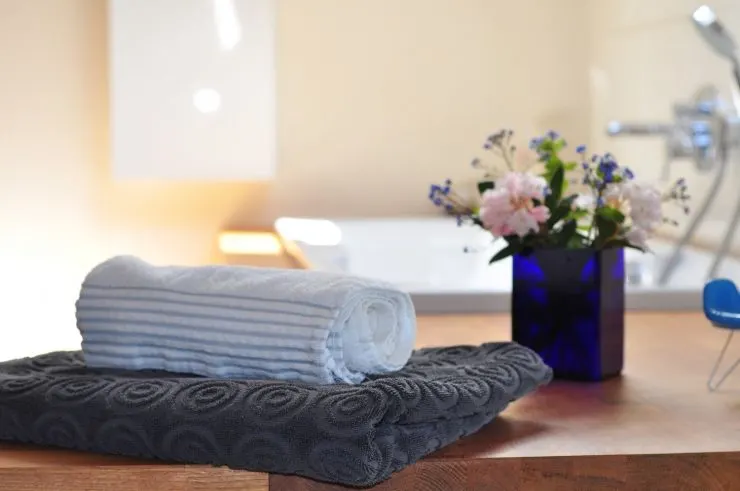
To set up a hammam-like exfoliation at home, you will need an exfoliating glove (kessa or kees), some black soap, a bucket, a small pail or large cup, hot water, and the soap, shampoo and other products that you normally use to shower. A hot, steamy bathroom will help the process along.
First, fill the bucket with water as hot as you can handle. Then, using the small pail, splash your entire body with hot water until you feel that your skin is well-heated.
Next, take some black soap and cover your entire body with it. Leave on for a few minutes, then rinse off.
Now comes the part that foreigners find difficult. Take the exfoliating glove and scrub your entire body. You can start with your arms, a section at a time. Hold the glove firmly to your skin, then maintain that pressure as you rub up and down, repeating several times until you see some gray dead skin rolling off.
This might feel a little rough, but it’s the only way to remove those layers of dead skin. After scrubbing your upper then lower arms, start at the neck then work down, scrubbing your chest, stomach, sides, buttocks, and down each leg. Rinse frequently while you’re doing this.
After your whole body has been exfoliated and is completely clean of dead skin, give it a final rinse with warm water. You can then shampoo your hair, shave your legs, and do all the other self-care rituals that you normally do while bathing.
After the skin exfoliation, when you dry off and get dressed, you will feel like your skin is unbelievably clean, smooth and super exfoliated. You might also feel a bit drained of energy. This is normal after a long, steamy hammam experience. Read More…