Muons reveal the inner worlds of pyramids, volcanoes and more
-
 Loading...
 - Badria Hadid
- 20 Jun 2022
- 235 Views
- 0 Like
- 0 Comment
Inside Egypt’s Great Pyramid of Giza lies a mysterious cavity. This void has never been seen by any human alive today. Its surface is untouched by modern hands. Luckily, scientists are no longer limited to human senses.
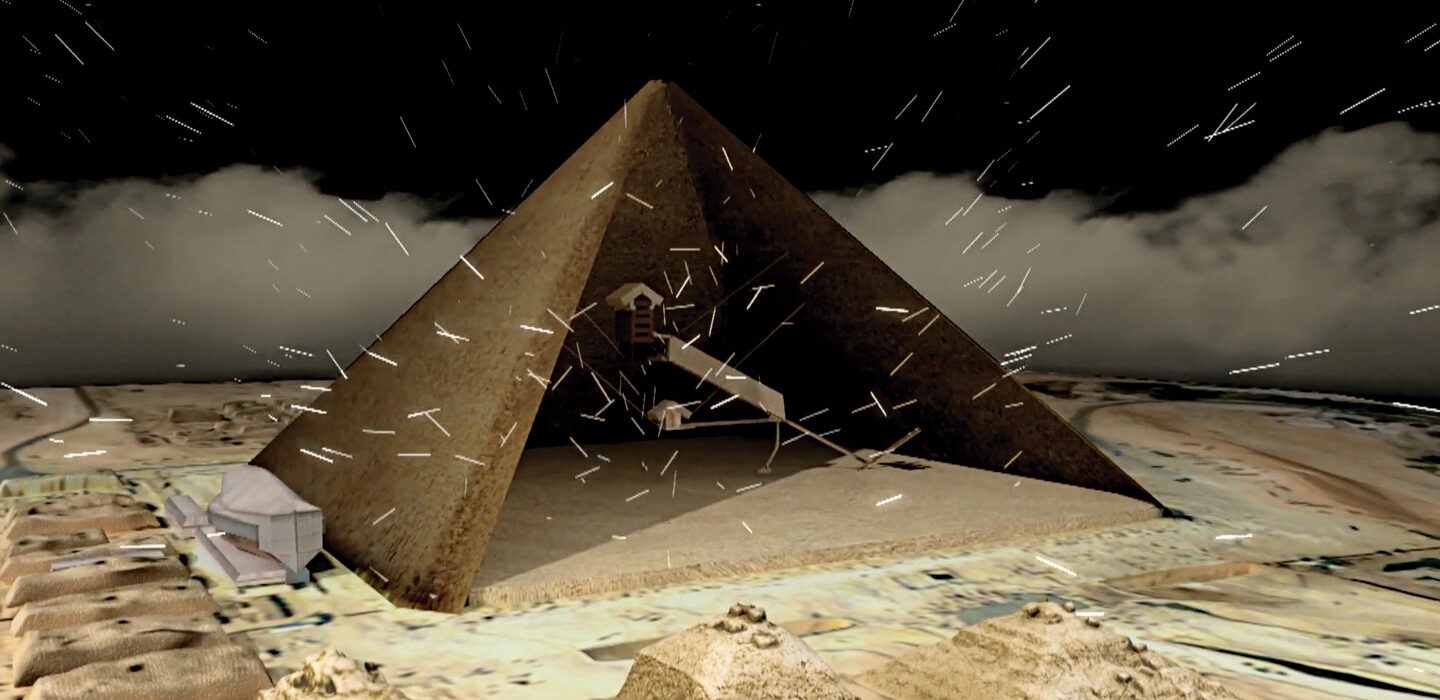
To map out the pyramid’s unexplored interior, scientists tracked tiny particles called muons. Those subatomic particles are born high in Earth’s atmosphere.
From there, the muons hurtle toward the ground. Along the way, some have burrowed through the pyramid. Some of these particles left clues to their journey on sensitive detectors in and around the pyramid.
That stunning find inspired physicists to explore other ancient structures the same way. The technique is now called muography (Mew-AW-gruh-fee). Some researchers are using it to map the inner plumbing of volcanoes. “You can see inside the volcano,” says Giovanni Leone. He’s a geophysicist at Universidad de Atacama. It’s in Copiapó, Chile. Such images could signal how and when a volcano is likely to erupt.
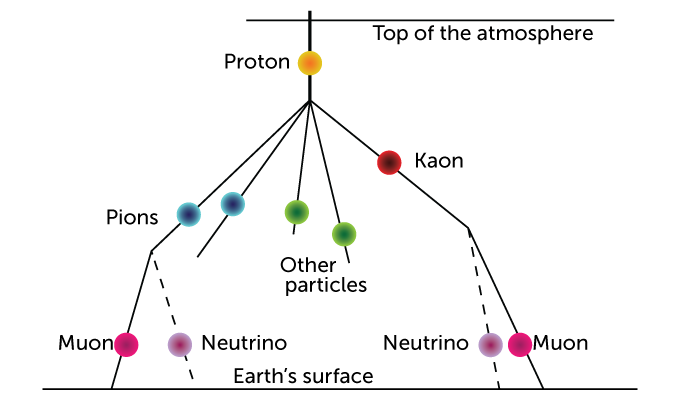
Muons form when high-energy particles from space — cosmic rays — crash into Earth’s atmosphere. Their smashups high in Earth’s atmosphere create a constant shower of muons. They rain down at various angles everywhere on Earth’s surface. Scientists are now looking to use them to peer inside structures anywhere and everywhere.
When the muons reach Earth’s surface, they tickle the insides of large structures. Such as those pyramids. (They zip through smaller stuff too. Your thumbnail is pierced by a muon about once a minute.) Measuring how many muons something absorbs as they pass through it can reveal how dense the structure is. That, in turn, can expose any hidden gaps in the material.
The technique is sort of like taking a huge X-ray, explains Mariaelena D’Errico. But “instead of X-rays, we use … a natural source of particles.” That is, Earth’s very own, never-ending supply of muons. D’Errico is a particle physicist. She works at the National Institute for Nuclear Physics in Naples, Italy.
In the past, physicists studied cosmic rays to better understand outer space. But muography turns this tradition on its head. It uses these cosmic particles to learn more about concealed parts of our own world.
For the most part, “particles arriving from the universe have not been applied to our regular lives,” says Hiroyuki Tanaka. This particle physicist at the University of Tokyo and others are trying to change that.
A particle like no other
Muons are like the awkward cousins of electrons. Like electrons, they carry a negative electric charge. But muons are much heavier than electrons. And, unlike electrons, they don’t play a key role in atoms. In fact, when muons were first discovered, physicists wondered why these strange particles existed at all.
Muons, it turned out, are ideal for imaging the insides of large objects. A muon’s mass is about 207 times as large as an electron’s. That extra bulk means muons can pass through hundreds of meters of rock or more. If an electron passes through matter like a bullet, a muon tears through like a cannonball. A wall may stop a bullet, while a cannonball can pass through.
Another upside of muons: They are plentiful. They rain from the sky everywhere, all the time. So muon imaging needs no artificial radiation beam, such as the one produced by that X-ray machine in a doctor’s office. Muons “are for free,” says Cristina Cârloganu. This particle physicist works at CNRS and the National Institute of Nuclear and Particle Physics. She’s based in Aubière, France.
“They’re also very easy to detect,” says Richard Kouzes. He’s a nuclear physicist. He works at the Pacific Northwest National Laboratory in Richland, Wash. A simple detector made of plastic strips and light sensors can pick up muons. Other detectors need little more than special photographic film. Such instruments can detect both muons and their antiparticles. “Antimuons” are like muons, but carry a positive charge. They, too, shower down on Earth from high in the atmosphere.
When muons and antimuons pass through an object, they lose energy in various ways. One is by colliding with electrons in the material. That energy loss slows the particles. Sometimes they even stop. The denser the material, the fewer muons and antimuons that make it through to a detector under or next to the material.
Large, very dense objects — such as volcanoes or pyramids — will cast a muon shadow. Any gaps within those structures appear as bright spots within the shadow (because more particles slipped through). Inspecting such dappled shadows can open a vista into hidden worlds.
Probing pyramids
Muography first proved itself in a pyramid. In the 1960s, a team led by physicist Luis Alvarez hunted for hidden chambers in Khafre’s pyramid in Giza. This monument is a slightly smaller neighbor of the Great Pyramid. Detectors found no hint of unexpected rooms. The search did, however, prove the technique works.
Still, its use took didn’t take off right away. Muon detectors of the era tended to be bulky. And they worked best in well-controlled labs. To spot muons, Alvarez and his team used detectors called spark chambers. These chambers are filled with gas and metal plates under high voltage. When charged particles such as muons pass through, they create trails of sparks.
Today tech has largely replaced spark chambers. “We can make very compact, very sturdy detectors,” says Edmundo Garcia-Solis. He’s a nuclear physicist Chicago State University in Illinois. One type of detector that works outside the lab contains a type of chemical known as a scintillator. It emits light when a muon or other charged particle passes through it. Electronics then capture and measure that light.
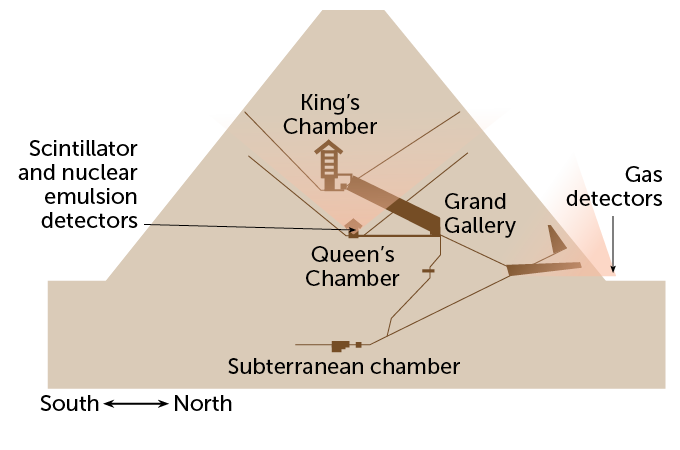
This year, physicists will use these detectors to take another look at Khafre’s pyramid. Kouzes and his colleagues announced their plan February 23 in the Journal for Advanced Instrumentation in Science. Their detector is small enough to fit inside two large carrying cases. Once inside the pyramid, it can be run with a laptop.
A nuclear emulsion film was key to finding the Great Pyramid’s hidden void in 2017. As muon detectors go, this muon detector is pretty low maintenance. It uses a special type of film to record the tracks as muons pass through. Researchers left detectors sitting in and around the pyramid. Later, they brought those films back to a lab to study the particle tracks they had recorded. Read More...