New advances in the search for molecular magnets
-
 Loading...
 - ollie darcie
- 07 Jul 2022
- 121 Views
- 0 Like
- 0 Comment
The current demand for the exchange and manipulation of data through information technologies, caused by the massification of electronic devices, has led scientists to reflect about more efficient computation methods. Storing information in binary systems works by switching between two stable states under ambient conditions, by applying a stimulus. A new model of spin electronics (spintronics), based on the orientation of electron spins to store binary information, allows for non-volatile memory, increased processing speeds, lower energy consumption and lower integration densities.
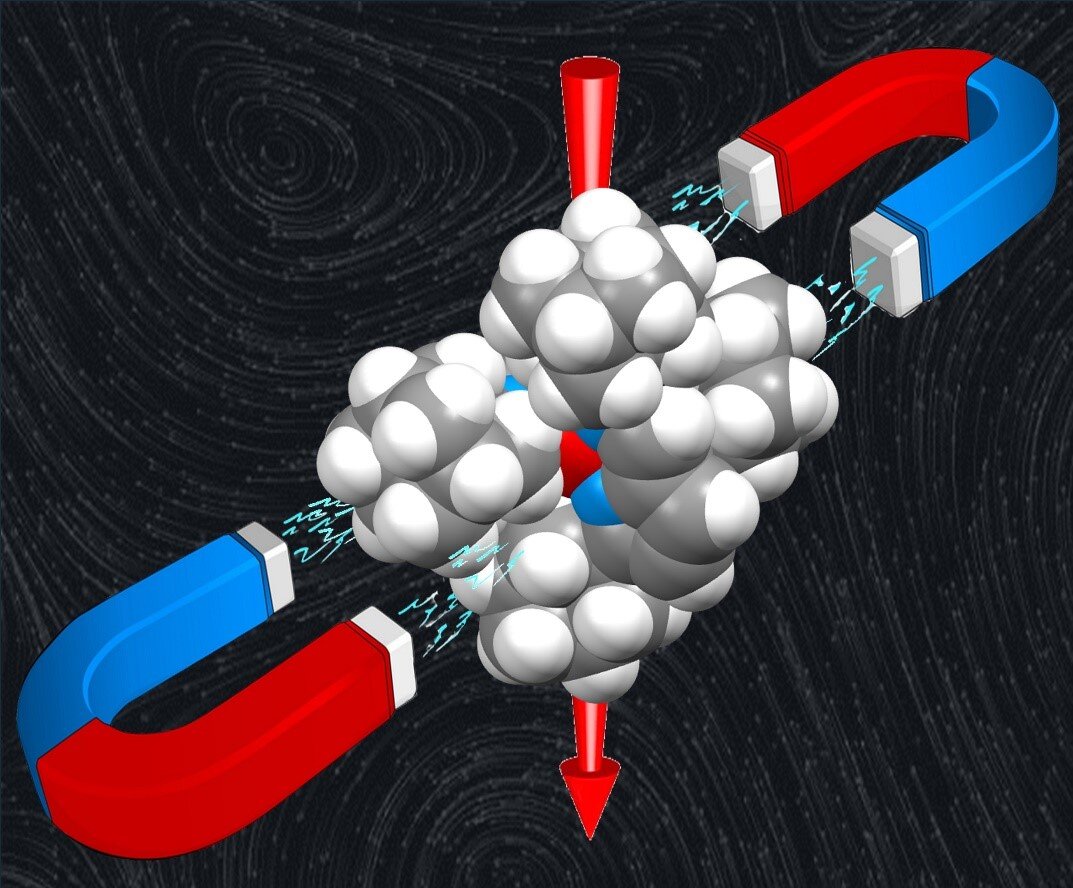
A research team from the University of Lisbon (Portugal) and the University of Stuttgart (Germany) have studied a series of cobalt molecules that can switch between two magnetic states, albeit at low temperatures. These molecules that exhibit magnetic bi-stability are called molecular magnets, and characterization techniques such as high-field electronic paramagnetic resonance allow the evaluation of the response capabilities that these materials exhibit in the face of magnetic fields.
Based on previous work by the research team on cobalt complexes, which had been hitherto unexplored for this application, computational studies on atomistic models were carried out to provide the physical origin of their properties and yield a rationale to optimize their performance. The results now published employ characterization techniques such as high-field electronic paramagnetic resonance that allow for the evaluation of the response capabilities that these materials exhibit in the face of magnetic fields.
Nuno Bandeira, member of the research team and researcher at Faculty of Sciences of the University of Lisbon (Portugal), says:
“There are currently two ‘battle fronts’ with regards to research of single molecule magnets: one of them handles research with lanthanide complexes. And indeed, one may obtain gigantic magnetization reversal barriers from them. But lanthanides are costly to produce. The other research front handles first row transition metals which are cheaper to obtain but the magnetization barriers are much smaller, which means they can only function adequately at very low temperatures. Ideally one would like to attempt to obtain a single molecule magnet that operates at room temperature”. Read More…