New laser lightning rod to deflect lightning over several dozen meters
-
 Loading...
 - gabriel phoebe
- 02 Feb 2023
- 63 Views
- 0 Like
- 0 Comment
This experimental breakthrough will lead to progress in lightning protection and lightning physics.
Lightning discharges between charged clouds and the Earth’s surface are responsible for considerable damages and casualties. It is, therefore, important to develop better protection methods in addition to the traditional Franklin rod.
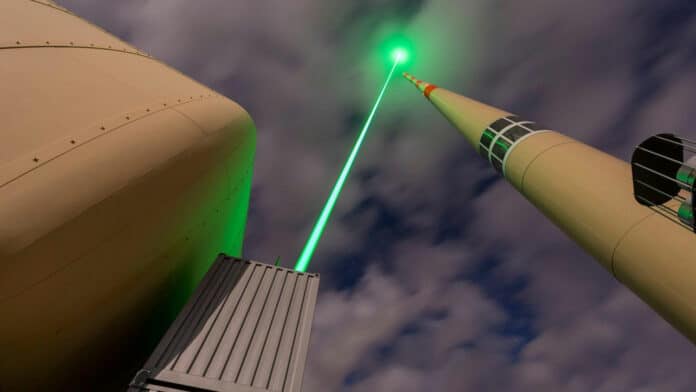
A European consortium consisting of the University of Geneva (UNIGE), École Polytechnique (Paris), EPFL, the School of Engineering and Management HEIG-VD, and TRUMPF scientific lasers (Munich) has developed a promising alternative: the Laser Lightning Rod or LLR. This laser lightning rod can deflect lightning over several dozen meters, even in poor weather.
The LLR was used to direct lightning along its beam by producing channels of ionized air, which is electrically conductive, using strong laser pulses. By extending upward from a conventional lightning rod, it might essentially increase both the height and surface of the area it shields.
A new laser with an average power of one kilowatt, a pulse energy of one joule, and a pulse duration of one picosecond was created as part of the LLR project. The rod is 8 meters long, 1.5 meters wide, and more than 3 tonnes in weight. It was created by TRUMPF Scientific Lasers.
The terawatt laser of the LLR was tested on Säntis’ top (2,502 meters above sea level), close to a Swisscom communications tower that is 124 meters tall, and it was outfitted with instruments by EPFL and HEIG-VD / HES-SO to observe lightning. The tower experiences lightning strikes roughly 100 times a year and is one of Europe’s lightning hotspots. Read More…