French aristocrat's golden dental secret revealed 400 years on
-
 Loading...
 - Gretel Meier
- 02 Feb 2023
- 68 Views
- 0 Like
- 0 Comment
Scientists have discovered the long-buried secret of a 17th-century French aristocrat 400 years after her death: she was using gold wire to keep her teeth from falling out.
The body of Anne d'Alegre, who died in 1619, was discovered during an archaeological excavation at the Chateau de Laval in northwestern France in 1988.
Embalmed in a lead coffin, her skeleton -- and teeth -- were remarkably well preserved.
At the time the archaeologists noticed that she had a dental prosthetic, but they did not have advanced scanning tools to find out more.
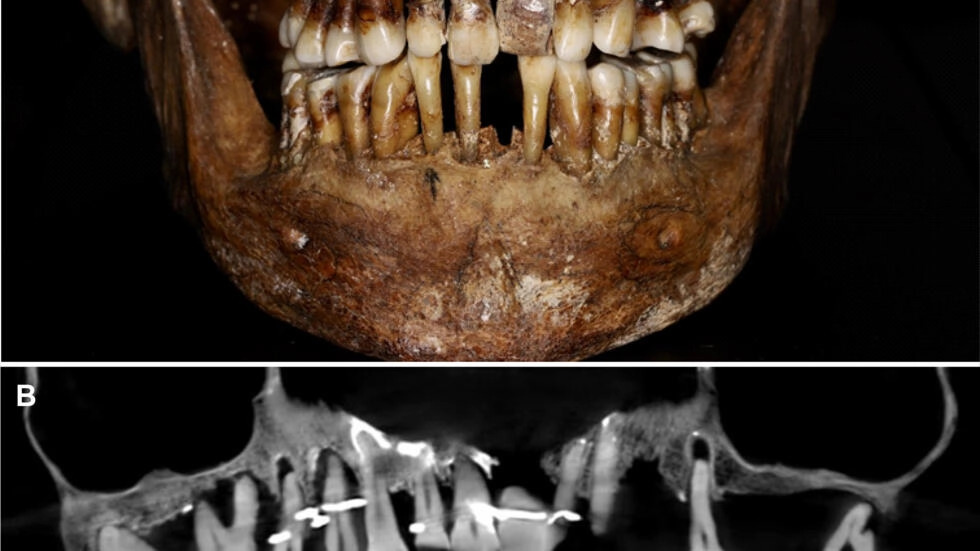
Thirty-five years later, a team of archaeologists and dentists have identified that d'Alegre suffered from periodontal disease that was loosening her teeth, according to a study published in the Journal of Archaeological Science: Reports this week.
A "Cone Beam" scan, which uses X-rays to build three-dimensional images, showed that gold wire had been used to hold together and tighten several of her teeth.
She also had an artificial tooth made of ivory from an elephant -- not hippopotamus, which was popular at the time.
But this ornate dental work only "made the situation worse", said Rozenn Colleter, an archaeologist at the French National Institute for Preventive Archaeological Research and lead author of the study.
The gold wires would have needed repeated tightening over the years, further destabilising the neighbouring teeth, the researchers said.
D'Alegre likely went through the pain for more than just medical reasons. There was huge pressure on aristocratic women at a time when appearance was seen as related to value and rank in society.
Ambroise Pare, a contemporary of D'Alegre's who was the doctor for several French kings and designed similar dental prosthetics, claimed that "if a patient is toothless, his speech becomes depraved", Colleter told AFP.
A nice smile was particularly important for d'Alegre, a "controversial" twice-widowed socialite "who did not have a good reputation," Colleter added. Read More…