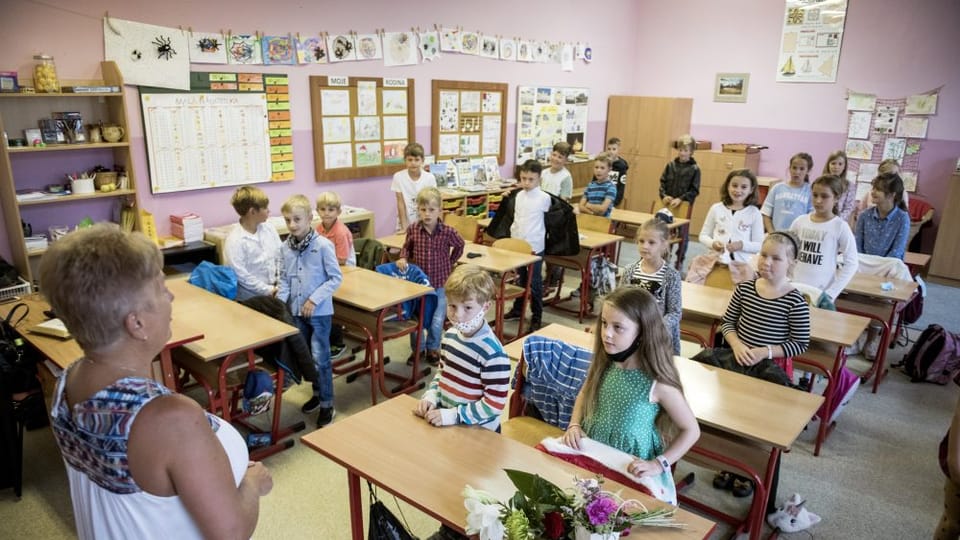
New study points to “feminisation†of Czech education system after 1989
-
 Loading...
 - Francesco Ricci
- 13 Jul 2022
- 114 Views
- 0 Like
- 0 Comment
During the 1990s the Czech teaching cohort became more “feminised” as large numbers of male teachers opted to leave the profession and pursue a career elsewhere, according to a new study conducted by the CERGE-EI think-tank at the Czech Academy of Sciences. To find out why this happened. and what it means for the Czech education system, I spoke to one of the authors of the study, Filip Pertold.
“In the study we observe that the share of female teachers has been increasing over the period of several generations and that there was a particular increase during the 1990s when there was a transformation from central planning to a market economy.
“This didn’t just happen in the Czech Republic but in the whole Central European region, because the returns to education increased a lot and that means that university educated workers were very scarce at the time.
“It was especially males who were disappearing from the profession during this period, because they saw that they could earn better wages in different professions.
“Females, on the other hand, seem to be staying in the teaching profession during this period. That is what we observed in the data.
“Otherwise, the rate of teachers exiting the profession is roughly the same as it is in other regions of Europe, except perhaps for Southern Europe where labour market turnover is generally lower.”
Is there any reason why you think this trend applied less to women? Was it because of old gender roles, or something else?
“Well, what is happening in the teaching profession, but is also happening elsewhere, is that if someone exits the profession it generally happens at the beginning of their career. That means within the first two or three years following graduation.
“Based on the data we have, it looks like females are more fixed to the profession.
“There is also this social norm that males should ‘feed the family’, something quite common in this region.
“In any case, it seems to me that male teachers basically switched professions to earn more money somewhere else because there were a lot of opportunities to do this.” Read More...