Nikos Kazantzakis: The Greatest Greek Writer of the 20th Century
-
 Loading...
 - Minna Virtanen
- 23 Jun 2022
- 164 Views
- 0 Like
- 0 Comment
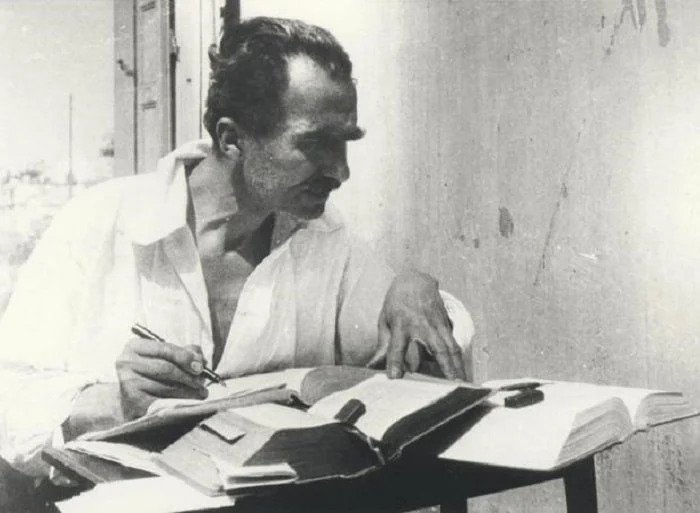
Nikos Kazantzakis is considered by many the greatest Greek writer of the 20th century, and his books have been translated more so than any of his contemporaries.
The Cretan man’s literary genius was recognized posthumously after his book Zorba the Greek was created into an award winning film in 1964.
If Kazantzakis’ work is to be described in one word, it would be a Greek word, of course, and that is pathos.
The writing of the great writer is passionate, raw, rebellious, unpredictable, and often mystical—much like Crete itself.
His life was as exciting as his books. He was a novelist, poet, playwright, journalist, philosopher, and politician, and he lived in several European cities.
Early life of the great Cretan
Nikos Kazantzakis was born on February 18, 1883 in Heraklion, Crete, which at that time was still part of the Ottoman Empire.
His father, Michalis, was a trader in agricultural products and came from Varvaroi, where the Kazantzakis Museum is located today.
After completing his high school studies in his hometown and Naxos in 1902, he moved to Athens to study Law.
In 1906, he appeared for the first time in Greek letters with the essay “The Disease of the Century” and his first novel Ofis and Krinos.
In 1907, Kazantzakis began his postgraduate studies in law in Paris. At the same time, he attended lectures by existentialist philosopher Henri Bergson and studied Friedrich Nietzsche’s work. Both philosophers exerted a tremendous influence on him for the rest of his life.
In the same year, he began his journalistic career and became interested in Freemasonry; he was soon to be initiated into that group.
In 1909, upon his return to Greece, Kazantzakis published his doctoral dissertation, called “Frederick Nietzsche in the Philosophy of Law and the State.”
At the time, he was earning a living translating books and lived with his compatriot intellectual, Galatia Alexiou, whom he later married.
The writer participated in the movement for the establishment of the Educational Club, the most important pressure group for the establishment of demotic Greek in education.
In 1914, he became friends with the poet Angelos Sikelianos. Together, they traveled to Mount Athos, where they stayed for about forty days while touring many other parts of Greece.
During this period, he was introduced to the work of Dante, whom he described as one of his teachers, along with Homer and Henri Bergson, in his diaries. He and Sikelianos even dreamed of creating a new religion.
In October 1916, Kazantzakis took his first business step. He traveled to Thessaloniki to sign a contract for the collection of timber from Mount Athos.
The next year, he tried to exploit a lignite mine in the Peloponnese and hired a worker named Georgios Zorbas. Their acquaintance was the inspiration for the novel Life and Times of Alexis Zorbas.At the same time, he translated Dante’s Divine Comedy and wrote some of the odes that were later incorporated into Tertsines (1960).
In 1935, he traveled to Japan and China, enriching his travel texts while as a correspondent for Kathimerini he covered the Spanish Civil War (1936).
In 1938, Kazantzakis completed The Odyssey: A Modern Sequel, consisting of a total of 33,333 verses and 24 rhapsodies. Kazantzakis spent almost fourteen years working on its completion after he revised it eight times.
The poem begins with the return of Odysseus to Ithaca, an unsatisfied hero who was still wandering, trying to achieve “full freedom.”
Kazantzakis wanted to write an epic of modern man, so he considered the Odyssey as his most important work.In 1918, Kazantzakis met and fell in love with Elli Lampridi, a brilliant educator, philosopher, and active feminist.
The restless mind of Nikos Kazantzakis
From early on in his youth, Kazantzakis’ soul was restless. He was tormented by anxiety and metaphysical and existential agony, as the scholars of his work emphasize.
Religious concerns haunted the mind of the unbelieving Nietzschean thinker. He especially dwelled on the figure of Christ, “this union, so mysterious and so real, this union of man and God,” he observed.
This union followed Kazantzakis throughout his life as an obsession, evidenced by his writing until the end. He was also fascinated by the lives of saints.
During a break from writing, Kazantzakis became involved in politics. Prime Minister Eleftherios Venizelos appointed him General Director of the Ministry of Health in 1919 with the mission of repatriating Greeks from the Caucasus region.
The experience was used much later in the novel Christ Recrucified (know as The Greek Passion in the U.S.) with the theme being a representation of the Passion of Christ in a Greek village.
The following year, after the defeat of Venizelos’ Liberal Party in the election, Kazantzakis left the Ministry of Health and made several trips to Europe, starting his own Odyssey around the world.
In 1922 he visited Vienna, where he discovered the work of Sigmund Freud work and Buddhism. He also visited Germany, while in 1924 he stayed for three months in Italy.
In Berlin, Kazantzakis was introduced to Communist ideas and became an admirer of Vladimir Lenin. Yet he never became a loyal communist. At that time his nationalist ideals were replaced by a more internationalist ideology.
During the 1923-1926 period he also made several journalistic trips to the Soviet Union, Palestine, Cyprus and Spain, where he met dictator Miguel Primo de Rivera.
During that period, he worked as a correspondent for the newspapers Eleftheros Logos and Kathimerini. In 1924, Kazantzakis met Eleni Samiou and divorced his wife, Galatia, in 1926.
In May of 1927, he isolated himself on Aegina Island in order to complete his most ambitious work, The Odyssey: A Modern Sequel, an epic poem in the style of Homer’s Odyssey.
In the same year, he started the anthology of his travel articles for the publication of the first volume (Traveling) while the magazine of Dimitris Glinos, called Renaissance, published his philosophical work Asceticism.
The latter is one of the most important texts of Kazantzakis and one in which he expresses his metaphysical beliefs. He considered Asceticism as the seed of all his later work.
On January 11, 1928, he he gave a speech in Athens about the Soviet Union, praising the Soviet model.
Both Kazantzakis and co-organizer Dimitrios Glinos were prosecuted for organizing the speech at the Alhambra Theater, which ended in an open demonstration, but their trial was never held.
In April, Kazantzakis returned to Russia, where he completed a screenplay on the Russian Revolution.
In May of 1929, he isolated himself on a farm in Czechoslovakia, where he completed the novels Toda Raba and Kapetan Elias, a forerunner of Captain Michael. Both works were written in French.
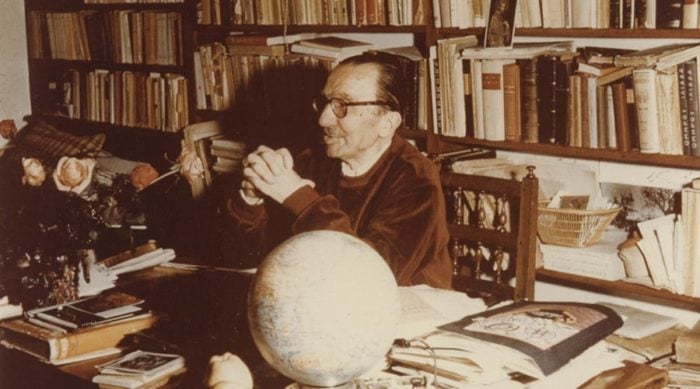
These works were part of Kazantzakis’s effort to gain international recognition as a writer. Toda Raba was released under the pseudonym Nikolai Kazan.
In 1931, Kazantzakis returned to Greece and settled in Aegina once again, where he undertook the writing of a French-Greek dictionary in order to cover his living expenses.
At the same time, he translated Dante’s Divine Comedy and wrote some of the odes that were later incorporated into Tertsines (1960).
In 1935, he traveled to Japan and China, enriching his travel texts while as a correspondent for Kathimerini he covered the Spanish Civil War (1936).
In 1938, Kazantzakis completed The Odyssey: A Modern Sequel, consisting of a total of 33,333 verses and 24 rhapsodies. Kazantzakis spent almost fourteen years working on its completion after he revised it eight times.
The poem begins with the return of Odysseus to Ithaca, an unsatisfied hero who was still wandering, trying to achieve “full freedom.”
Kazantzakis wanted to write an epic of modern man, so he considered the Odyssey as his most important work. Read More...