Oregon State develops catalyst that purifies herbicide-tainted water and produces hydrogen
-
 Loading...
 - elliot aria
- 07 Mar 2023
- 61 Views
- 0 Like
- 0 Comment
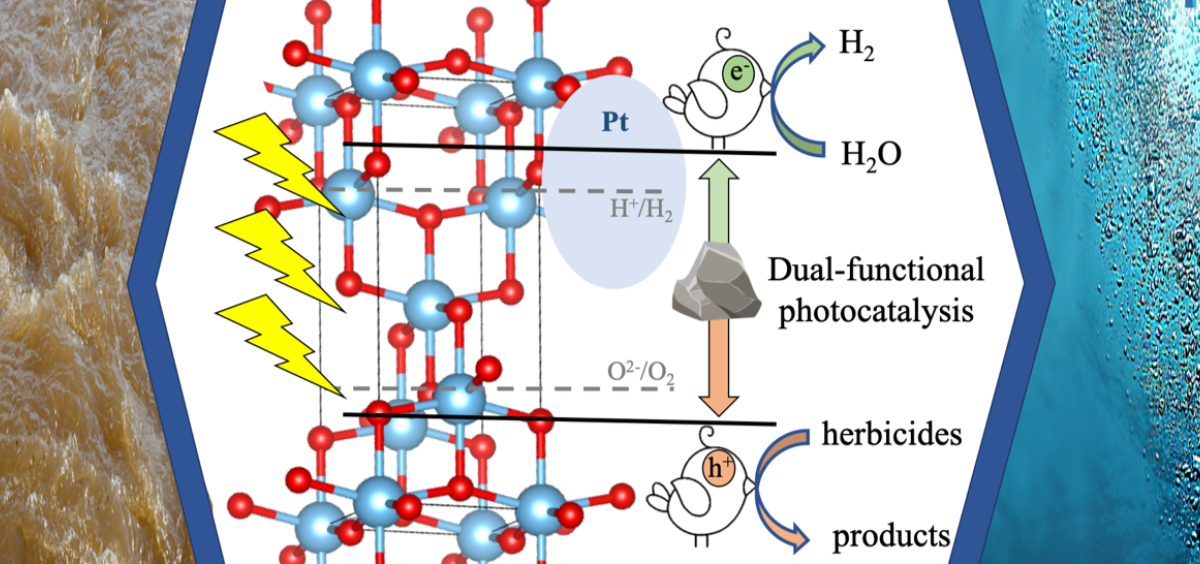
Researchers in the Oregon State University College of Science have developed a dual-purpose catalyst that purifies herbicide-tainted water while also producing hydrogen.
The project, which included researchers from the OSU College of Engineering and HP Inc. is important because water pollution is a major global challenge, and hydrogen is a clean, renewable fuel.
Findings of the study, which explored photoactive catalysts, were published today in the journal ACS Catalysis.
“We can combine oxidation and reduction into a single process to achieve an efficient photocatalytic system,” OSU’s Kyriakos Stylianou said. “Oxidation happens via a photodegradation reaction, and reduction through a hydrogen evolution reaction.”
A catalyst is a substance that increases the rate of a chemical reaction without itself undergoing any permanent chemical change.
Photocatalysts are materials that absorb light to reach a higher energy level and can use that energy to break down organic contaminants through oxidation. Among photocatalysts’ many applications are self-cleaning coatings for stain- and odor-resistant walls, floors, ceilings and furniture.
Stylianou, assistant professor of chemistry, led the study, which involved titanium dioxide photocatalysts derived from a metal-organic framework, or MOF.
Made up of positively charged metal ions surrounded by organic “linker” molecules, MOFs are crystalline, porous materials with tunable structural properties and nanosized pores. They can be designed with a variety of components that determine the MOF’s properties. Read More…