Painting of Saint Sargis Displayed at the National Gallery of Armenia
-
 Loading...
 - Luna Alfaro
- 10 Mar 2025
- 40 Views
- 0 Like
- 0 Comment
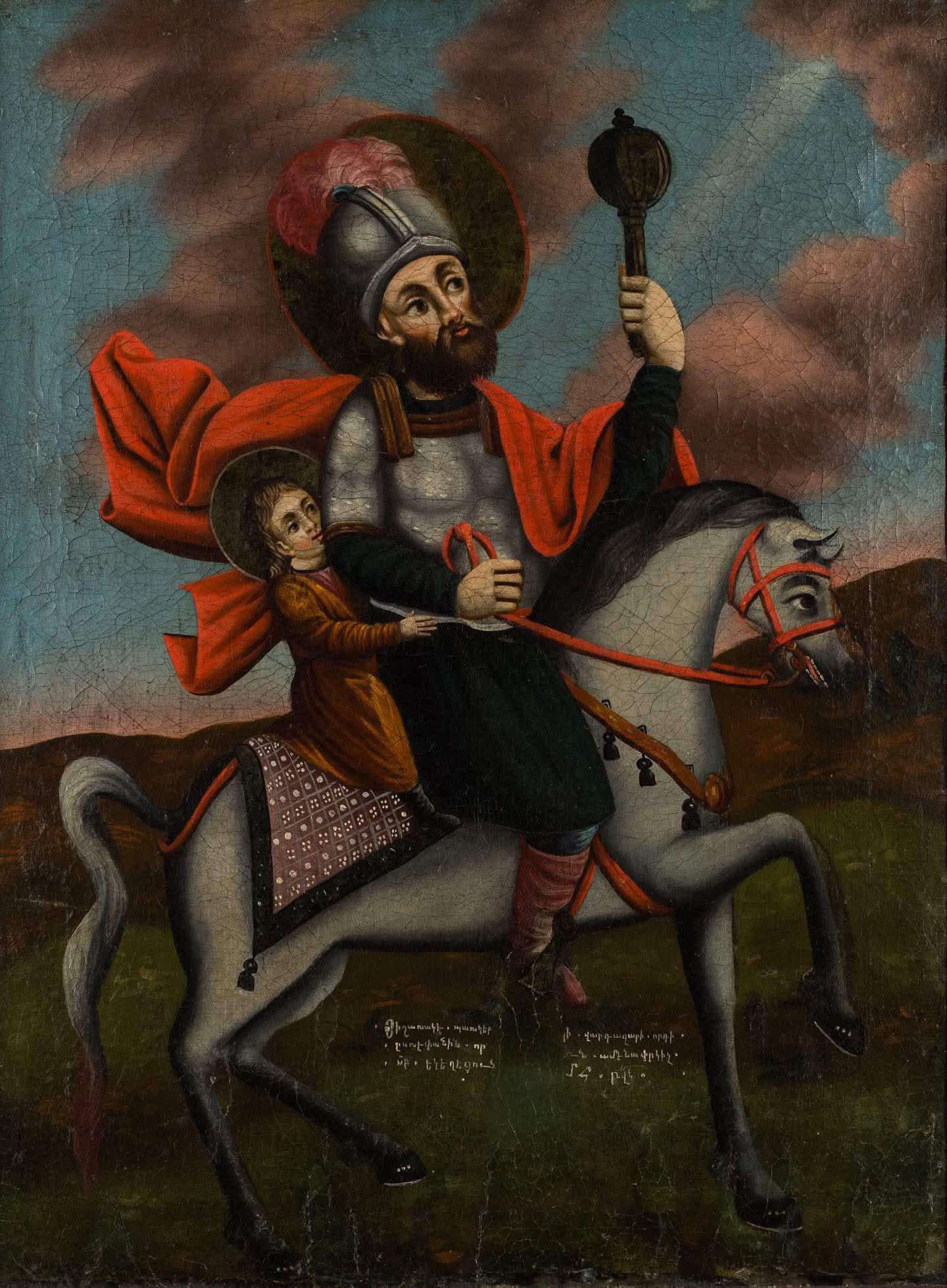
The National Gallery of Armenia is currently showcasing a captivating painting of Saint Sargis, created by an unknown Armenian artist in the 19th century. This artwork depicts Saint Sargis the General (285-337 A.D.), a revered figure in the Armenian Church, alongside his son Martiros, who, along with 14 soldiers, was martyred for their Christian faith. The relics of Saint Sargis were transported to Armenia by Saint Mesrop Mashtots and buried in the village of Karbi, where a church was later built in his honor.
The painting was transferred to the National Gallery from Karmravor Church in the Ashtarak province. Father Shahe Hayrapetyan, the head priest of the Saint Sargis Cathedral in the Araratian Pontifical Diocese, noted that a prototype of this painting can also be found at Saint James Cathedral in Jerusalem’s Armenian Quarter. He described the artwork as part of late medieval iconography, which has historically adorned Karmravor Church, where murals of Saint Sargis are also present.
Father Hayrapetyan highlighted the cultural significance of Saint Sargis, particularly among young people who seek his blessings for newlyweds. He mentioned that legends often depict Saint Sargis as a swift figure who unites couples despite societal taboos, symbolizing the divine love he shares.
Art scholar Knarik Avetisyan, who has studied the painting for years, explained that images of soldier saints began to emerge in medieval art during the fifth and sixth centuries, with Saint Sargis being one of the most beloved. She noted that certain episodes in his biography, including the depiction of his martyred son Martiros, are unique to Armenian sources. These early iconographic traditions have been preserved in Armenian medieval art and miniature paintings, such as those found in the Cathedral of Ani.
Although the painting has suffered damage from wax burn marks, it has been restored at the National Gallery. An inscription in white letters provides some context, with a partially burnt section reading: “In memory of the image of Vardazari’s son Stepan, who… at the door of the Savior’s Holy Church.” The painting is dated 1821, confirming its status as a 19th-century Armenian icon.
The artist captures the dynamic motion of Saint Sargis on his white horse, dressed in military attire with a helmet and lance. The flowing edges of his red cloak enhance the sense of movement, while Martiros is depicted alongside him, reflecting the historical account of his martyrdom for refusing to worship fire as decreed by King Shapur.
In contrast to other cultural depictions where Saint Sargis is shown striking a dragon, this painting focuses on the theme of martyrdom. Avetisyan praised the lush green meadow and the brown-edged mountains in the background, which create a naturalistic atmosphere reminiscent of a yellow-orange sunset.
The artist has imbued Saint Sargis and Martiros with distinct national features, making them appear as a father and son with similar facial traits, akin to the resemblance between the Christ Child and the Virgin Mary. This approach represents a significant innovation in Armenian iconography, as the artist offers a contemporary interpretation of Saint Sargis while respecting traditional structures.
Avetisyan described the painting as a beautiful piece measuring 69 cm in height and 51 cm in width, noting its vibrant colors and overall charm. She remarked on the anonymity of many medieval artists, who adhered to the principle of humility, viewing their work as an act of divine grace. The study of inscriptions and stylistic analysis has been crucial in determining the period of such works, as seen in other Armenian icons like “Saint Gregory Illuminates King Trdat,” whose creator remains unknown.