Portugal Participates in the Development of a First-Class Instrument for the Largest Telescope in the World
-
 Loading...
 - Manger Bard
- 02 Jun 2023
- 58 Views
- 0 Like
- 0 Comment
A team of researchers from the University of Lisbon and the University of Oporto in Portugal has actively contributed to the development of an advanced instrument known as METIS (Mid-infrared ELT Imager and Spectrograph). This groundbreaking tool is set to equip the Extremely Large Telescope (ELT), currently being constructed by the European Southern Observatory (ESO) in Armazones, Chile. As the project reaches a critical phase of acceptance, ESO has arranged for a captivating film presentation showcasing the remarkable capabilities of the METIS instrument. The presentation is scheduled for May 12 at 4:00 PM (CEST).
The primary function of METIS is to detect mid-infrared radiation that is beyond the range of human vision but is perceptible as heat. Leveraging the ELT's massive primary mirror, which spans approximately 39 meters in diameter, the instrument will facilitate groundbreaking scientific research across a wide range of subjects. METIS will enable investigations ranging from our solar system to distant active galaxies with unparalleled precision.
Marta Gonçalves, the manager of Science and Education projects at the Portuguese Space Agency, emphasizes the complexity of METIS as one of the ELT's most intricate instruments. She notes that the involvement of the Portuguese team is a testament to their national capabilities in the development of large-scale international projects. Participating in this venture not only allows them to apply their expertise but also offers an opportunity for further growth due to the inherent challenges involved. Gonçalves further highlights that this collaboration places Portugal at the forefront of observational research while promoting the participation of the entire ecosystem, including industry stakeholders.
António Amorim, who is responsible for Portugal's involvement in METIS and serves as a professor in the Physics Department of the Faculty of Sciences at the University of Lisbon, explains how engaging in the development of METIS has presented significant challenges. This endeavor has tested their capacity for innovation, simulation, and instrument construction in Astrophysics. Additionally, projects like METIS foster the development and engagement of Portuguese industries in major international initiatives. As teachers, researchers, engineers, and students, this strategic positioning allows Portugal to remain at the forefront of scientific advancements.
The Portuguese contribution to METIS spans various aspects of the project. Their primary involvement lies in the construction of the mechanical support structure, alignment, and access system called the Warm Support Structure (WSS). Portugal also contributes to the METIS operations team and the scientific team, further emphasizing their role in this cutting-edge endeavor.
The development of METIS incurs an approximate cost of €95 million and weighs around 12 tons, equivalent to the size of a double-decker bus. According to Mercedes Filho, the manager of the METIS project in Portugal and a researcher at the Physical Engineering Department at the Faculty of Engineering of the University of Oporto, the Warm Support Structure (WSS) faces rigorous requirements. On one hand, it must position the instrument with an accuracy of 10 millionths of a rotation and 100 millionths of a meter. On the other hand, it must withstand major earthquakes with utmost safety, supporting an equivalent mass of 40 tons.
The participation of Ph.D. and Master's students has also been integral to the METIS project. André Bone, a Ph.D. student in Physical Engineering at the University of Lisbon, and Ricardo Costa, a Master's student in Mechanical Engineering at the University of Oporto, have actively contributed to the initiative.
Regarding the field of Astrophysics, meticulous preparation is essential due to the significant costs and intense competition for infrastructure. Paulo Garcia, co-responsible for Portugal's participation in METIS, a researcher at the Center for Astrophysics and Gravitation (CENTRA), and a professor at the Department of Physical Engineering at the University of Oporto, explains that Portugal will have privileged access to METIS for conducting observations of celestial phenomena using this cutting-edge scientific instrument. METIS will enable unprecedented studies across various astrophysical topics. CENTRA's priority lies in studying gravity in the vicinity of the supermassive black hole at the center of our galaxy. Particularly, they aim to detect new stars in orbits closer to the black hole than currently known and analyze their motion.
Other Portuguese researchers involved in the scientific preparations for this initiative include André Moitinho, a professor at the University of Lisbon, Koraljka Muzic, a researcher at the University of Oporto, and Alexandre Correia, a professor at the University of Coimbra's Physics Department.
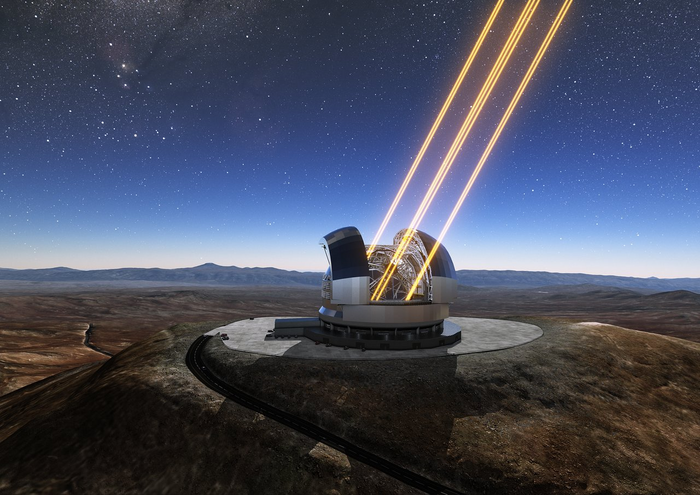
The construction of the ELT, spearheaded by ESO, is underway in Armazones, Chile. Upon its operational debut, anticipated in the mid-2020s, the ELT will be the world's largest terrestrial optical and infrared telescope. With its primary mirror spanning 39 meters in diameter and equipped with advanced adaptive optics systems, this telescope will provide a level of detail six times finer than the James Webb Space Telescope and 20 times finer than the Hubble Telescope.