Prehistoric reptile pregnant with octuplets
-
 Loading...
 - MaryKennedy
- 06 Apr 2021
- 1210 Views
- 0 Like
- 0 Comment
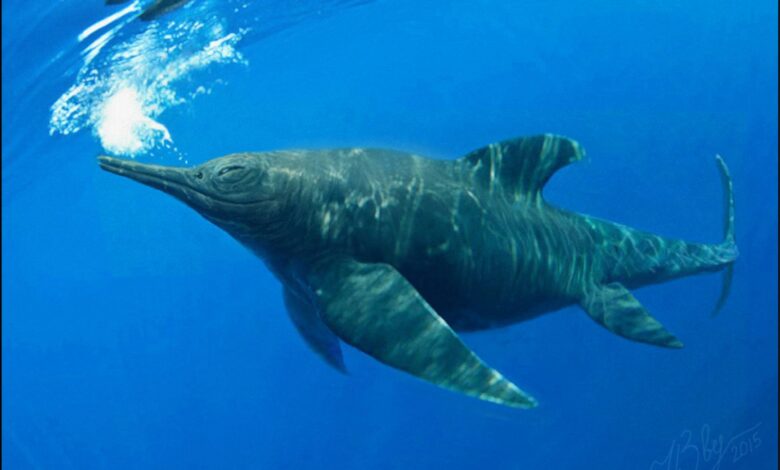
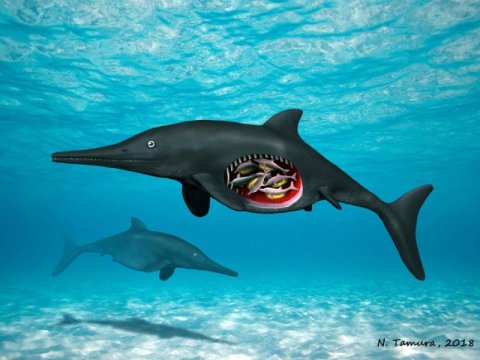
Palaeontologists have discovered part of the skeleton of a 180 million-year-old pregnant ichthyosaur with the remains of between six and eight tiny embryos between its ribs.
The new specimen was studied by palaeontologists Mike Boyd and Dean Lomax from The University of Manchester. It was collected around 2010 from near Whitby, North Yorkshire and is from the Early Jurassic. The fossil was in the collection of fossil collector, Martin Rigby, who thought the specimen might be a block of embryos. Dean confirmed the suspicion and the specimen was acquired by the Yorkshire Museum, York.
Ichthyosaurs were aquatic reptiles that dominated the Jurassic seas. They gave birth to live young, rather than laying eggs, and did not need to return to land, even to breed. They were carnivores, feeding upon other reptiles, fish, and marine invertebrates such as the squid-like belemnites.
Ichthyosaur fossils are quite common in the UK and often found in British Jurassic rocks. However, only five ichthyosaur specimens from Britain have ever been found with embryos and none with this many. All five were collected from Jurassic exposures in the south-west of England and are between 200-190 million years old. This is the first to be found in Yorkshire. The new specimen is a star attraction in the new major exhibition, Yorkshire's Jurassic World, which recently opened on March 24.
The Jurassic rocks of Yorkshire have produced hundreds of ichthyosaur and other marine reptile skeletons, but have not, until now, yielded any reptilian embryos. The new specimen, as well as being the first embryo-bearing ichthyosaur recorded from Yorkshire, is also geologically the youngest of the British embryo-bearing specimens, being from the Toarcian Stage of the Jurassic, around 180 million-year-old.
The specimen is a small boulder that has been cut in half and polished, which exposes several large ribs (of the adult) and several strings of vertebrae and various indeterminate tiny bones. Boyd and Lomax say there are at least six embryos present, but probably eight.
Mike said: "We also considered the possibility that the tiny remains could be stomach contents, although it seemed highly unlikely that an ichthyosaur would swallow six to eight aborted embryos or newborn ichthyosaurs at one time. And this does not seem to have been the case, because the embryos display no erosion from stomach acids. Moreover, the embryos are not associated with any stomach contents commonly seem in Early Jurassic ichthyosaurs, such as the remains of squid-like belemnites."
Eight different species of ichthyosaur have been documented with embryos. By far, the most commonly found ichthyosaur with embryos is Stenopterygius. Over a hundred specimens of Stenopterygius from Holzmaden and surrounding areas in Germany have been found with embryos, ranging from one to eleven in number.
"The German sites are approximately the same age as the new specimen from Whitby and it is possible that the new specimen is also Stenopterygius, but no identifiable features are preserved in the adult or embryos. Nonetheless, this is an important find." added Dean.
Sarah King, curator of natural science at the Yorkshire Museum, said: "This is an incredible find and the research by Dean and Mike has helped us confirm it is the first example of fossilised ichthyosaur embryos to be found in Yorkshire. Its display in Yorkshire's Jurassic World incorporates the latest digital technology to reveal the embryos and to explain the significance of the discovery. It also allows us to show a softer and more nurturing side to the Sea Dragons which were the top marine predator of their time."