New source of global nitrogen discovered
-
 Loading...
 - Ivana Lucija
- 09 Apr 2021
- 1238 Views
- 0 Like
- 0 Comment
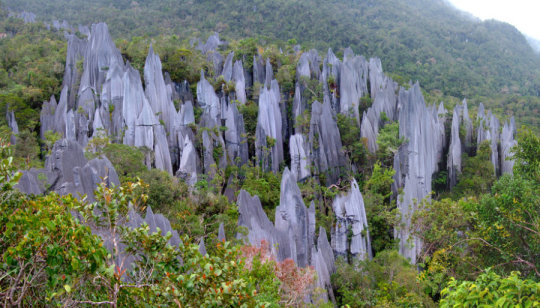
For centuries, the prevailing science has indicated that all of the nitrogen on Earth available to plants comes from the atmosphere. But a study from the University of California, Davis, indicates that more than a quarter comes from Earth's bedrock.
The study, to be published April 6 in the journal Science, found that up to 26 percent of the nitrogen in natural ecosystems is sourced from rocks, with the remaining fraction from the atmosphere.
Before this study, the input of this nitrogen to the global land system was unknown. The discovery could greatly improve climate change projections, which rely on understanding the carbon cycle. This newly identified source of nitrogen could also feed the carbon cycle on land, allowing ecosystems to pull more emissions out of the atmosphere, the authors said.
"Our study shows that nitrogen weathering is a globally significant source of nutrition to soils and ecosystems worldwide," said co-lead author Ben Houlton, a professor in the UC Davis Department of Land, Air and Water Resources and director of the UC Davis Muir Institute. "This runs counter the centuries-long paradigm that has laid the foundation for the environmental sciences. We think that this nitrogen may allow forests and grasslands to sequester more fossil fuel CO2 emissions than previously thought."
Weathering Is Key
Ecosystems need nitrogen and other nutrients to absorb carbon dioxide pollution, and there is a limited amount of it available from plants and soils. If a large amount of nitrogen comes from rocks, it helps explain how natural ecosystems like boreal forests are capable of taking up high levels of carbon dioxide.
But not just any rock can leach nitrogen. Rock nitrogen availability is determined by weathering, which can be physical, such as through tectonic movement, or chemical, such as when minerals react with rainwater.
That's primarily why rock nitrogen weathering varies across regions and landscapes. The study said that large areas of Africa are devoid of nitrogen-rich bedrock while northern latitudes have some of the highest levels of rock nitrogen weathering. Mountainous regions like the Himalayas and Andes are estimated to be significant sources of rock nitrogen weathering, similar to those regions' importance to global weathering rates and climate. Grasslands, tundra, deserts and woodlands also experience sizable rates of rock nitrogen weathering.
Geology and Carbon Sequestration
Mapping nutrient profiles in rocks to their potential for carbon uptake could help drive conservation considerations. Areas with higher levels of rock nitrogen weathering may be able to sequester more carbon.
"Geology might have a huge control over which systems can take up carbon dioxide and which ones don't," Houlton said. "When thinking about carbon sequestration, the geology of the planet can help guide our decisions about what we're conserving."
Mysterious Gap
The work also elucidates the "case of the missing nitrogen." For decades, scientists have recognized that more nitrogen accumulates in soils and plants than can be explained by the atmosphere alone, but they could not pinpoint what was missing.
"We show that the paradox of nitrogen is written in stone," said co-leading author Scott Morford, a UC Davis graduate student at the time of the study. "There's enough nitrogen in the rocks, and it breaks down fast enough to explain the cases where there has been this mysterious gap."
In previous work, the research team analyzed samples of ancient rock collected from the Klamath Mountains of Northern California to find that the rocks and surrounding trees there held large amounts of nitrogen. With the current study, the authors built on that work, analyzing the planet's nitrogen balance, geochemical proxies and building a spatial nitrogen weathering model to assess rock nitrogen availability on a global scale.
The researchers say the work does not hold immediate implications for farmers and gardeners, who greatly rely on nitrogen in natural and synthetic forms to grow food. Past work has indicated that some background nitrate in groundwater can be traced back to rock sources, but further research is needed to better understand how much.
Rewriting Textbooks
"These results are going to require rewriting the textbooks," said Kendra McLauchlan, program director in the National Science Foundation's Division of Environmental Biology, which co-funded the research. "While there were hints that plants could use rock-derived nitrogen, this discovery shatters the paradigm that the ultimate source of available nitrogen is the atmosphere. Nitrogen is both the most important limiting nutrient on Earth and a dangerous pollutant, so it is important to understand the natural controls on its supply and demand. Humanity currently depends on atmospheric nitrogen to produce enough fertilizer to maintain world food supply. A discovery of this magnitude will open up a new era of research on this essential nutrient."
UC Davis Professor Randy Dahlgren in the Department of Land, Air and Water Resources co-authored the study.
The study was funded by the National Science Foundation's Division of Earth Sciences and its Division of Environmental Biology, as well as the Andrew W. Mellon Foundation.