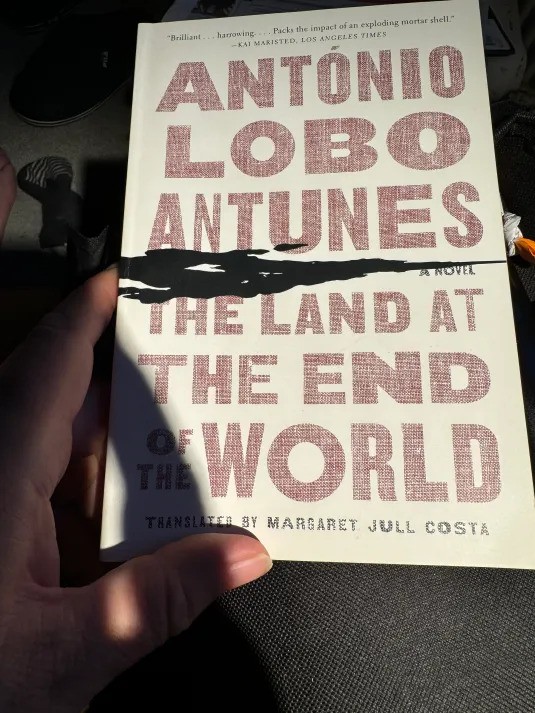
Review of The Land at the End of the World by António Lobo Antunes
-
 Loading...
 - Addison Chapman
- 03 Mar 2025
- 27 Views
- 0 Like
- 0 Comment
António Lobo Antunes’ early novel, The Land at the End of the World, published in 1979, presents a stark and unflinching exploration of Portugal's socio-political landscape, particularly during the tumultuous period of the Salazar dictatorship and the war in Angola. The novel's title evokes a sense of desolation, reflecting both the geographical and existential plight of its characters.
Set against the backdrop of a struggling Portugal and its distant African colony, the narrative is deeply rooted in the author's own experiences as an army doctor. Lobo Antunes’ prose is visceral, often likening the political and social decay of his homeland to bodily functions and excrement, a theme that permeates the text. The original title, Os Cus de Judas, translates to "The Arseholes of Judas," a slang term that captures the essence of neglect and hopelessness associated with the regions and issues the novel addresses. The choice of the English title, The Land at the End of the World, while evocative, softens the rawness of the original.
Lobo Antunes is not a writer who shies away from the grotesque. His narrative is filled with vivid and often disturbing imagery, as he delves into the human condition and the scars left by war and dictatorship. The author’s background as a physician informs his writing, which often reads like an autopsy of the Portuguese psyche. The novel is less a conventional story and more a stream of consciousness, a monologue directed at a silent woman in a bar, where the narrator reflects on his childhood, military service, and the disintegration of his marriage.
The language in The Land at the End of the World is both poetic and chaotic, filled with metaphors that twist and turn like jazz improvisations. Lobo Antunes draws comparisons to jazz greats like Charlie Parker and John Coltrane, suggesting that his prose is a form of artistic expression that mirrors the complexity and improvisational nature of music. The narrative is rich with surreal and grotesque imagery, such as the description of a woman as a "vast ambulant gluteus maximus," which exemplifies the author’s fixation on the body and its functions.
However, the novel's dense and allusive style can be challenging for readers, particularly those unfamiliar with Portuguese culture and history. The translator, Margaret Jull Costa, provides footnotes to clarify local references and political contexts, but the need for such assistance indicates that Lobo Antunes’ work may resonate more deeply with Portuguese readers. His references to cultural icons and personal anecdotes, while aiming for universality, sometimes feel like an attempt to assert his relevance beyond the confines of his homeland.
In contrast to José Saramago, another prominent Portuguese writer, Lobo Antunes’ work is less accessible and more demanding. While Saramago’s narratives often blend magical realism with philosophical musings, Lobo Antunes confronts the reader with the harsh realities of life, death, and the lingering effects of trauma. His fixation on the darker aspects of existence can lead to a sense of despair, as he navigates the complexities of identity and history.
In conclusion, The Land at the End of the World is a powerful, if challenging, exploration of the human condition set against the backdrop of a troubled nation. Lobo Antunes’ unflinching gaze at the foulness of the body politic and the visceral nature of his prose make this novel a significant contribution to Portuguese literature. While it may not be an easy read, those willing to engage with its complexities will find a profound meditation on the scars of history and the struggle for identity in a world that often feels like an "arsehole."