Scientists Boost The Efficiency of a Cheap And Promising Solar Panel Material by 250%
-
 Loading...
 - Brittany Johnson
- 27 Feb 2023
- 72 Views
- 0 Like
- 0 Comment
Cheaper to produce and better at absorbing higher energy forms of light, perovskite materials have the potential to replace silicon in solar panel technology. Unfortunately scientists are still figuring out how to make these perovskites more stable and longer-lasting.
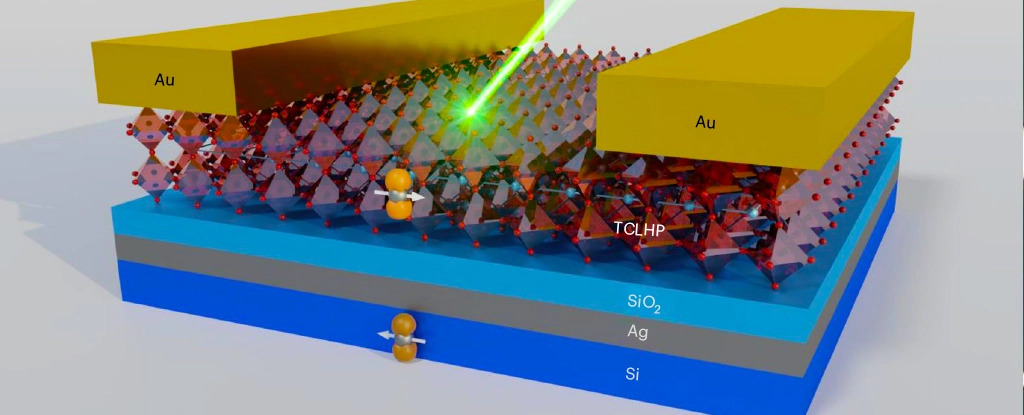
In a new study, scientists have been able to significantly improve the efficiency of a particular type of this material, known as a lead-halide perovskite. By combining the perovskite with a substrate of metal rather than glass, light conversion efficiency was increased by 250 percent.
"No one else has come to this observation in perovskites," says Chunlei Guo, a professor of optics at the University of Rochester in New York.
"All of a sudden, we can put a metal platform under a perovskite, utterly changing the interaction of the electrons within the perovskite. Thus, we use a physical method to engineer that interaction."
While there's still plenty of work to do to get this technology out of the lab and into a solar panel, it's another indication that these perovskite crystalline structures could soon be the go-to materials when it comes to boosting solar power production.
Solar panels work by using photons of sunlight to excite electrons into leaving their place next to an atom to produce an electrical current. When electrons and the gaps they've left behind recombine, however, energy that could be used as electricity is instead lost as heat. Read More…