Scientists find out how Antarctic Krill adapted to extreme climate
-
 Loading...
 - Logan Devine
- 22 Mar 2023
- 69 Views
- 0 Like
- 0 Comment
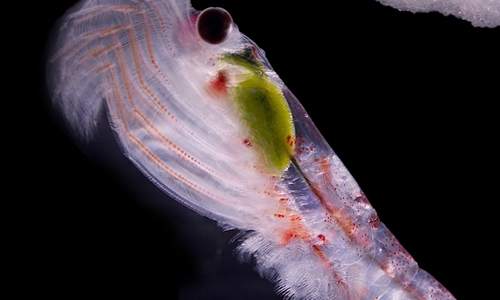
Scientists have decoded the secrets of the genes of Antarctic Krill, explaining the reason why such small creatures have been able to adapt to the extremely harsh climate of the South Pole, according to a recent report published in the journal Cell.
The research, carried out by the Yellow Sea Fisheries Research Institute of the Chinese Academy of Fishery Sciences (CAFS), was a joint effort by scientists and researchers from countries including China, Germany and Australia.
The scientists used genome sequencing data to learn how Antarctic Krill have adapted to the Southern Ocean and how they shaped the local ecosystem.
It turns out that Antarctic Krill have a complicated, high-level genetic duplication in their DNA.
Due to this duplication, the sequence for Antarctic Krill is the largest animal genome sequence produced to date, according to the report. At 48 gigabytes, the sequence is 20 to 30 percent bigger than that of African and Australian lungfish.
In addition, the research team also found out that Antarctic Krill, whose genome is around 16 times longer than that of a human, have a total of 25 significantly expanded gene families. It means that "krill can continuously molt, or shed its outer layers as the organism grows, generally supporting its lifecycle in the Antarctic environment," Dr. Fan Guangyi, co-corresponding author of the report and a researcher at BGI-Research, noted to the Global Times. Read More…