Seven ways the Covid-19 pandemic has changed Austria
-
 Loading...
 - Alina Wallner
- 25 Mar 2022
- 388 Views
- 0 Like
- 0 Comment
The Covid-19 pandemic has been more than a global health crisis – it has disrupted international supply chains, brought about changes in the way we work and socialise, and led to an increase in the cost of living.
But how has it all impacted Austria in particular?
The Local took a look at the major changes from the past two years and how they have influenced the Alpine Republic.
Digital payments are more popular
Austria’s love for cold, hard cash can be summed up in the saying, “Nur Bares ist Wahres” (only cash is true).
But according to Petia Niederländer, Director of the Department for Payment Transactions, Risk Monitoring and Financial Education at the Austrian National Bank, the pandemic has massively accelerated the trend towards card payments.
Cash is still the preferred payment method accounting for 66 percent of all transactions in Austria, but the overall use of cash has dropped by 13 percent since 2019 as a result of hygiene regulations in shops.
Don’t expect Austrians to completely ditch cash any time soon though.
As Niederländer told the WKÖ: “More than two thirds cannot imagine a world without cash.”
Kissing is no longer the standard greeting
In pre-pandemic times, a common greeting between men and women in a non-professional setting was two kisses (one for each cheek). Although in reality they were more like air kisses.
Since Covid-19 though, kissing has been relegated to a fist pump or simply a smile due to social distancing and fears of transmitting, or passing on, the virus.
For some people (especially those from countries where kissing is not common), it’s a welcome change and a relief from awkward moments. But others might miss the continental flair of kissing.
Home ownership has increased
In the past two years, Austrians have invested lots of money in residential property leading to a real estate boom across the country.
In 2021, the number of entries in the land register (a public register of property ownership) rose by 12 percent to 163,266, according to figures by Remax.
The overall value of property transactions in Austria also increased from €35.15 billion in 2020 to €43.18 billion in 2021. Vienna alone accounted for property sales worth €12.7 billion last year.
This has led to rising prices and more Austrians being priced out of the property market, especially in high-demand tourist areas like Tyrol, as reported by The Local.
Stress and scandals have increased political instability
Before the pandemic, politics in Austria had already been rocked by the Ibiza scandal (find out more here), but it seems that was just the start of a tumultuous few years for the federal government.
At the time of the first lockdown in March 2020, former political wonderkid Sebastian Kurz of the Austrian People’s Party (ÖVP) was Austria’s Federal Chancellor. Kurz then stepped down from the role in October 2021 following allegations of corruption before completely resigning from politics.
Foreign Minister Alexander Schallenberg (ÖVP) then became interim Chancellor in October before being replaced by Karl Nehammer (ÖVP) in December. Nehammer became Austria’s third Chancellor in as many months, and the sixth in five years.
In the meantime, Johannes Rauch of the Greens Party (Greens) recently became Austria’s third Health Minister since 2020 after Wolfgang Mückstein (Greens) and Rudolph Anschober (Greens) both quit after several months citing the stresses of the job.
As a result, public satisfaction with the ruling coalition government of the Austrian People’s Party (ÖVP) and the Greens has dropped.
According to a September 2021 Statista survey, just 45 percent of those surveyed were satisfied with the government, compared to 64 percent in winter 2020/2021.
Vaccine scepticism is widespread
The roll-out of the Covid-19 vaccination in early 2021 lowered anxiety levels for many people in Austria, especially as many restrictions ended in the spring. But it also led to a rise in anti-vaccine sentiment, particularly after plans for mandatory vaccinations were announced.
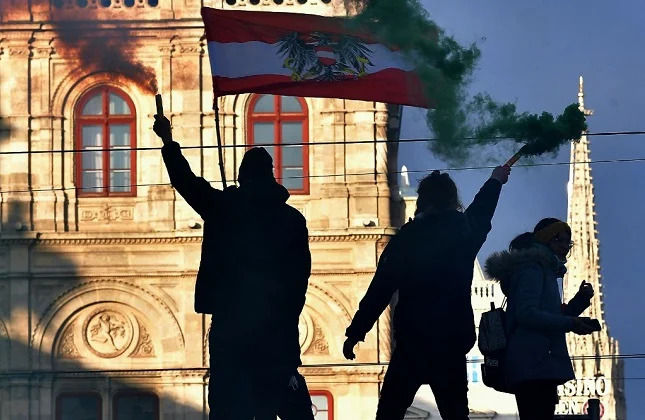
By late 2021, Vienna became the stage for weekly protests against the vaccine and other Covid-19 restrictions. It even led to then-Chancellor Alexander Schallenberg blaming the Freedom Party of Austria (FPÖ) for fuelling vaccine scepticism.
The planned mandatory vaccination order has now been put on hold, but the episode has led to a growing distrust of government and authority figures in Austria.
Working from home is now acceptable
Before the pandemic, working from home was not common in Austria.
But after several lockdowns and the ongoing risks associated with Covid-19, the home office has become a central part of working life for many people.
The rise in working from home has even led to new laws and tax breaks, such as benefits up to €600 to cover heating costs, digital equipment (laptops, mobile phones, wifi) and office furniture. Insurance coverage has also extended to the home office.
The new tax regulations are scheduled to be reviewed in 2023, although they are expected to remain in place after the pandemic.
Cost of living is more expensive
The pandemic and subsequent lockdowns led to supply chain bottlenecks around the world in 2020. The result was rising prices and an increase in the cost of living.
The cost of meat and fruit in Austria significantly increased in 2020 with the price of an average shopping cart almost twice as expensive as inflation. In 2020, the average rate of inflation was 1.4 percent.
By December 2021, inflation had jumped to 4.3 percent and has continued to rise throughout the first quarter of 2022. In February, inflation in Austria hit 5.9 percent – the highest rate since 1984 – mostly driven by rising energy prices and the financial impacts of the war in Ukraine. Read More...