Switzerland's secret fourth language
-
 Loading...
 - Genevieve Francoise
- 27 Jul 2021
- 1042 Views
- 0 Like
- 0 Comment
Despite Romansh being one of Switzerland’s four national languages, less than 0.5% percent of Swiss can answer that question – ‘Do you speak Romansh?’ – with a ‘yes’.
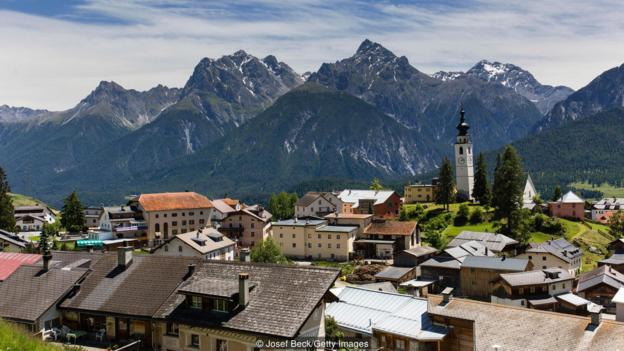
Romansh is a Romance language indigenous to Switzerland’s largest canton, Graubünden, located in the south-eastern corner of the country. In the last century, the number of Romansh speakers has fallen 50% to a meagre 60,000. Travellers in the canton can still see Romansh on street signs, or hear it in restaurants when they’re greeted with ‘Allegra!’ (Welcome in). But nearly 40% of Romansh speakers have left the area for better job opportunities in places like Zürich and it’s rare that you will see or hear Romansh outside the canton. In such a small country, can a language spoken by just a sliver of the population survive, or is it as doomed as the dinosaur and dodo?
Romansh is believed to have originated around 15BC when the Romans conquered Rhaetia, which is now Graubünden. Romansh is the result of the combination of the Vulgar Latin spoken by soldiers and colonists, and Rhaetian, the language of the native people. This new hybrid language became the primary language of the area until the 15th Century, when the canton first came together in a loose confederation known as the Free State of the Three Leagues.
The leagues used German as their primary language, and because local villages were isolated in the mountainous area’s 150 valleys, Romansh fragmented into five somewhat different dialects, each with its own written language. This lack of a uniform standard hindered Romansh’s ability to grow the way German or French did in the country. More and more Germans came to the area, and by the 19th Century, the canton encouraged its Romansh residents to learn German. Today German is the prominent language in Graubünden.
You might think that would be the end of Romansh, but the Swiss are proud of their culture and in 1938 more than 90% of the country voted to make Romansh an official national language. The Swiss government spends about 7.6 million CHF annually to promote and preserve Romansh.
Because the economics and practicality of having an official language with five idioms was cumbersome, in 1982 an artificial, unified version of Romansh, Rumantsch Grischun, was developed by Heinrich Schmid, a linguist from the University of Zürich, and the Lia Rumantscha, a non-profit organisation dedicated to preserving and promoting Romansh language and culture. Since 1996, the unified Romansh has served as the administrative language, but the people of Graubünden have resisted giving up their own dialects in favour of the common version.
“The individual speakers regard unification as a major threat to their own original dialect or idiom,” explained Daniel Telli, head of the Unit Lingua at Lia Rumantscha. “They frequently consider the unified language as artificial, whereas the variety they use is the language of the heart.”
Language exists to convey a people’s culture to the next generation, so it makes sense that each area is protective of its unique dialect. When the world loses a language, as it does every two weeks, we collectively lose the knowledge from past generations.
“Language is a salient and important expression of cultural identity, and without language you will lose many aspects of the culture,” said Dr Gregory Anderson, Director of the Living Tongues Institute for Endangered Languages.
Without the Romansh language, who is to say if customs like Chalandamarz, an ancient festival held each 1 March in the Engadine Valley to celebrate the end of winter and coming of spring, will endure; or if traditional local recipes like capuns – spätzle wrapped in greens – will be forgotten.
“Romansh contributes in its own way to a multilingual Switzerland,” Telli said. “And on a different level, the death of a language implies the loss of a unique way to see and describe the world.”
But the number of Romansh speakers continues to dwindle as Graubünden residents place a bigger value on more mainstream languages. In many Graubünden schools, German is the main language of instruction, with only a handful of smaller villages continuing to teach in a mix of their specific dialect and the unified Romansh. Most schools offer Romansh language lessons, but it is not a required course. Maja Gartmann, a public relations professional who lives in Graubünden, for example, elected to learn French, Italian and English instead, languages that will make her more marketable in a globalised economy.
However, there is hope on the horizon: in recent years, there has been a slight uptick of interest in Romansh that could help revive the language.
Ironically, globalisation might be driving the trend.
“Years ago no-one wanted things that were traditionally Swiss, but now people are tired of everything being the same everywhere. It’s seen as hip and cool to go back to your roots and be more local than global,” Gartmann said. “Now people are proud to speak Romansh because it’s different and rare, and anything that is rare and exclusive is interesting today.”
There is a Romansh TV and radio station and a Romansh newspaper, all of which use a mix of the unified language and the different dialects; and bookstores like Provini Il Palantin, which carries one of the largest selections of Romansh books in the canton. There is even a hip-hop group who rap in Romansh.
“Everyone in the band grew up in Grison [Graubünden],” said Johannes Just, a member of Liricas Analas (Ass Lyrics) “The language in rap is a tool for expression, and if you don’t rap in your mother tongue you’re more absorbed with the usage of that tool than the free expression of thoughts and ideas. It was never the idea to promote the language by our musical work, but if we can do our part [promoting Romansh] it is a welcome effect.”
And technology is helping resuscitate fading languages like Romansh. The language lives on websites and blogs; online apps like Memrise help teach the language; online translators like Romansh English Translator APK can aid communication; and social media sites allow Romansh speakers to connect, especially among younger people. Technology behemoth Google launched The Endangered Languages Project, to preserve the world’s most at-risk languages, including Romansh.
A line from 19th-Century poem Al pievel romontsch (To the Romansh people) by Giachen Caspar Muoth instructed people to ‘Stand up and defend your ancient language, Romansh!’ What remains to be seen is whether enough canton residents believe that preserving the area’s historic culture and language is a worthy thing to do in the 21st Century.