What the Indian head wobble really says
-
 Loading...
 - Courtney Trump
- 30 Jul 2021
- 1001 Views
- 0 Like
- 0 Comment
In Thanjavur city, in the South Indian state of Tamil Nadu, street markets are flooded with a particular type of bobblehead toy. It is known in Tamil as the Thanjavur Thalaiyatti Bommai, literally meaning The Head Shaking Doll of Thanjavur. The brightly painted clay bommai, usually the figure of a classical dancer or an old couple as a set, comes in two parts: the full body and the head that sits loosely on a small hinge extending up from the neck. A slight tap on the head, or even a vigorous breeze, can set off the head shaking from side to side in an almost circular fashion.
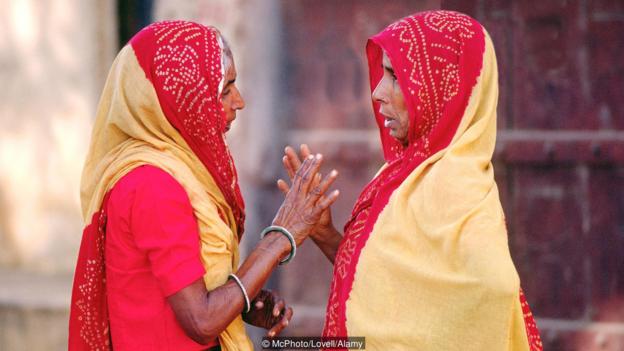
This is the closest imitation of the unique Indian gesture that often leaves visitors to the country flummoxed. One thing all travellers to India talk about – apart from the dreaded Delhi Belly, of course – is the great Indian head nod. It’s not exactly a nod (up and down from the neck, meant to indicate ‘yes’) – or a shake (straight side to side to convey ‘no’). It’s a smooth movement that involves tilting the head from side to side vertically, either gently or fiercely.
The great nod is also called the Indian head wobble, bobble, waggle or the headshake. It is not a jerky or firm motion, but even and continuous; one that Priya Pathiyan, a Mumbai-based writer who conducts guided tours in her city for visitors, describes as “somewhat like an infinity sign, or a numeral eight lying down”.
There are pages of writing devoted to it on the internet, not to mention demonstration videos, to demystify it for the traveller. A casual search on YouTube throws up dozens of enthusiasts – both Indians and foreigners – attempting to explain the Indian head nod. A few years ago, one such video even went viral, attracting more than a million views in just a week.
Does it mean a clear yes? Is that a kind no? A maybe? A sign of uncertainty? Annoyance perhaps? It is difficult to say without knowledge of the context. Pathiyan thinks that it is almost always a ‘yes’, or at least indicates agreement. “There is also an element of being friendly or being respectful, and it is difficult to say exactly which unless you know the situation,” she added.
Margot Bigg, a British-American travel writer who lived in India for more than five years and has written guidebooks on the country, is of the opinion that different types of head nods mean different things. “Like a one-stroke side nod could mean ‘yes’ or ‘let’s go’, while a more consistent back-and-forth bobble is an acknowledgment of understanding.”
In my own experience, the faster the shake, the more enthusiastic the agreement – especially when used with raised eyebrows for added emphasis. But, on the other hand, it could also be used to convey “Ok… whatever you say…”; an indifferent shoulder shrug without actually shrugging the shoulders.
However, there is more to the Indian head wobble than just a cultural quirk passed through the generations. In renowned cultural scientist Geert Hofstede’s exhaustive research on cultural norms across different countries, India scored 77 on the dimension of Power Distance – the extent to which people expect and accept power inequalities within their own society – compared to a world average of 56.5. This high score indicates a deep respect for hierarchy and limited scope for disagreement with those considered superior in any way.
Having lived all my life in this country, I can confirm that Indians are brought up to be pliant and polite, especially to guests and to elders, and do not like to say ‘no’ directly. We mumble incoherently, we smile sheepishly, we nod vaguely, all to put off making a firm commitment. Indeed, the head nod is a gesture meant to convey ambiguity, and does so effectively.
Pradeep Chakravarthy, a writer from Chennai and a corporate behaviour consultant, says that this gesture is the Indian way of both dealing with grey areas and leaving the door open in all major and minor relationships.
“In the traditional agrarian economy such as the one in India, you don’t openly convey refusal or disagreement with any other person in the community,” he said. “Because you never know when you will need their help, and saying no means cutting off a relationship completely.”
Chakravarthy elaborated on the absolute formality of relationships and hierarchies in Indian society, which means that people often find themselves in situations where saying ‘no’ is just not possible. These would typically be interactions with bosses at work, elders within the family or leaders in the community. In these cases, this vague movement comes through as the perfect compromise, allowing the viewer to interpret what they want, while leaving wriggle room for the speaker.
As Chakravarthy puts it: “I know I can’t do it, but I can’t say no either. So rather than outright refusal, I buy time by being deliberately vague.”
In theory, this seems like a recipe for all-round happiness, but it often leads to great confusion and exasperation. While this is true mainly for cross-cultural interactions, such as when foreign bosses deal with their Indian employees or when a tourist tries to bargain with a street vendor, it sometimes has the same effect on Indians, even those who use the action themselves in other situations.
So, despite all those explanatory videos, it is not as if Indians come with a ready key to cracking the nod code. I often find myself wanting to scream, “What exactly are you saying?” The American sitcom Outsourced – purportedly set in a Mumbai call centre – even devoted space in an episode to discussing this action.
Love it or hate it, play along with it or stay perplexed, but it is impossible to ignore this nod while in India. Most Indians aren’t even aware they’re doing it, and many travellers to India find themselves imitating it after a time. Anita Rao Kashi, a journalist from Bangalore, said to me, “As much as we’d like to deny it, this gesture is ingrained in Indians, passed on through heredity.”
Bigg also admitted to doing the nod without realising it, particularly when she speaks in Hindi. “I’ve had Western visitors notice that I do it and point it out to me, but it’s so much part of my natural code switching that I’m not at all aware of it,” she said.
As a lifelong resident of India, I have a word of advice for those seeking to crack the Indian cultural code. When you encounter the wobble, respond with a wobble of your own; you may just end up making a friend for life.