The agricultural sector receives patch solutions for its problems
-
 Loading...
 - Laura Gomez
- 18 Mar 2022
- 398 Views
- 0 Like
- 0 Comment
The government of Guillermo Lasso , within its 'Plan for the Creation of Opportunities 2021-2025' , establishes goals such as increasing agricultural and agro-industrial exports from 13.35% to 17.67%; or increase agricultural productivity from 117.78 to 136.85 tons per hectare.
However, since the beginning of the current administration, actions have been above all reactive, in response to de facto measures in sectors such as the rice and banana sectors .
Rosendo Mira, a small potato producer, explained that so far no real plan has been seen to achieve the goals.
“In the best of cases, kits with certain aid are delivered to certain sectors. The effectiveness of 1% credits should be assessed in a little more time, but the risk is that, as always, they end up reaching a minority of farmers . When there are stoppages or de facto measures, the response is more of the same: reinforce price controls and supposed targeted aid”, he said.
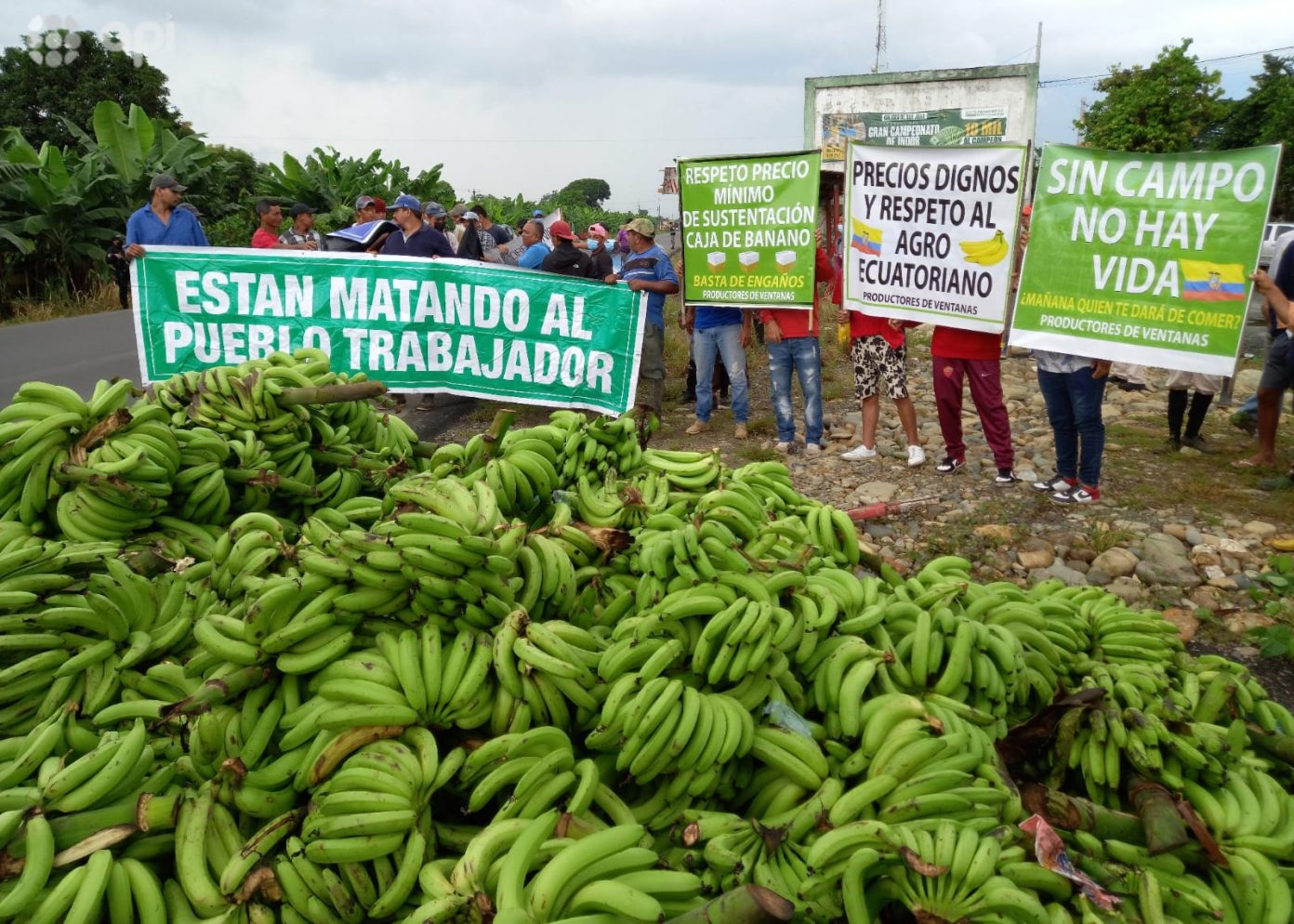
In the context of the war in Russia and Ukraine, sectors of small banana producers, for example, have come out to block streets in search of state aid .
However, the official response does not come from the Ministry of Agriculture . Newspaper LA HORA requested an interview with the head of that agency. The objective was not only to obtain details on the circumstantial solutions to the problem of the loss of the Russian and Ukrainian market, but also to know what measures are being taken to face the problem of rising production costs (present for more than a year) and low productivity , among others.
The reason for the denial of the interview is that the Minister is not giving statements at the moment and that the answer to the questions is in President Lasso's last interview, during his weekly radio program, where he talks about giving targeted credits , see the possibility of seeking options for tax refunds or reduction of tariffs and further work on the trade agreement with China and South Korea (medium-term goal).
90% of crops concentrated in 10 products
In addition to the lack of access to technology and basic tools such as irrigation systems (most farmers plant according to the rainy season), there is a problem of overproduction of certain products.
Of a total of 2,265,489 hectares that are used for permanent and transitory crops each year in Ecuador, 90% is concentrated in the sowing and production of cocoa, African palm, banana, plantain, sugar cane, coffee, hard and soft corn. (dry grain), paddy rice, potato and soy.
Beyond the current situation, sectors such as bananas have structural problems such as overproduction on land that is not optimal for planting this fruit.
Santiago Carrasco, teacher and researcher on agricultural production , commented that above all small farmers look a lot at official prices to decide to plant a certain product.
“When there are times of high prices, many people believe that it is a safe business and start producing on land that is not suitable. The results are low productivity , higher costs, and ever lower profits. No government, and the current one is no exception, has a plan to diversify crops according to the possibilities of the land in each area," he said.
This situation has produced significant drops in production in other products such as potatoes. Ten years ago, the planted area was 45,000 hectares, but now it does not exceed 25,000, because, without any type of technical support and accompaniment , small and medium producers switch to crops that seem to be winners because in theory the profit is insured by the state.
"There are cases like the one in the Netherlands where it has been proven that credit without technical support and access to technology , hand in hand with joint work with universities, causes minimal results and deepens problems of low productivity and high costs ," added Richard Domínguez , medium producer of cereals in the central highlands. (JS)
For more than 14 years, the agricultural, livestock and fishing sector has not exceeded 10% of the Gross Domestic Product (GDP)
81% of the people who cultivate in the field are 41 years old or older. Only 13% have higher education.
Super foods grow, but they are less than 5% of exports
Ecuador has great potential to become a major exporter of so-called super foods such as canned vegetables, instant soups based on quinoa, teas from different ancient plants, Andean potato sandwiches, cocoa nibs, among others.
Markets such as the United States and Europe demand more and more of this type of food offer. According to the Ecuadorian Federation of Exporters (Fedexpor), this type of value-added exports totaled $771 million in 2021.
The promotion of this production can be a tool to diversify crops and improve the conditions of small and medium farmers. At the time of it, Felipe Ribadeneira, stressed that the productive future of Ecuador lies in betting on agri-food exports with added value, in which we have a real competitive advantage.
Only in this way could the country stop depending on the instability of oil prices and have more efficient investments that generate sustained employment.
Currently, agriculture is the largest generator of jobs in Ecuador. The percentage of Ecuadorians working in agricultural, livestock and fishing activities exceeds, between two and three times, the generation of employment in industry and commerce.
Credits and tax refunds to alleviate the blow of the war
The Minister of Production, Julio José Prado, has assured that the State cannot buy part of the production of sectors such as the banana; but if you can offer targeted credits. Thus, a financing line of up to $52,000 is being worked on for working capital and irrigation and up to $70,000 for the renovation of plantations. It will have a term of up to 4 years, with a one-year grace period and 7% interest. Read More...