The Making Of A Femicide
-
 Loading...
 - Mido Nabil
- 04 Jul 2022
- 117 Views
- 0 Like
- 0 Comment
In September of 1967, Gabriel García Márquez and Mario Vargas Llosa, perhaps the greatest Latin American novelists of the twentieth century, met twice in Lima, Peru, to talk about literature in front of a university audience. In the middle of one conversation, after discussing questions as diverse as the origins of “One Hundred Years of Solitude” and the political commitment of the novelist, Vargas Llosa asked García Márquez about William Faulkner and his influence on Latin American literature. “I think it’s the method,” García Márquez said. “The Faulknerian method is very effective in narrating Latin American reality. . . . This is not strange at all, because I’m not forgetting that Yoknapatawpha County borders the Caribbean Sea.”
Actually, Yoknapatawpha County would appear to be landlocked, at least according to a hand-drawn map that Faulkner published in 1936. But the geographical mistake is beautifully eloquent: for decades, Latin American novelists have claimed Faulkner as one of their own, finding in his fiction—in its exploration of a problematic history, in its use of lore and myth, in its formal inventiveness—a key to the interpretation of their world. That’s evident in the Mexican novelist Fernanda Melchor’s astonishing “Hurricane Season,” which, in 2020, became her first novel to appear in English, and now in its successor, “Paradais” (New Directions), both translated by Sophie Hughes. With a nimble command of the novel’s technical resources and an uncanny grasp of the irrational forces at work in society, the books navigate a reality riven by violence, race, class, and sex. And they establish Melchor, who was born in 1982, as the latest of Faulkner’s Latin American inheritors, and among the most formidable.
“Hurricane Season” is a taut novel with chapter-length paragraphs of relentless, serpentine prose and a claustrophobic intensity barely mitigated by the open spaces where the action occurs—a scattering of shacks built amid cane fields near a port city modelled on Veracruz. The inhabitants live in squalor, moral as well as physical. Prostitution and drug dealing are part of the daily grind, and Melchor paints a hellscape of distrust, venality, private aggressions, and general grimness. The novel begins with a group of roaming children—“their slingshots drawn for battle and their eyes squinting, almost stitched together, in the midday glare”—who are about to come upon a body. Melchor’s prose is muscular but always attentive to the world of the senses and carried forward by an impeccable ear. (Hughes sticks close in her agile rendering, riding an untamed beast and staying in the saddle.) The chapter closes with an arresting image:
The ringleader pointed to the end of the cattle track, and all five of them, crawling along the dry grass, all five of them packed together in a single body, all five of them surrounded by blowflies, finally recognized what was peeping out from the yellow foam on the water’s surface: the rotten face of a corpse floating among the rushes and the plastic bags swept in from the road on the breeze, the dark mask seething under a myriad of black snakes, smiling.
We learn that the body is that of a local woman who was known as the Witch, just as her mother had been; we learn about her mother’s dealings with the town, the curses she conjured and the poisons she concocted from herbs; we learn about the rumor that the mother killed her husband, a landowner straight out of Faulkner’s “Sartoris” saga, who died before he could finish building his own house. Once widowed, she locked herself away in the house, perhaps out of fear of the town’s reaction, perhaps because “she was hiding something, a secret she couldn’t let out of her sight.” When she died, in “the year of the landslide” (an incident invoked momentously, like a Biblical flood), her daughter inherited her nickname. And now, many years later, the daughter has turned up dead in an irrigation canal, and nobody knows what happened.
Such is Melchor’s world. The scene is contemporary, but the atmosphere is unmistakably gothic; events here have a mythic quality, and hearsay, rumor, and gossip, filtered through the narrative voice, are our only access to the ambiguous truths of these lives. “So the story went,” “they say,” “some say”: these expressions drape a gauzy veil between the characters and the reader. (“Absalom, Absalom!,” with its movements back and forth in time, and between reality and perception, comes to mind.) The result is that our relation to the victim is distanced. “Hurricane Season” proposes that we slowly discover the Witch—gain a fuller sense of her uncertain identity—through the different perspectives of the men and women who gravitate toward her and her legendary ruin of a house. The ensemble of observers is presented both in various group formations and, through deft shifts in point of view and diction, as distinctive voices.
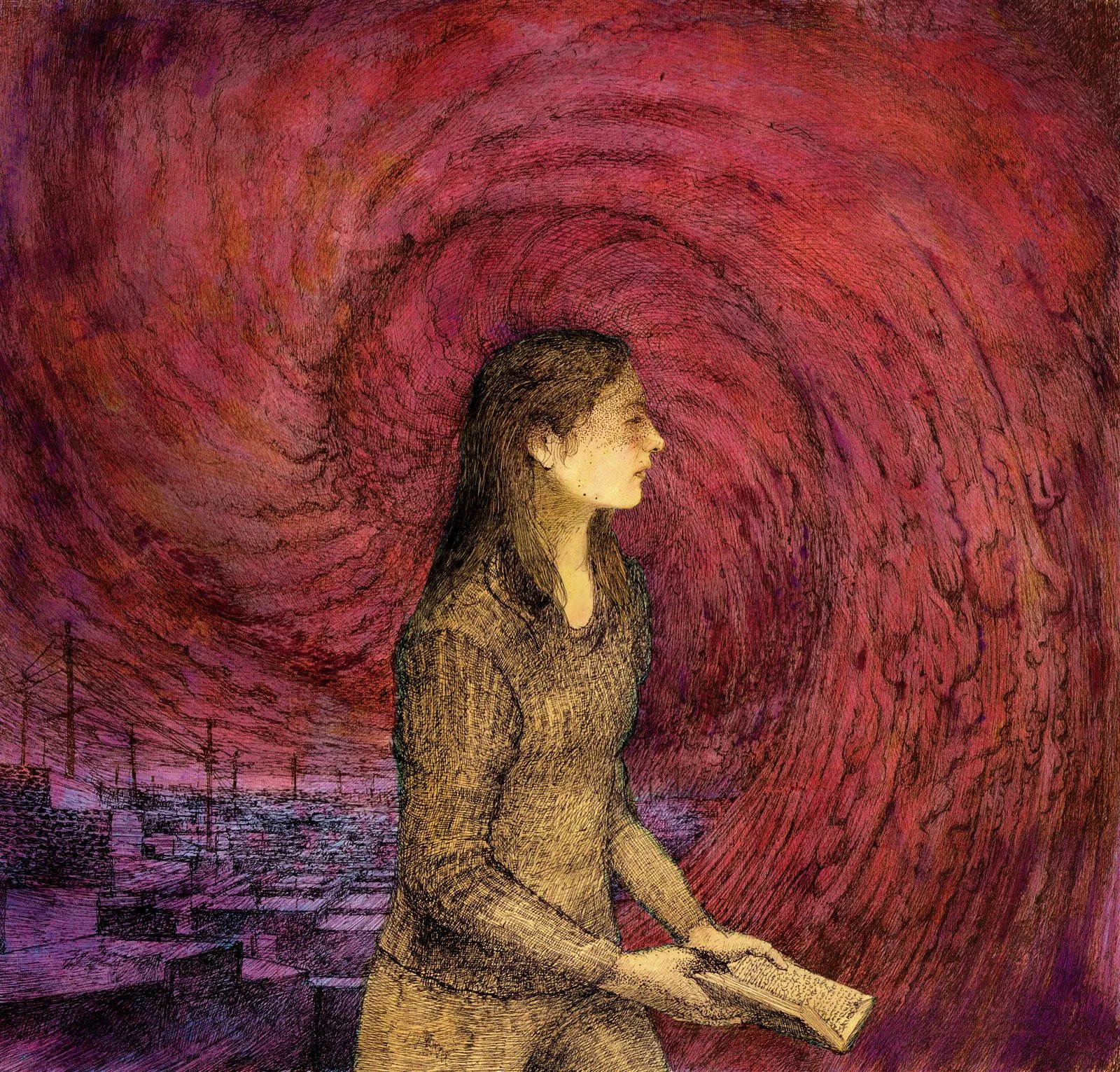
“Hurricane Season” is built in circles, with narrative segments starting at a given point in the chronology and then returning to the past and spiralling forward to tell us how we got there. The novel’s success depends on this structure: beginning with an effect and then asking us to hunt for the cause. The approach also obviates transitional scenes, a hazard of conventional realism. In the acknowledgments of the novel’s Spanish-language original, Melchor thanks a friend for recommending that she read “The Autumn of the Patriarch,” and “at just the right moment.” Melchor plainly owes quite a bit to García Márquez’s use of time. In the 1971 study “García Márquez: Historia de un Deicidio,” Vargas Llosa evokes the temporal movement of “One Hundred Years of Solitude” with a quote from Joseph Conrad’s “The Secret Agent”: “Circles, circles; innumerable circles, concentric, eccentric; a coruscating whirl of circles.” Melchor built “Hurricane Season” in just this way. The fact that it feels like the only way to tell this story is a measure of the book’s success.
Melchor’s characters are defeated, dispossessed, and disenfranchised, never in control of their own existence, always victims of violence and too often (and too easily) turned into willing perpetrators. The governing forces here include deep-seated machismo and systemic misogyny, and it’s virtually impossible to escape them. This is clear in the case of Luismi and Brando, young men thrust into premature manhood by the hardships and the viciousness of their messy lives. Like the men in the novel, they live in fear and awe—or awe produced by fear—of the narcos who rule the area; their sexual lives regularly involve rape (although they don’t call it that), homosexual encounters filled with ambiguity, and, in Brando’s case, compulsive masturbation to images of bestiality and the like. While Melchor’s prose calls to mind “Absalom, Absalom!,” the brutality of her world outstrips even that of “Sanctuary.”
Enter Norma, a thirteen-year-old girl who becomes pregnant after being serially raped by her stepfather, and receives an abortifacient from the Witch. If the Witch’s murder is the engine that moves the novel forward, Norma’s predicament swiftly becomes its center, the eye of the narrative hurricane; a novel that had been about men becomes a novel about what men do to women. Norma has been trailed by men in a pickup truck who call her names, “clicking their tongues as if she were a dog.” But there’s nowhere to turn for help; when she tells Luismi about the men, he worries that one of them is a narco known for abducting girls, and asks her to promise to never “go asking the police for help, because those fuckers worked for the same boss.”
The atmosphere of permanent threat, of constant vulnerability, recalls the fourth section of Roberto Bolaño’s “2666,” titled “The Part About the Crimes,” loosely based on a spate of murders in Ciudad Juárez. But where Bolaño looks at victims from the outside, relying on inventory and reiteration to produce a feeling of numbness that is itself an indictment of the routinized violence against women, Melchor uses her sinuous sentences to inhabit her women and impersonate her men, granting an almost spooky knowledge of their darkest recesses. Throw in her peculiar awareness of superstition (“They say she never died, because witches don’t go without a fight,” we read in the last pages) and we begin to understand what Melchor is after. She isn’t holding a Stendhalian mirror up to Mexican society; she’s dissecting its body and its psyche at the same time, unafraid of what she might find.
Violence against women has shaped Mexican life in recent decades, so much so that a neologism popularized in the seventies has become omnipresent: feminicidio, or “femicide.” The term describes murders in which the gender of the victim is part of what motivates the perpetrator. This concern takes center stage in “Paradais.” Like its predecessor, “Paradais” is a portrait of an ailing society inured to its own cruelty, and employs long paragraphs and supple sentences, always alive to the rhythms of speech. But the new novel departs from the previous one in important ways: it is more contained, less daring, less ambitious; it is, in a peculiar way, more reader-friendly. Read More...