The rains will be stronger in Ecuador
-
 Loading...
 - Lisbeth Medina
- 23 Mar 2022
- 390 Views
- 0 Like
- 0 Comment
It is no coincidence that in Ecuador it rains more than usual. So far in 2022, the strong winter has left 50 people dead , 82 injured and hundreds of material damages.
This situation will worsen every year, not only due to the lack of policies focused on prevention and risk management, but also due to the behavior of those who minimize the impact of their actions on the environment.
Data from the Ministry of the Environment details that between 1960 and 2010 the temperature in Ecuador increased by one degree Celsius .
Meanwhile, from the National Institute of Meteorology and Hydrology (Inamhi) it is expected that between 2040 and 2070 there will be an increase of 2.7 degrees Celsius in the average temperature.
The projections of climate change in Ecuador -Inamhi experts point out- are alarming, since with the increase of one degree in the average temperature, rainfall of 75 millimeters per square meter has been registered, when the normal average is two millimeters .
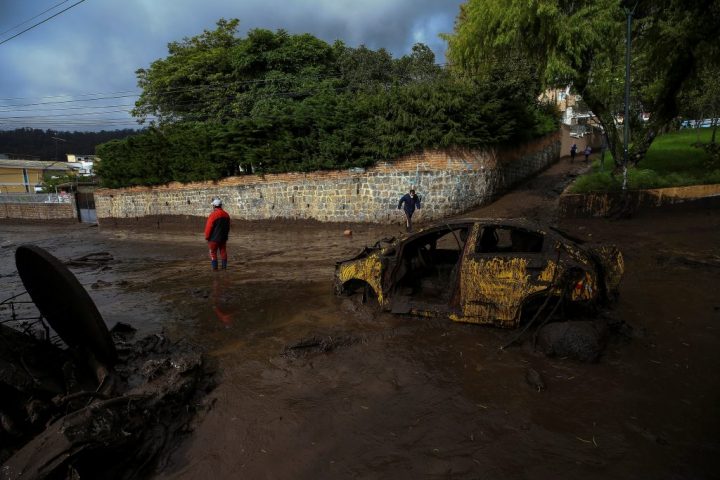
In Quito alone, the rain recorded on January 31, 2022 caused a flood that left 27 dead and 53 injured. The water that fell that day, according to the technicians, would be equivalent to what should have been registered in a whole month.
negative outlook
With just a 1.5 degree Celsius rise in temperature, a population will experience devastating effects, according to the Intergovernmental Panel on Climate Change , which released a report on August 9, 2021, using global and regional climate simulations.
Experts warn that this increased warming of the atmosphere will lead to more wildfires, higher degree flooding, and long winters with extremely low temperatures . These natural processes will generate water and food shortages.
The biggest problem is that no city in Ecuador has a long-term plan to prevent or act against this problem. This has been demonstrated in Pichincha, Guayas, Cotopaxi, Esmeraldas and Los Ríos, where the winter season has caused serious damage.
In addition to the landslide in Quito, human and material losses have been reported due to events such as the landslide that destroyed the Insiliví-Guangaje road in Cotopaxi, where 12,000 people from 11 communities were left isolated and incommunicado. This, in addition, represented losses in their production (especially in the sale of milk) as well as their houses and animals.
Although officials from the Ministry of Economic and Social Inclusion (MIES) arrived at the site and delivered food kits, experts say that continuing to act on the fly , with food or hygiene rations, is not a solution.
Prevention and response
Although the authorities are responsible for generating policies with a risk management approach, it cannot be denied that climate change is everyone's responsibility . The poor management of solid waste (as in Quito) , the non-classification of garbage from homes, the uncontrolled use of single-use plastics (which was enhanced in the pandemic), the poor management of wastewater and more .
Cristopher Velasco, president of the Association of Professionals in Risk Management of Ecuador, details that there are short-term actions that can remedy problems such as those of the streams and would serve to prevent a disaster like the last flood from repeating itself.
Velasco explains that work must be done on retaining walls, mud traps, and gutters to guarantee the drainage of rain .
Generate actions of constant cleaning of streams, expand the declarations of protected areas and avoid irregular settlements are other recommendations.
On the last point, the councilor of Quito, Mónica Sandoval, has criticized that, as a political benefit, permits are granted to fill in ravines and build houses and even buildings with more than five floors in sensitive areas.
For Velasco, it is the job of the sectional governments to protect the slopes and ravines that are natural drainages. He explains that if these areas are filled, as happens in Quito , their capacity to capture and release water is lost. Another question he raises is that in the capital, as in other cities, a rainfall plan is presented every year, when "a long-term project" should be structured and executed. (AVV)
Educational platform
Since 1900 there have been 644 floods in Quito , "7% were due to anthropic causes (human activity)", it is pointed out in a study carried out by professionals from the Latin American Faculty of Social Sciences (Flacso), the National Polytechnic School and the Union audiovisual Latin America.
The group, which today March 23 will present the platform 'Reduce risks in Quito', also warns that "the lack of protection and maintenance of the streams can cause more damage and flooding, as has been seen in the Monjas river basin , San Antonio de Pichincha. These and other data are available on the portal www.reduceriesgosenquito.com
The proposal will be presented at the Flacso Auditorium (La Pradera E7-174 Y Av. Diego de Almagro), in the north center of Quito, from 10:00 . The Mayor of Quito, Santiago Guarderas, and the Minister of Education, María Brown Pérez, have been invited to the event. Read More...