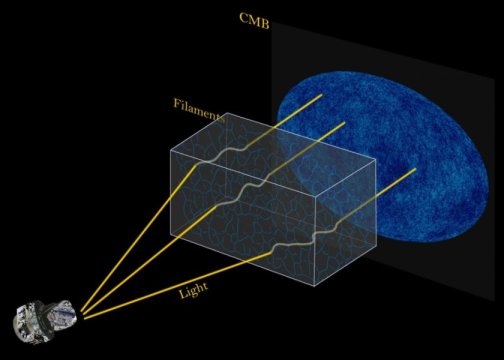
Tiny distortions in universe's oldest light reveal strands in cosmic web
-
 Loading...
 - Lisa Kendrick
- 12 Apr 2021
- 1271 Views
- 0 Like
- 0 Comment
Scientists have decoded faint distortions in the patterns of the universe's earliest light to map huge tubelike structures invisible to our eyes -- known as filaments -- that serve as superhighways for delivering matter to dense hubs such as galaxy clusters.
The international science team, which included researchers from the Department of Energy's Lawrence Berkeley National Laboratory (Berkeley Lab) and UC Berkeley, analyzed data from past sky surveys using sophisticated image-recognition technology to home in on the gravity-based effects that identify the shapes of these filaments. They also used models and theories about the filaments to help guide and interpret their analysis.
Published April 9 in the journal Nature Astronomy, the detailed exploration of filaments will help researchers to better understand the formation and evolution of the cosmic web -- the large-scale structure of matter in the universe -- including the mysterious, unseen stuff known as dark matter that makes up about 85 percent of the total mass of the universe.
Dark matter constitutes the filaments -- which researchers learned typically stretch across hundreds of millions of light years -- and the so-called halos that host clusters of galaxies are fed by the universal network of filaments. More studies of these filaments could provide new insights about dark energy, another mystery of the universe that drives its accelerating expansion.
Filament properties could also put gravity theories to the test, including Einstein's theory of general relativity, and lend important clues to help solve an apparent mismatch in the amount of visible matter predicted to exist in the universe -- the "missing baryon problem."
"Usually researchers don't study these filaments directly -- they look at galaxies in observations," said Shirley Ho, a senior scientist at Berkeley Lab and Cooper-Siegel associate professor of physics at Carnegie Mellon University who led the study. "We used the same methods to find the filaments that Yahoo and Google use for image recognition, like recognizing the names of street signs or finding cats in photographs."
The study used data from the Baryon Oscillation Spectroscopic Survey, or BOSS, an Earth-based sky survey that captured light from about 1.5 million galaxies to study the universe's expansion and the patterned distribution of matter in the universe set in motion by the propagation of sound waves, or "baryonic acoustic oscillations," rippling in the early universe.
The BOSS survey team, which featured Berkeley Lab scientists in key roles, produced a catalog of likely filament structures that connected clusters of matter that researchers drew from in the latest study.
Researchers also relied on precise, space-based measurements of the cosmic microwave background, or CMB, which is the nearly uniform remnant signal from the first light of the universe. While this light signature is very similar across the universe, there are regular fluctuations that have been mapped in previous surveys.
In the latest study, researchers focused on patterned fluctuations in the CMB. They used sophisticated computer algorithms to seek out the imprint of filaments from gravity-based distortions in the CMB, known as weak lensing effects, that are caused by the CMB light passing through matter.
Since galaxies live in the densest regions of the universe, the weak lensing signal from the deflection of CMB light is strongest from those parts. Dark matter resides in the halos around those galaxies, and was also known to spread from those denser areas in filaments.
"We knew that these filaments should also cause a deflection of CMB and would also produce a measurable weak gravitational lensing signal," said Siyu He, the study's lead author who is a Ph.D. researcher from Carnegie Mellon University -- she is now at Berkeley Lab and is also affiliated with UC Berkeley. The research team used statistical techniques to identify and compare the "ridges," or points of higher density that theories informed them would point to the presence of filaments.
"We were not just trying to 'connect the dots' -- we were trying to find these ridges in the density, the local maximum points in density," she said. They checked their findings with other filament and galaxy cluster data, and with "mocks," or simulated filaments based on observations and theories. The team used large cosmological simulations generated at Berkeley Lab's National Energy Research Scientific Computing Center (NERSC), for example, to check for errors in their measurements.
The filaments and their connections can change shape and connections over time scales of hundreds of millions of years. The competing forces of the pull of gravity and the expansion of the universe can shorten or lengthen the filaments.
"Filaments are this integral part of the cosmic web, though it's unclear what is the relationship between the underlying dark matter and the filaments," and that was a primary motivation for the study, said Simone Ferraro, one of the study's authors who is a Miller postdoctoral fellow at UC Berkeley's Center for Cosmological Physics.
New data from existing experiments, and next-generation sky surveys such as the Berkeley Lab-led Dark Energy Spectroscopic Instrument (DESI) now under construction at Kitt Peak National Observatory in Arizona should provide even more detailed data about these filaments, he added.
Researchers noted that this important step in sleuthing the shapes and locations of filaments should also be useful for focused studies that seek to identify what types of gases inhabit the filaments, the temperatures of these gases, and the mechanisms for how particles enter and move around in the filaments. The study also allowed them to determine the length of filaments.
Siyu He said that resolving the filament structure can also provide clues to the properties and contents of the voids in space around the filaments, and "help with other theories that are modifications of general relativity," she said.
Ho added, "We can also maybe use these filaments to constrain dark energy -- their length and width may tell us something about dark energy's parameters."


